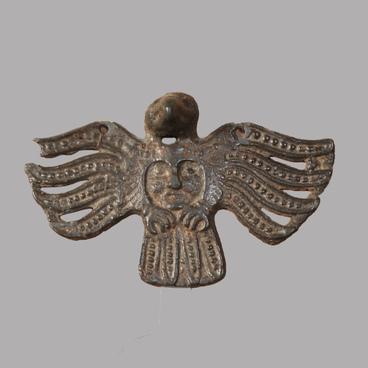
Lockets were a popular personal item in the 8th — early 11th centuries. They are found exclusively in the pre-Ural region, with only two finds registered beyond it. Lockets with noisemaking charms are found in both women’s and men’s burials.
Medieval fashionistas used them to keep incense — solid perfume made from a mixture of vegetable and animal fats, wax and local fragrant herbs. The boxes had an original and ornate design, because they served as additional accessories to the costume. Men used locket pendants as personal amulets and talismans against evil spirits, bad spells and wild beasts.
The metal pendants, with their halves sealed, were replaced by another type of lockets, the “samovarchiks”. They resembled miniature samovars and consisted of two parts, which were placed one on top of the other like in a float and were tied by a thin strap.
Metal locket pendants may have been borrowed from the peoples of Volga Bulgaria, where 36 such items have been found. In the Perm pre-Urals, however, this category of ancient objects is much more common, so archaeologists continue to study their origin.
Locket pendants of the Rodanovsky culture found in the Kama region are distinguished by a characteristic “goose-foot” — an additional rattle charm of pointed shape close to a triangle or rhombus, with notches in the place of the webbing. Along with the lockets the casting molds for making the diamond-shaped “goose feet” were also discovered — this is the signature style of the Perm craftsmen.
The locket pendant from the collection of the Komi-Permyak Local History Museum was found in a woman’s burial of the Kanevsky burial ground during excavations led by the Ural State University in 1953. The body of the locket has a cylindrical shape and consists of two identical parts, which are inserted into each other and decorated with a floral ornament: a dotted circle with petals and notched patterns. Five rattling charms in the form of massive chains with bells at the ends are attached to each half. The locket itself is suspended from a long metal chain.