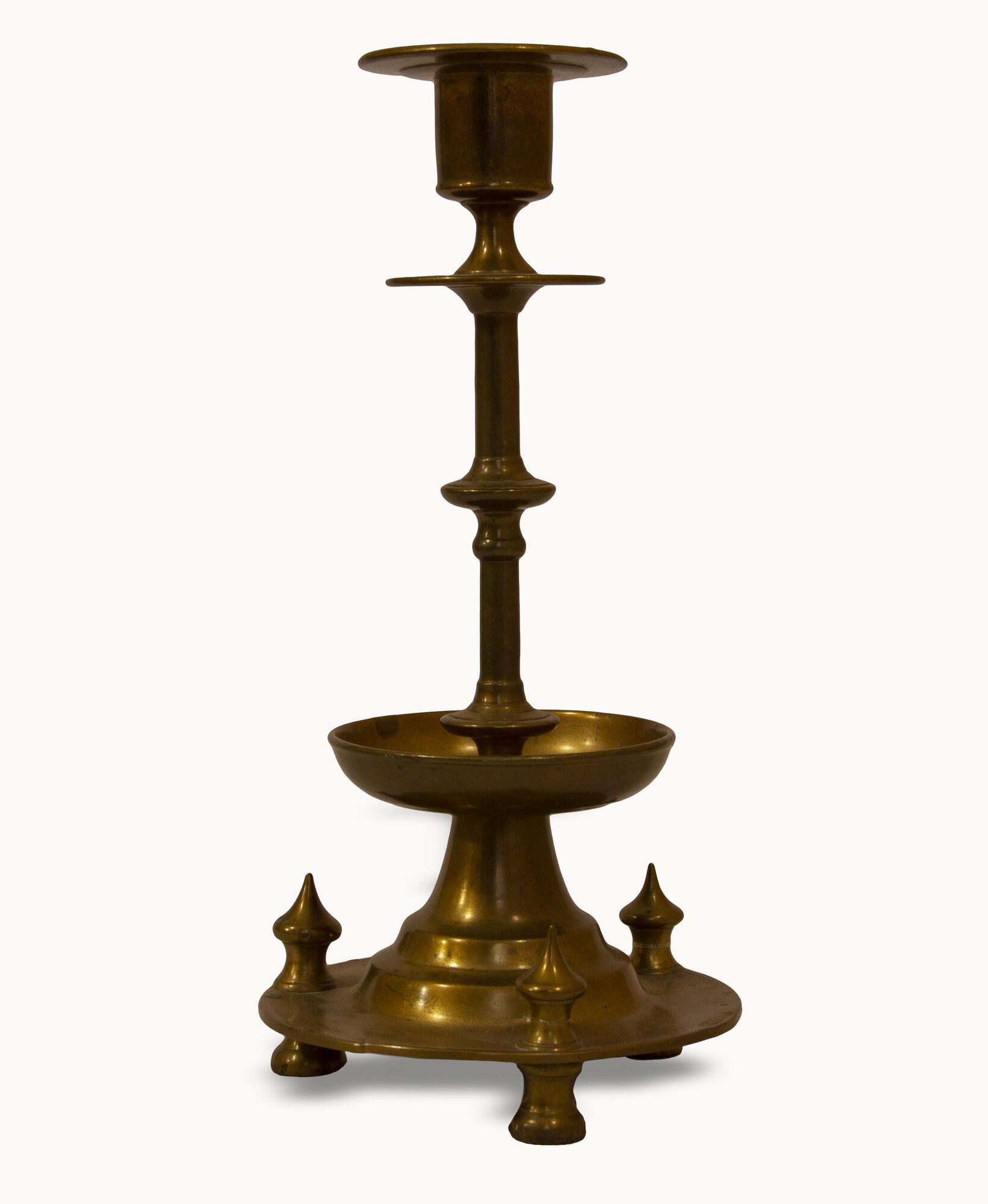


In pre-revolutionary Russia, candlesticks were widely used in households. Despite the growing popularity of kerosene lamps in the late 19th — early 20th century, candlesticks still remained a familiar and relatively cheap way of lighting.
This candlestick is made of brass. To save material and time, the candlestick’s elements were cast in special molds, and after cooling, they were also turned on a lathe to eliminate any shortcomings. The parts are connected with bolted joints. There are also parts made by punching and metal spinning. The candlestick features a label — “1st Yudin” — which indicates the factory where the candlestick was produced.
Unfortunately, little is known about the factory. It turned out to be difficult to establish which Yudin owned the enterprise. In the index of the All-Russian Handicraft and Industrial Exhibition of 1902, Konstantin Yudin is mentioned in the section of the Moscow Governorate. Since 1889, he produced candlesticks and matchboxes in the village of Krupino, Bogorodsky district. However, considering the population of the village (about 200 people), it is hard to believe that so many candlesticks could be produced there. Other Yudins are mentioned in the town of Krapivna, Tula Governorate, near the estate of Leo Tolstoy called “Yasnaya Polyana”. Those Yudins ran an iron foundry with a mechanical engine. The authorized capital of the Yudin company was 60,000 rubles. Although it was an impressive amount of money for a provincial town, it was still insufficient for such a large production. The most famous Yudins were the merchants from Moscow. In 1829, the citizen Sergey Mikhailovich Yudin, a merchant of the 3rd guild in the Sadovaya Bolshaya Sloboda, founded a copper workshop. He had five sons — in 1866, they founded a company, which they called “A. S. M. and A. Yudin brothers” (“A. S. and M. Yudin brothers” after 1910). The enterprise included a trading house and a factory that produced officers’ uniforms and gilded wire for decorative embroidery. Alexey Sergeyevich Yudin, a merchant of the 1st guild, headed the family business. According to some antiquarians, the brand “1st Yudin” means “the merchant of the 1st guild Yudin.” However, this is only a guess.
This candlestick is made of brass. To save material and time, the candlestick’s elements were cast in special molds, and after cooling, they were also turned on a lathe to eliminate any shortcomings. The parts are connected with bolted joints. There are also parts made by punching and metal spinning. The candlestick features a label — “1st Yudin” — which indicates the factory where the candlestick was produced.
Unfortunately, little is known about the factory. It turned out to be difficult to establish which Yudin owned the enterprise. In the index of the All-Russian Handicraft and Industrial Exhibition of 1902, Konstantin Yudin is mentioned in the section of the Moscow Governorate. Since 1889, he produced candlesticks and matchboxes in the village of Krupino, Bogorodsky district. However, considering the population of the village (about 200 people), it is hard to believe that so many candlesticks could be produced there. Other Yudins are mentioned in the town of Krapivna, Tula Governorate, near the estate of Leo Tolstoy called “Yasnaya Polyana”. Those Yudins ran an iron foundry with a mechanical engine. The authorized capital of the Yudin company was 60,000 rubles. Although it was an impressive amount of money for a provincial town, it was still insufficient for such a large production. The most famous Yudins were the merchants from Moscow. In 1829, the citizen Sergey Mikhailovich Yudin, a merchant of the 3rd guild in the Sadovaya Bolshaya Sloboda, founded a copper workshop. He had five sons — in 1866, they founded a company, which they called “A. S. M. and A. Yudin brothers” (“A. S. and M. Yudin brothers” after 1910). The enterprise included a trading house and a factory that produced officers’ uniforms and gilded wire for decorative embroidery. Alexey Sergeyevich Yudin, a merchant of the 1st guild, headed the family business. According to some antiquarians, the brand “1st Yudin” means “the merchant of the 1st guild Yudin.” However, this is only a guess.


