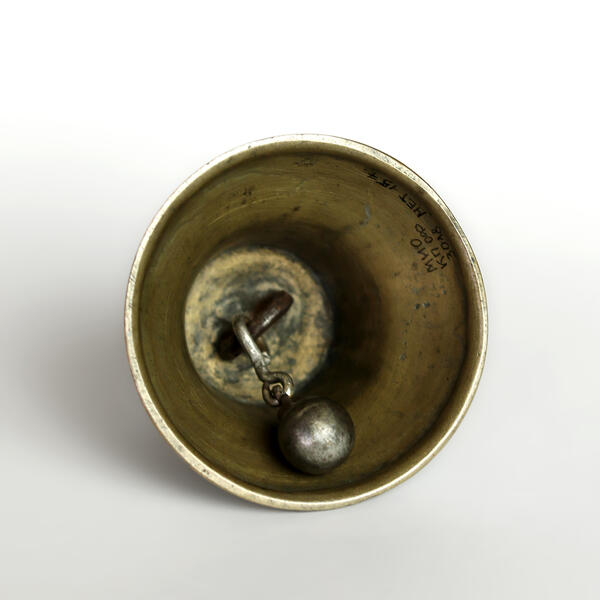
Legend has it that the production of bells in Valday was associated with the veche bell from Novgorod, which was broken in that area in the late 15th century. It is believed that Valday coachmen’s bells originated from its fragments.
In 1478, Tsar Ivan III ordered the veche bell to be removed from the bell tower of the St. Sophia Cathedral in Novgorod and transported to Moscow. The sled carrying the bell slipped on one of the slopes of the Valday Hills, causing it to fall off the wagon and roll into a ravine, where it shattered into pieces. Locals collected the fragments and started casting them into smaller replicas of the veche bell.
Valday blacksmiths were successful in creating shaft bow bells with intricate patterns and picturesque elements. They added inscriptions to the bells, including the name of the maker, the place of manufacture, and the year. This allowed the craftsman to distinguish their product from others, while demonstrating the high quality of their work.
The bell makers from the village of Purekh in the Nizhny Novgorod Governorate were as skilled as the Valday craftsmen. The village has long been known for its various crafts (woodworking, frame building, bricklaying) and trade. In the second half of the 19th century, Purekh became a center of copper foundry production.
Thanks to the proximity of the Volga River with the Vasilyovo pier and the famous Nizhny Novgorod Fair, it was convenient to deliver raw materials and sell the products. In addition, due to the development of cargo and passenger transportation in the Nizhny Novgorod Governorate, copper products were always in demand.
For decades, bells rang on Russian roads, suspended under the shaft bows of famous troikas. However, both coachmen and shaft bow bell production became things of the past. Still, hundreds of products by the craftsmen of the past can be found in different parts of Russia. They continue to delight people with their perfect shape and melody.
The Purekh Copper Foundry District included a number of villages in two volosts of the Balakhninsky District — the Purekh volost (including the villages of Purekh, Ostapovo and Pyryevo) and the Andreyevskaya volost (including the villages of Levino, Pleshchikha, Andreyevo, Krapivino, Ostashino, and Filino). The production started with the manufacture of various parts for horse harness, such as rings, buckles, plaques, and decorative elements, like buttons, thimbles, and crosses. Later, Purekh residents started producing shaft bow and neck bells of different types.