The first days in Melikhov, Chekhov with Lika
Creation period
Март 1892 г. / 1898 г.
Place of сreation
с. Мелихово
Technique
Фотография
Collection
0
Open in app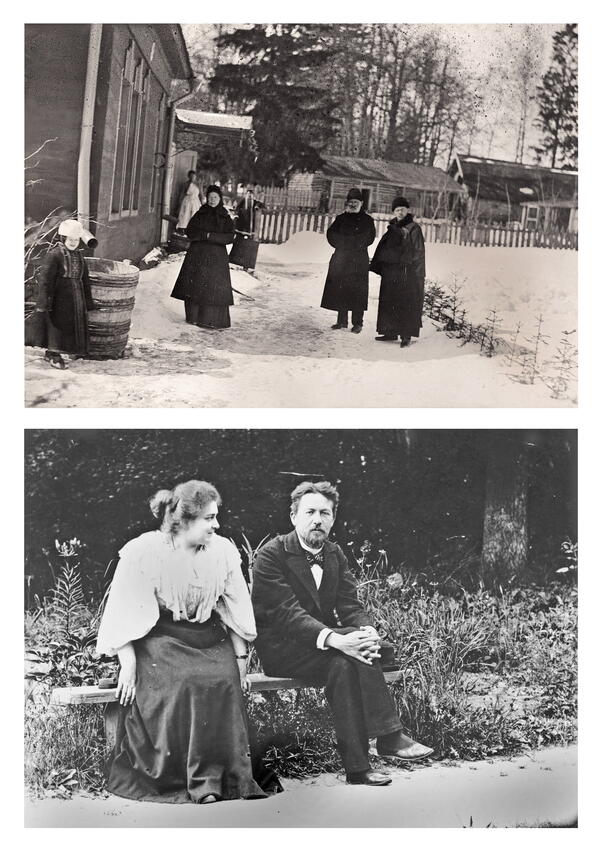
#18
#19
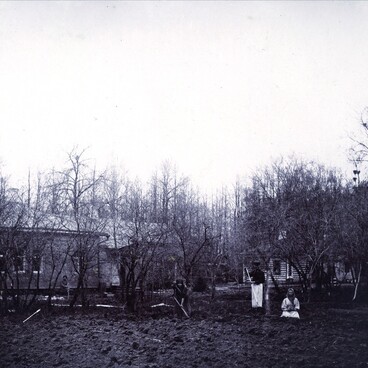
This photo was taken by Anton Pavlovich’s elder brother Alexander Chekhov. It shows the writer’s mother Evgeniya Yakovlevna, his father Pavel Yegorovich, and younger brother Mikhail Pavlovich. In March 1892 the Chekhovs just moved to Melikhovo. It was their first house of their own: before that, in Taganrog and Moscow, the Chekhovs had rented accommodation, frequently moving house. The constant relocations and rented apartments only caused frustration, and Anton Pavlovich spoke more and more about having to leave Moscow, to buy their own land and their own house.
Two years before buying the estate in Melikhovo, Anton Chekhov had undertaken an arduous trip across Russia to the Far East, resulting in his book “Sakhalin Island”. The harsh journey was the ultimate reason for the writer’s determination to leave Moscow. Anton Chekhov wrote, “After Sakhalin labors and the tropics, my Moscow life now seems so petty and so dull to me that I feel ready to bite.” The capital drove him away with its prices and bustle, and the writer’s health, undermined by his hard trip across the country to “a prison island”, left Chekhov with no choice, “It has been decided: out of Moscow!”
Having moved to Melikhovo, the Chekhovs immediately began to settle in their new place. There was a lot of work, everyone tried to do their part: the elderly parents kept bustling about, happy to have their own house and garden; the younger Chekhovs got involved in the household chores. “All the jobs like painting, fixing various small things, etc. are done by my family with Misha in charge. We have planted and sowed everything in the glasshouses ourselves, without outside help; we will plant trees and vegetable gardens ourselves too.”
Subsequently, Melikhovo had a magnificent vegetable garden with exotic vegetables and a real cherry orchard.
Alexander Chekhov noted in his memoirs that, having settled in Melikhovo, Anton Pavlovich “recovered and got immersed into nature and rural life. He had at his disposal a forest, fields, and a vegetable garden, as well as a neglected orchard, horses, farming implements and cows. There was plenty to work on after the stuffy city. He began to plow, sow, plant, and cultivate. In the beginning, his brother, Mikhail Pavlovich, and especially his sister Maria Pavlovna, would help him zealously with household chores.”
#20
Наименование: First Days in Melikhovo
Размеры: 11,7×17 см
Коллекция: The Manor House of Anton Chekhov in Melikhovo
Правообладатель изображений: The Manor House of Anton Chekhov in Melikhovo
#21
Anton Chekhov with Lika on the bench
#22
The photograph depicts Anton Pavlovich Chekhov and Lidiya Stakhievna Mizinova, or Lika, as she was known among friends.
One of the most enduring myths that emerged during Chekhov’s lifetime was the one about the writer’s irrevocable love for Lika. How, why could the myth emerge when the characters were still alive, and why was it not dispelled for so long?
A major role was played by the comedy “The Seagull”, where a lot of details were identical to those in Lika’s fate: the desire to go on stage, the romance with the writer, and the birth of a child. For Lydia Stakhievna “The Seagull” was inseparable from her own destiny. In 1934, a book by Yuri Sobolev “Chekhov” from the series “Lives of Great People” came out. It contained a number of quotes from Mizinova’s letters addressed to Chekhov. They gave a lot of insight into their relationship, but it was only them who knew the whole truth.
As his contemporaries recalled, Anton Pavlovich was shy, very reserved and “discreet in everything that concerned his intimate feelings”; “he did not share the deepest and most serious feelings in his soul with those close to him. As a man of great substance and modesty, he loved the loneliness of feeling and the loneliness of thought.”
Chekhov enjoyed great success with women, but did not like to talk about it. Many contemporaries, including Lika, took it for callousness and inability to experience strong feelings. Chekhov kept himself at ease and withdrawn at the same time, a rare and purely Chekhovian quality; his jokes would divert him from serious explanations. He invented admirers for Lika: Trofimov, Pryshchikov, Pet’ka — and mocked them in his letters. Displays of his true feelings were drowned in his games and jokes. In this manner, it was not Chekhov’s insensitivity, but rather his masculine magnanimity, his unwillingness to highlight his victory in order to preserve the joy and ease of communication with Lika.
In 1898, Lydia Mizinova sent Chekhov a photo of herself to Yalta from Paris. She signed it as follows, “Whether my days be bright or dismal, // If I go quickly — a wasted life! // I know one thing, that until the grave itself // thoughts, feelings, and songs, and powers — always will be for you, always will be for you!!! (Tchaikovsky — Apukhtin) Let this inscription compromise you, I will be glad. I could have written it eight years ago, and I am writing it now, and I will write it in ten years’ time.”
This inscription and Lika’s letters refute the myth of Chekhov’s unrequited love for the “lovely Lika”.
#23
Наименование: Anton Chekhov with Lika on the bench
Размеры: 22,7×34 см
Коллекция: The Manor House of Anton Chekhov in Melikhovo
Правообладатель изображений: The Manor House of Anton Chekhov in Melikhovo
#24
Ministry of Culture of the Russian Federation
read morehide
The first days in Melikhov, Chekhov with Lika
Creation period
Март 1892 г. / 1898 г.
Place of сreation
с. Мелихово
Technique
Фотография
Collection
0
 Point your smartphone camera to open in the app
Open in app
Share