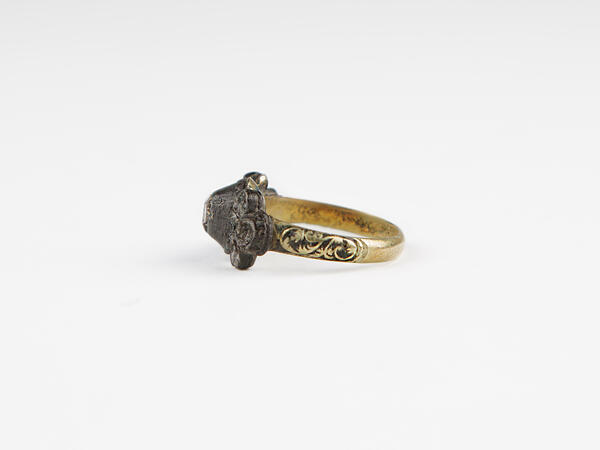
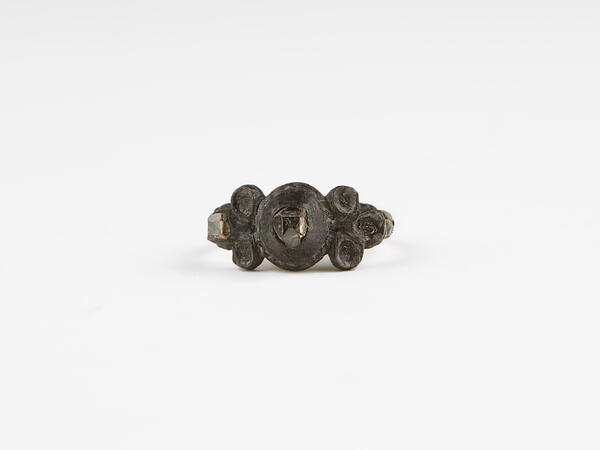
The jewelry collection of Historical and Memorial Museum of the Demidovs presents an elegant gold ring with a niello engraving, with a head made of blackened alloy featuring diamond inserts. It was found in the Demidov family tomb.
Precious stones are mineral crystals. They are highly expensive. According to the classification of the English mineralogist G. F. Herbert Smith, only minerals that most meet the following three criteria can be considered precious: “beauty, durability and rarity”. There are relatively few materials that meet these three requirements, and in the olden days in Russia, they were called “noble” materials. When it comes to durability and cost, the diamond is the undisputed leader (a cut diamond is a brilliant), followed by the ruby, sapphire, and emerald. Slightly more common minerals are called semiprecious.
In old and Medieval Russian jewelry art, precious stones were seen as merely colorful spots. They were valued mainly for their color. In 18th-century Russia the concept of fashion takes shape. Before that, the outfit of a Russian person remained almost the same for centuries, but changes began occurring with increased frequency. Fashionable things were brought from abroad. New clothes walked hand-in-hand with accessories. Empress Anna Ioannovna paid fortunes to foreign and Russian merchants in exchange for dress fabrics, mirrors, curtains, dishes made of silver and gold. She also bought jewelry with amber and diamond jewelry. Interest in gemstones reached unprecedented proportions. There were jewelers who specialized in cutting diamonds and gemstones, and it became important for them to learn how to combine stones with metal.
Throughout the 18th century, people were fascinated by precious stones. This fascination was passed onto the following century. Metal reigned supreme as the primary material for making jewelry in the 18th century but was pushed back by gemstones. Now precious stones set the rules of the game, and even gold was forced to comply, as it was reduced to being only the base or frame for the precious stone. In the last quarter of the 17th — beginning of the 18th century, diamonds were used in large quantities. By the middle of the 18th century, they were replaced by brilliants, which pushed the rest of the competition into the background.