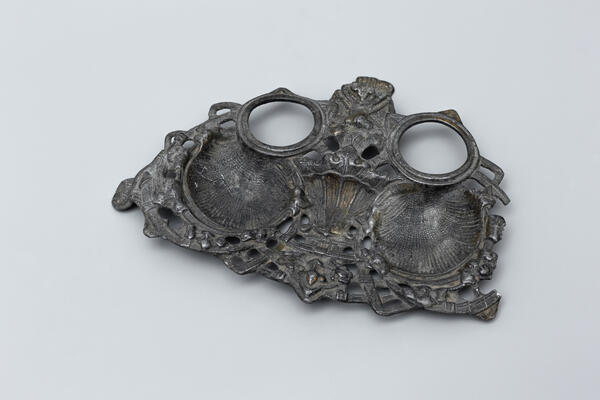
The Nizhny Lomov Museum of Local Lore houses a 19th-century metal ashtray. Its bowls resemble shells. Such receptacles for tobacco ash were created for both cigars and cigarettes. Cigar ashtrays appeared earlier.
Cigars started to be supplied to Europe in the 18th century. This was also when the first cigar ashtrays appeared. Initially, various tableware items, such as plates and saucers, were used as receptacles for ash, but later, entrepreneurs realized that a specialized container could be used to showcase the owner’s personality and status. They understood that an ashtray could be a statement that reflected the owner’s taste.
Ashtrays became available for sale and gained popularity almost immediately. One of the reasons was that they could be made of all kinds of fireproof materials. Ashtrays were made of silver and gold, copper and crystal, glass, and even seashells, as well as cast iron, and sometimes ceramics.
Craftsmen decorated these ash receptacles with precious and semiprecious stones, chasing, and colored enamel. Ashtrays were also designed in the shape of various animals and plants. Smoking cigars was a practice reserved for nobility. The first ashtrays were made by hand and cost a lot.
Cigarette ashtrays did not appear until the end of the 19th century. In the Russian Empire, in the early 20th century, many ashtrays had fanciful shapes. For example, they were often made in the shape of a policeman’s hat. Later, during Soviet times, star-shaped ashtrays appeared. The most practical shape was a cut-off cylinder with recesses for cigarettes along the edges.
The ashtray served both as a practical smoking accessory and as an original interior décor for non-smokers. It was common to see ashtrays in households where no one actually smoked.