The podea “Sergius of Radonezh” was made by the Solvychegodsk gold embroidery workshop of Anna Ivanovna Stroganova. Starting from the early 1650s, her workshop produced dozens of pictorial embroidery works, including podeai, veils, shrouds, and robes.
Along with other examples of pictorial embroidery, the podea “Sergius of Radonezh” was made for the Stroganovs’ house church — the Solvychegodsk Annunciation Cathedral. It was hung at the foot of the icon of the same name which was exhibited at the altar stand on the corresponding feast.
St. Sergius of Radonezh is considered one of Russia’s greatest ascetics. He founded the Trinity Monastery near Moscow (nowadays known as the Trinity Lavra of St. Sergius) and some other monasteries and educated many disciples who also organized monasteries throughout Russia.
St. Sergius lived during a difficult period when Russia was oppressed by the Mongol Yoke and strove to achieve independence and build a strong and united state. Sergius of Radonezh preferred to live in solitude and never took up arms but became a spiritual support in the resistance to the Yoke, inspiring princes and warriors to fight for the independence of Russia.
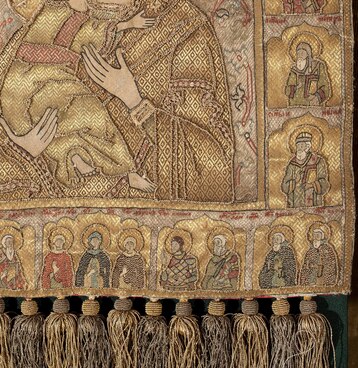
The podea “Sergius of Radonezh” has a standard composition. At the top, there is a rectangular frame with the image of Our Lady of the Sign. Underneath, there is a front face full-length image of the saint himself wearing monastic attire. His right hand is raised in a blessing gesture, and in his left hand, he holds a rolled-up scroll.
The earth is embroidered with filigree — silk thread twisted with gold thread. A large floral pattern is embroidered on the silver background using gold threads. The face and other exposed parts of the body are embroidered with tightly twisted silk threads of pearl gray, and the hair — with threads of a darker shade of gray. The modeling of the faces is schematic, done with silk threads of a grayish-brown tone. The facial features are sketched using silk threads of a grayish-brown tone.
The clothes and other details of the composition are embroidered with spun gold and silver threads using the couching technique. Colorful silk couching threads form traditional geometric patterns.
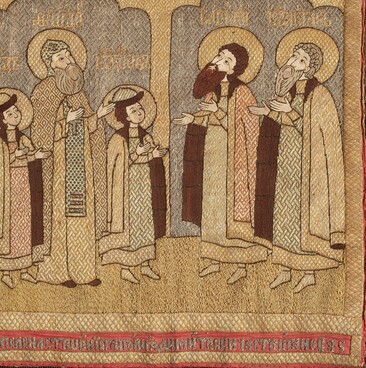
The border is made of red satin. The silver calligraphic inscription along the border is a troparion to St. Sergius of Radonezh, “You have been zealous for virtue…”
At the bottom of the podea,
there is an embroidered inscription made using silver threads,