The need for paper folders emerged with the advent of bureaucracy as a system of government. Over time, the Russian Empire started producing paper in standard sizes. A series of formats was used from the 14th to the 19th century. One of these was known as a “quire” with a sheet size of approximately 44×35 cm. Smaller formats were called “half a quire, ” “one fourth, ” “gluing ½, ” and “gluing 1/3.”
Friedrich Soennecken, a German merchant, entrepreneur, inventor, and graphic artist (1848–1919), invented a lot of items in the field of stationery. In 1886, he applied for a patent for a hole punch and began manufacturing hardback ring binders.
In the center of the folder, there was a lock with steel rods. Sheets of papers were hung on them in the required order, then the rods were bent to the sides and secured. The Germans stored important documents in an organized manner in binders. By that time, corrugated cardboard had already been invented and mass-produced in Europe. In 1895, Carl Gladitz, an employee of the Soden City Administration, came up with a new binder in which documents were secured with metal rings.
In 1922, Germany introduced a new paper standard — DIN 476. This standard was later adopted around the world. The USSR officially introduced it in 1934. However, even before that, in the 1920s, information about formats such as A5 and the size of sheets — 210×148 mm — was already included on some forms.
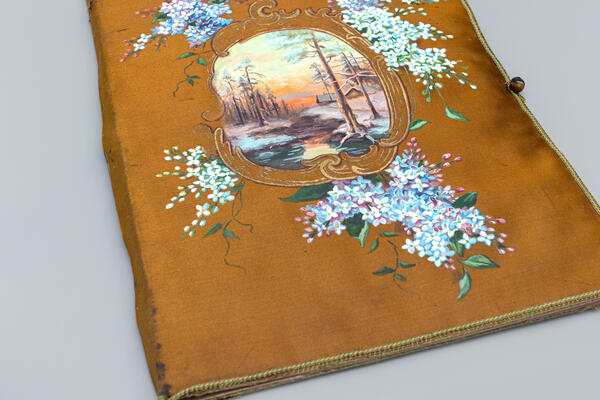
The exhibition of the Nizhny Lomov Museum of Local Lore features a paper folder decorated with silkscreen printing. It was produced in the USSR in 1925. This folder is decorated with lilac flower clusters and a winter sunset. The landscape is enclosed in a frame reminiscent of rocaille, an ornament based on stylized shells and popular in the 18th century. Such a folder could be used by teachers and students for storing music sheet and sketches. It contained sheets of any size up to A2.