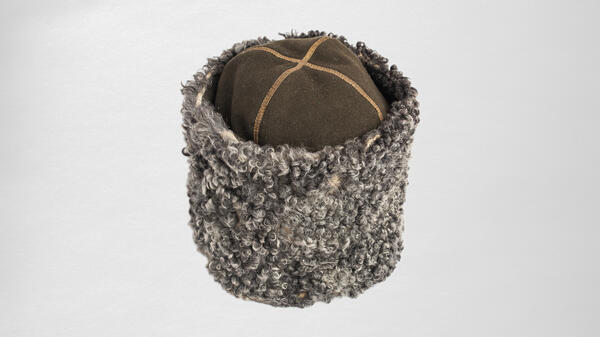
Papakha is a men’s fur headdress that was used as part of the military uniform, among other things. Most often it was sewn from sheep skin or karakul sheep skin. In the Russian army, the prototype of a papakha was a fur hat, which since 1817 was worn by soldiers in the Caucasus and Central Asia. In 1855, it was officially designated as a winter headwear in the Cossack troops.
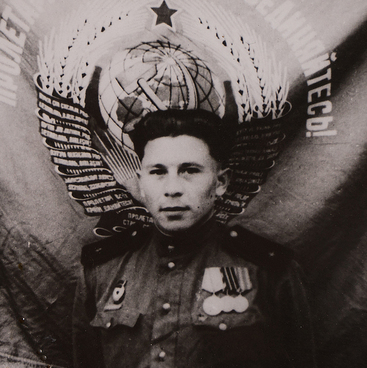
The papakha from the collection of the City Museum Of Local History belonged to Joseph Leshchev, one of the first members of the Komsomol of Sudzhensk mines, a participant of the Great Patriotic War and a resident of Anzhero-Sudzhensk.
In the early twentieth century Joseph Leshchev’s parents — Nikolay and Olga — moved from the town of Mariinsk to the Sudzhensk mines of Michelson, in the future town of Anzhero-Sudzhensk. The head of the family worked as a machinist on a hoisting machine at Mine No. 5–7 and later at Mine No. 1.
Joseph Leshchev studied at the Red Army Academy of Military Engineering named after В. V. Kuibyshev in Moscow. From the first days of the war, he went to the front — he built defensive structures in the 9th Army of the Southern Front.
In September 1941, Leshchev was appointed chief aide and then the chief of the operational department of the staff of the 8th Sapper Army. He participated in the defense of Rostov, and in May 1942, received another promotion — became head of the engineering troops of the North Caucasus direction. At the height of the war, he asked to join any active military unit. Then Joseph Leshchev was sent to command the 9th Engineer Brigade, which was engaged in all combat operations of the Black Sea group of troops from Tuapse to Novorossiysk.
After the Battle of Stalingrad, the Black Sea Group recaptured Krasnodar from the Germans and joined the newly created North Caucasus Front. Soldiers of Leshchev’s Sapper Brigade took part in clearing mines in Kuban. After that, they were sent to Moscow and re-formed into the 15th Assault Engineer Sapper Brigade, commanded by the same Joseph Leshchev.
In 1943, Leshchev fought on the North West front, near the town of Staraya Russa. Then, as a member of the 10th Guards Army, he liberated Latvia. While rebuilding a bridge near the village of Mazili, Leshchev’s brigade fought the retreating SS group, which outnumbered them. The battalion eventually captured 170 German soldiers.
For his military merits he received the Order of Lenin, two Orders of the Red Banner, the Order of the Red Star and the Order of the Great Patriotic War, 2nd class, as well as state medals. After the war he continued to serve in the army: as a civil engineer he commanded the 32nd construction brigade. In 1954, Leshchev retired to the reserve with the rank of colonel.
The papakha from the collection of the City Museum Of Local History belonged to Joseph Leshchev, one of the first members of the Komsomol of Sudzhensk mines, a participant of the Great Patriotic War and a resident of Anzhero-Sudzhensk.
In the early twentieth century Joseph Leshchev’s parents — Nikolay and Olga — moved from the town of Mariinsk to the Sudzhensk mines of Michelson, in the future town of Anzhero-Sudzhensk. The head of the family worked as a machinist on a hoisting machine at Mine No. 5–7 and later at Mine No. 1.
Joseph Leshchev studied at the Red Army Academy of Military Engineering named after В. V. Kuibyshev in Moscow. From the first days of the war, he went to the front — he built defensive structures in the 9th Army of the Southern Front.
In September 1941, Leshchev was appointed chief aide and then the chief of the operational department of the staff of the 8th Sapper Army. He participated in the defense of Rostov, and in May 1942, received another promotion — became head of the engineering troops of the North Caucasus direction. At the height of the war, he asked to join any active military unit. Then Joseph Leshchev was sent to command the 9th Engineer Brigade, which was engaged in all combat operations of the Black Sea group of troops from Tuapse to Novorossiysk.
After the Battle of Stalingrad, the Black Sea Group recaptured Krasnodar from the Germans and joined the newly created North Caucasus Front. Soldiers of Leshchev’s Sapper Brigade took part in clearing mines in Kuban. After that, they were sent to Moscow and re-formed into the 15th Assault Engineer Sapper Brigade, commanded by the same Joseph Leshchev.
In 1943, Leshchev fought on the North West front, near the town of Staraya Russa. Then, as a member of the 10th Guards Army, he liberated Latvia. While rebuilding a bridge near the village of Mazili, Leshchev’s brigade fought the retreating SS group, which outnumbered them. The battalion eventually captured 170 German soldiers.
For his military merits he received the Order of Lenin, two Orders of the Red Banner, the Order of the Red Star and the Order of the Great Patriotic War, 2nd class, as well as state medals. After the war he continued to serve in the army: as a civil engineer he commanded the 32nd construction brigade. In 1954, Leshchev retired to the reserve with the rank of colonel.