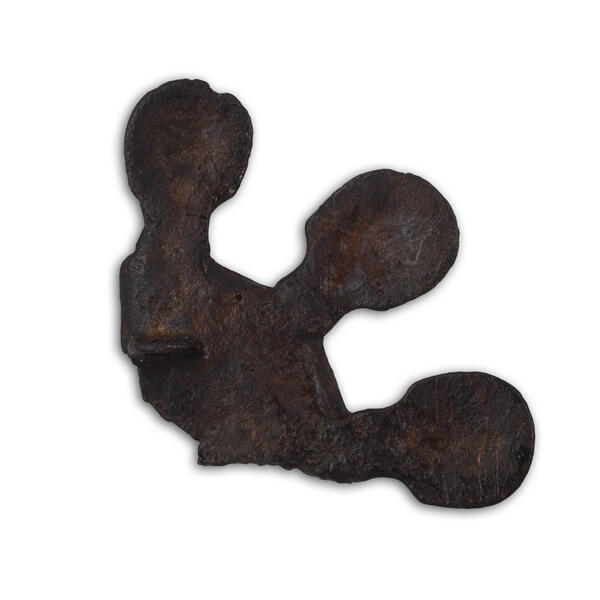
The collection of the Kursk Museum of Archaeology features a fragment of the headplate of a radiate-headed fibula, decorated with a circular (“eye”) pattern consisting of one or three circles with a dot in the center. The fragment was found during archaeological excavations at the Pereverzevo II settlement in the Zolotukhinsky District by Soviet and Russian archaeologist Anna Ivanovna Puzikova.
Radiate-headed fibulae of the so-called post-East German type of the Dnieper subgroup are one of the main categories of finds, often appearing, among other things, as part of the “Antiquities of the Antes” hoards. These hoards include the Gaponovo, Trubchevsky, Martynovsky, Novosudzhansky, Kurilovsky, and others. These items were characteristic of the Early Slavic population of the Middle Dnieper and Desna regions, belonging to the Kolochin and Penkovka archaeological cultures.
Fibulae have various prototypes and analogs among the 6th–7th century antiquities in Central Europe and some regions of Eastern Europe. They are often found at sites in the Dnieper region as well as in southwestern Crimea and the Bosporus. The fragment on display was once part of an entire piece cast from copper alloy. The clasp consisted of two metal plates with a bow between them, a needle holder, a needle and a catch for fastening to clothing. The headplate (lower plate) had a semicircular shape and was bordered by five rounded projections — knobs — on short neck-like bridges. Its shape resembled a human hand with outspread fingers, hence the Russian name of this type of adornment — “finger-shaped.”
Paired radiate-headed or anthropozoomorphic fibulae
of the Dnieper subgroup are an important detail of the Early Slavic women’s
accessories — a set of cohesive adornments that carries not only decorative but
also significant semantic meaning. Fibulae were worn in pairs, symmetrically on
the side of the chest with the headplates facing down. They likely fastened
fabric ribbon-like straps or straps of a sarafan or peplos. A peplos is a type
of women’s outer garment without sleeves, with folds that fall over the chest
and back.