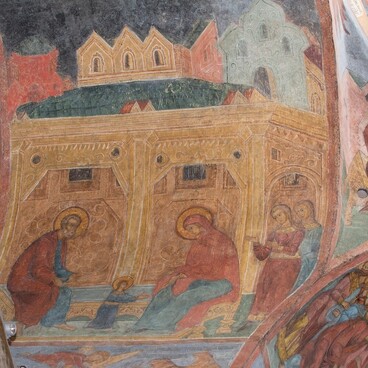
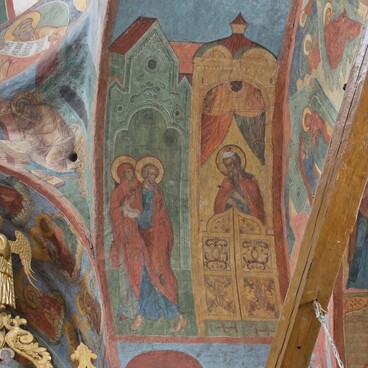
The composition got its name from the first verse of the Psalm 45 (44 in Ortodox tradition), which is sung on all the goddess festivals after the polyelle on the morning: ‘My heart is stirred by a noble theme as I recite my verses for the king; my tongue is the pen of a skillful writer…’ The fresco is a detailed illustration of this psalm. In the center of the composition, on the background of the Eden, we can see a young man on the throne in royal robes — an allegorical image of Jesus Christ. He is surrounded by archangels, the Virgin Mary, the Queen of Heaven, and John the Baptist, the Angel of the Desert. Above the throne is the rounded Glory with the image of God the Father, from whose lips comes the directed stream of light — a symbolic image of David’s prophecy about the eternal birth of God the Word, which is contained in the first verse of the psalm. On the sides, against the background of the buildings, the image of the kings of the prophets David and Solomon, Christ’s ancestors in the flesh, is presented. Underneath them are the righteous Joachim and Anna with candles, and the virgins covered with a blue board. At the foot of the throne are the fallen enemies of the Son of God. Such images of the hymnography content have become especially popular in Russian iconography since the middle of the 16th century. Researchers believe that Nikifor Shipulin, the customer of the wall (mural painting), is depicted with his son Isaac in the image of a kneeling old man and a young man without halo at the feet of the Savior.
The full name: ‘My heart is stirred by a noble theme’
Time of creation: 1641, partly under the layer of the 1838
Technique: Fresco, tempera.
Location: The southern slope of the southwest vault