Only 40 million years ago, the territory of Western Siberia was covered by the waters of a shallow salty sea, and it was part of the Arctic Ocean. However about 35 million years ago, that part of the land, which is now called the Indian subcontinent, ‘crashed’ into the Asian continent. At the site of the collision, the Himalayas were formed - the highest and one of the youngest mountains on the modern surface of our planet. At the same time, Western Siberia rose, and sea waters left this space. In place of the retreating sea in the central part of the plain, a vast lake, or Turtas Sea, and a whole network of freshwater rivers formed.
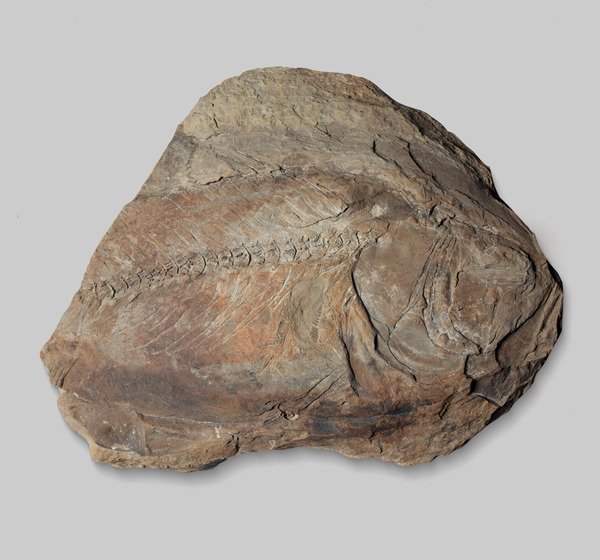
In 2011, during a paleontological expedition, the staff of the ‘Museum of Nature and Man’ discovered a large ferruginous nodule in the clay deposits of this sea-lake - a mineral body that differs from neighboring rocks in physical properties, structure and composition. On the surface of this nodule, scientists found the imprint of a huge fish. As was later established, it belonged to an ancient perch, almost a meter long.
Interestingly, the bones of the perch have not survived at all: they have completely dissolved, and only their imprints are visible on the surface of the geological sample. But they convey very well the structural features of the bones of the fish skull and the general contours of the body with fins. In some parts of the body, casts of the scale cover of ancient fish are even distinguishable.
Such preservation is a rarity for fossil fish, and the find from the bottom sediments of the Turtas Sea-Lake makes it possible to fairly represent the structure of the found specimen. Probably, this perch belongs to a new species not yet described in science, and may be the ancestor of our modern common perch.
Many scientists believe that the roots of the origin of freshwater fish, like all freshwater fauna, should be sought in the sea. At least among freshwater fish, there are those from typical marine families that migrated to fresh waters in ancient times. These include freshwater perch: perch, ruff, pike perch, as well as the only representative of cod - burbot.
In 2011, during a paleontological expedition, the staff of the ‘Museum of Nature and Man’ discovered a large ferruginous nodule in the clay deposits of this sea-lake - a mineral body that differs from neighboring rocks in physical properties, structure and composition. On the surface of this nodule, scientists found the imprint of a huge fish. As was later established, it belonged to an ancient perch, almost a meter long.
Interestingly, the bones of the perch have not survived at all: they have completely dissolved, and only their imprints are visible on the surface of the geological sample. But they convey very well the structural features of the bones of the fish skull and the general contours of the body with fins. In some parts of the body, casts of the scale cover of ancient fish are even distinguishable.
Such preservation is a rarity for fossil fish, and the find from the bottom sediments of the Turtas Sea-Lake makes it possible to fairly represent the structure of the found specimen. Probably, this perch belongs to a new species not yet described in science, and may be the ancestor of our modern common perch.
Many scientists believe that the roots of the origin of freshwater fish, like all freshwater fauna, should be sought in the sea. At least among freshwater fish, there are those from typical marine families that migrated to fresh waters in ancient times. These include freshwater perch: perch, ruff, pike perch, as well as the only representative of cod - burbot.