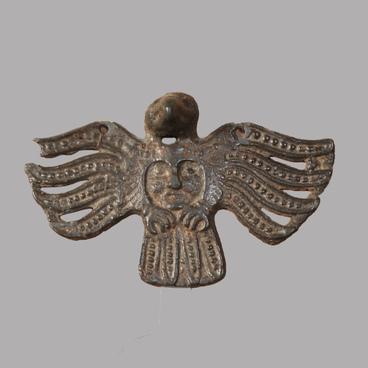
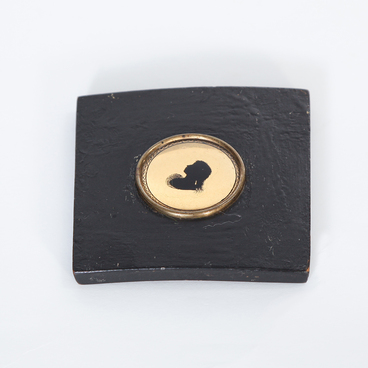
This small fragment of mammoth bone features a lifelike horse’s head carved with a knife. It is turned to the left, and the outlines of the mane, eyes, nostrils, and ears are clearly visible. This artefact was discovered in 1930 by a co-founder of the Komi-Permyak Museum, Aleksandr Aleksandrovich Krutetsky. The bone fragment has not been studied for its age and is dated as of the Kudymkar ancient settlement, where it was found.
The Kudymkar ancient settlement is a monument of the Rodanovsky culture of the Upper Kama region of the 9th–15th centuries. The settlement appeared on the left bank of the river Kuva in the 7th century, in a place called Izyur, which means “Stone Head” in translation from Komi-Permyak. Remains of log houses, cellars, holes from palisade stakes, as well as numerous tools were found there. The head of the Kama Archaeological Expedition Vladimir Antonovich Oborin suggested that there had been a fortified settlement, that had given rise to the Komi-Permyak ethnic group. The burials dated to the 17th century contained Russian baptismal crosses, but at the same time some artefacts associated with Komi-Permiak burial rites were found there as well, which suggests that the cultures were mixed.
Crafts such as spinning and weaving, pottery, metallurgy, jewelry, and bone carving were well developed in the Kudymkar settlement. The ancient town existed until the 15th century, when the lands of Great Perm became part of the Russian state in 1472.
Fossil mammoth bone is valuable natural material. Mammoths lived on earth about 1.5 million years ago; the last individuals became extinct 10,000 years ago. Remains of mammoths are found in deposits of river terraces and swamps in North America and Eurasia, but Full skeletons and mummies of mammoths have been only found in Russia. Finds of isolated remains and fragments of mammoth bones are incalculable.
Mammoth ivory is well preserved in the Arctic climate, in the permafrost. Since ancient times its mining and processing was the main trade of the people living on the coast of the Arctic Ocean from the Gulf of Ob to the mouth of the Kolyma River. Mammoth bone is suitable for making furniture, knife handles and cutlery, chess, caskets and jewelry.