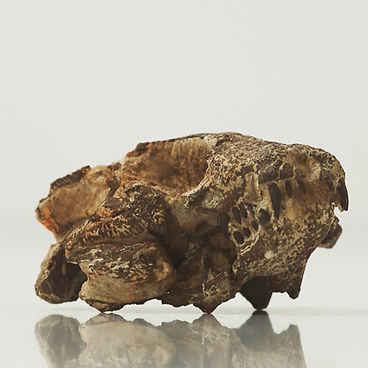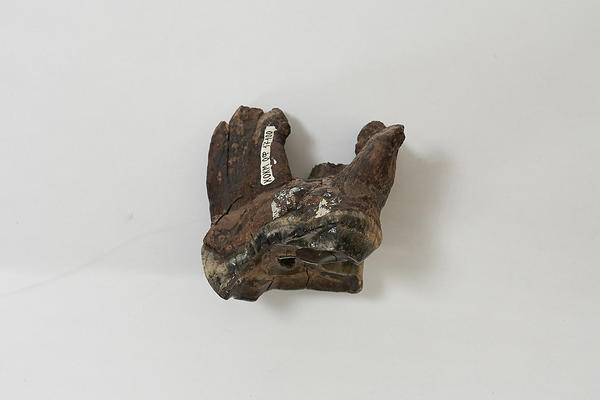
The show case displays a tooth of an extinct mammal discovered on the banks of the Ini River in 1964. Paleontologists worked with the material and found that the fossil belonged to the thermophilic Merck’s rhinoceros. The animal lived in Europe and Asia during the Pleistocene and Early Holocene, and died out due to global climate changes 8 to 14 thousand years ago.
According to the studies, this upper tooth belonged to an adult rhino that lived in northern Africa and in the steppe part of Eurasia. In the hot months, these mammals migrated to the northern latitudes of Siberia, which explains the finding of a tooth in the territory of the modern Kemerovo region, in Promyshlennaya settlement. In 1972, the study was conducted by paleontologist, candidate of biological sciences and a well-known researcher of the fauna of past geological epochs, Ernestina Alekseeva, who determined the species of extinct rhino that the fossil belonged to.
To date, about 35 remains of Merck’s rhinoceros have been discovered. It is known that the animal belonged to the order of artiodactyls, the rhinoceros family. Adult specimen weighed more than 3 tons, reached 4 meters in length and 2 meters in height, approximately resembling the parameters of a white rhino. Scientists suggest that the Merck’s rhinoceros was larger than its counterparts and, unlike the short-legged woolly rhinoceros, had high limbs with wide soles. Thanks to this structure, the animal easily moved through marshy areas and through areas overgrown with tall grass. This ancient mammal preferred living in forests.
Merck’s rhinoceros survived to the era of glaciations. With gradual cooling of the central part of the continent and the transformation of wooded areas into the steppes, the beast was driven back to southern Europe. Here, in the steppes resembling the American prairies, the rhino lived for a long time, next to the mammoths. In these territories, near the remains of ancient rhinos, extinct buffalo are often found.
The last representatives of Merck’s rhinoceros lived in the territory of Italy in about the same historical era with the Paleolithic man. The mammal died out, but was replaced by a new animal, better adapted to extremely cold conditions; it was the woolly rhino.
According to the studies, this upper tooth belonged to an adult rhino that lived in northern Africa and in the steppe part of Eurasia. In the hot months, these mammals migrated to the northern latitudes of Siberia, which explains the finding of a tooth in the territory of the modern Kemerovo region, in Promyshlennaya settlement. In 1972, the study was conducted by paleontologist, candidate of biological sciences and a well-known researcher of the fauna of past geological epochs, Ernestina Alekseeva, who determined the species of extinct rhino that the fossil belonged to.
To date, about 35 remains of Merck’s rhinoceros have been discovered. It is known that the animal belonged to the order of artiodactyls, the rhinoceros family. Adult specimen weighed more than 3 tons, reached 4 meters in length and 2 meters in height, approximately resembling the parameters of a white rhino. Scientists suggest that the Merck’s rhinoceros was larger than its counterparts and, unlike the short-legged woolly rhinoceros, had high limbs with wide soles. Thanks to this structure, the animal easily moved through marshy areas and through areas overgrown with tall grass. This ancient mammal preferred living in forests.
Merck’s rhinoceros survived to the era of glaciations. With gradual cooling of the central part of the continent and the transformation of wooded areas into the steppes, the beast was driven back to southern Europe. Here, in the steppes resembling the American prairies, the rhino lived for a long time, next to the mammoths. In these territories, near the remains of ancient rhinos, extinct buffalo are often found.
The last representatives of Merck’s rhinoceros lived in the territory of Italy in about the same historical era with the Paleolithic man. The mammal died out, but was replaced by a new animal, better adapted to extremely cold conditions; it was the woolly rhino.