The hunting dirk with the scabbard from the Gatchina Palace and Estate Museum collection was made in 1868 at the arms plant in Toledo, Spain. Toledo had been known as a centre of metalworking since the middle of the first millennium B.C. and for many centuries the steel produced in the city was considered the best in Europe for edged weapons. In 1761 by a decree of King Charles III an arms plant was founded in Toledo. It started manufacturing edged weapons for the army. In 1777 because of the increased production volume new plant buildings were built outside the city. Along with weapons for the army the Toledo plant also manufactured hunting and ceremonial edged weapons. In the last third of the 19th century it also produced cartridges. Over time the demand for army weapons decreased, its production in Toledo fell into decline and the plant was closed in 1996. Emperor Alexander III did not spend so much time hunting as his father Alexander II, but he used hunts to take a rest from his duties. He kept various hunting weapons in his private rooms in the Gatchina Palace, and this dagger also belonged to him. It is obvious from the monogram of Grand Duke Alexander Alexandrovich, an heir to the throne and future Emperor Alexander III, on the blade and on the cross-guard. The cross-guard and the scabbard furniture are made of silver and, just as the blade, are decorated with reliefs on gilded backgrounds. The blade is decorated with a hunting scene while the cross-guard and parts of the furniture — with floral patterns. The blade of the dirk is made of steel. It is straight with two sharp edges, a wide fuller and a curved central ridge near the point. On the right side of the ricasso there is a monogram of overlapping letters ‘A A’ under a crown made in the chasing technique. The fuller is decorated with a scene of dogs chasing a deer framed with winding stems made in the same technique. On the left side of the blade on the ricasso there is the coat of arms of Toledo with an inscription: ‘Fca de Toledo AŇO de 1868’. The hilt (the part held in hand) consists of a bone grip in the form of a baluster. The cross-guard is made of cast silver and is partially gilded. It is made in the form of winding grape vines with a round curved shield over them. In its centre there is a monogram of the overlapping letters ‘A A’ under a crown in relief. The butt cap of the hilt is made of silver in the form of a hemispherical nut which is threaded onto the tang of the blade. It is decorated with oak leaves in relief. In front of the cross-guard there is a large oval silver washer on the tang of the blade.


№26 Hunting dirk with scabbard
Creation period
1868
Place of сreation
Toledo
Dimensions
dirk’s overall length — 57 cm, blade length — 42,2 cm, blade width — 4 cm; scabbard’s length — 46,6 cm
Technique
chasing, bone carving, gilding, casting, wood carving, sewing
Collection
1
Open in app#1
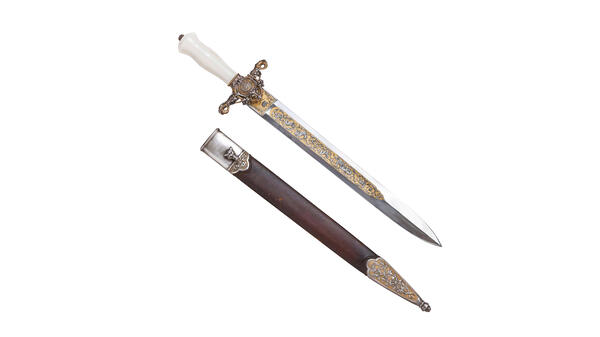
№26 Hunting dirk with scabbard
#2
#3
Ministry of Culture of the Russian Federation
read morehide
00:00
00:00
1x
№26 Hunting dirk with scabbard
Creation period
1868
Place of сreation
Toledo
Dimensions
dirk’s overall length — 57 cm, blade length — 42,2 cm, blade width — 4 cm; scabbard’s length — 46,6 cm
Technique
chasing, bone carving, gilding, casting, wood carving, sewing
Collection
1
 Point your smartphone camera to open in the app
Open in app
Share