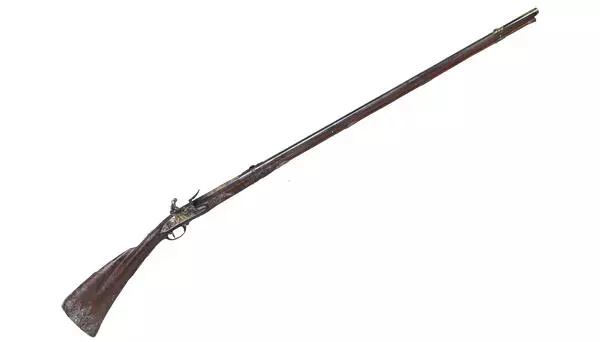
The flintlock rifle from the Gatchina Palace and Estate Museum was made approximately in the 1735–1740s in France. It was the result of joint work of two Parisian gunsmiths. Nicolas Pierron made the barrel ‘in the rough’ and Tristan Allevin decorated it, made the lock and probably assembled the gun. There is little information about gunsmiths of that time. The only things known about Tristan Allevin are the facts that he lived in Paris at the street Saint-André-des-Art and was a juror in the guild court in 1742. There is even less information about Nicolas Pierron — we only know that he died in 1735. The barrel of the flintlock gun is made of cast iron. It is blued and round in section. At the breech end it has two flat planes on the sides. There is also a flat plane on the upper side running along the main part of the barrel. The gun has no rear sight. The front sight is made of silver. At the breech end, around the front sight and near the muzzle face the barrel is decorated with a stylised floral pattern inlaid with gold. There are also images made in the same technique depicting a hunter’s trophies and a hunter with dogs, one of them carrying a killed bird. On the flat plane near the breech end there is an inscription inlaid with gold, reading: “Allevin AParis”. Most likely, it indicates the name of one of the gunmakers. On the bottom side of the barrel at the breech end there is an oval mark with the letters “NP”. These are initials of Nicolas Pierron. On the sides of the barrel there are two marks in the form of lilies. The gun has a French type flintlock mechanism. The surfaces of the lock plate and the hammer are flat. All the parts of the lock are decorated with elements of a stylised floral pattern made in the chasing technique. The lock plate is also decorated with elements of a rocaille pattern. In its left corner there is an image of a hunter’s trophies. The hammer is decorated with a mascaron — a type of an architectural ornament in the form of a human or animal face. On the lock plate there is an engraved inscription: ‘Allevin AParis’. The iron furniture includes a butt cap, a trigger guard, a lock bridle and four ramrod pipes. The upper part and the sides of the butt plate are decorated in the chasing technique: a hunter’s trophies are depicted on the upper part and a dog swimming towards a goose — on the sides. The images are complemented with rocaille motifs. On the back side of the butt plate there are engraved war trophies and a fox who has caught a heron.


№23 Flintlock gun
Creation period
1735–1740s
Place of сreation
Paris
Dimensions
overall length — 146.6 cm; barrel length — 107.2 cm; calibre — 16 mm
Technique
forging, bluing, gilding, engraving, wood carving, casting, inlay, embossing, horn carving
Collection
1
Open in app#1

Nicolas Pierron
№23 Flintlock gun
#2
#3
Ministry of Culture of the Russian Federation
read morehide
00:00
00:00
1x
№23 Flintlock gun
Creation period
1735–1740s
Place of сreation
Paris
Dimensions
overall length — 146.6 cm; barrel length — 107.2 cm; calibre — 16 mm
Technique
forging, bluing, gilding, engraving, wood carving, casting, inlay, embossing, horn carving
Collection
1
 Point your smartphone camera to open in the app
Open in app
Share