In spring, “the glare of snow” begins in the tundra. At this time, the arctic sun rises very high. Bright light is refracted by ice crystals, and everything around looks white, even the snow ledges do not cast shadows. Eyestrain and exposure to too much ultraviolet light lead to snow blindness.
The sunburn of the cornea results in inflammation, tearing, discomfort and pain. The eyelids swell and people feel dizzy. They see darkness and flickering flashes. Snow blindness is reversible: if a person immediately hides in a dark room, gives rest to the eyes and applies an opaque bandage, then the vision will be restored in a few days. However, if the person continues to look at the snow shining in the sun, real blindness can develop.
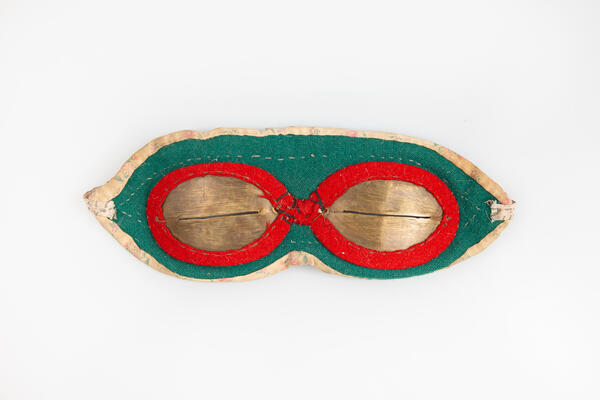
This disease was first described by travelers who explored the Far North. They used opium drops to save their eyes, but the drops only relieved the pain symptoms. The indigenous people of the North came up with their own way of protection from snow blindness. Eye goggles, vaguely reminiscent of modern glasses, were made of wood and birch bark, and the Nenets sewed special leather bandages. Nenets artisans took a piece of fur or rawhide about 20 centimeters long. They inserted thin copper plates with slits for the eyes — the inserts performed the function of spectacle lenses. The slits were under five centimeters long and under two millimeters wide.
The copper inserts were fixed in the fabric with a double leather rim and strong tendon threads. On the sides, there were leather straps, which were tied at the back of the head. The surface of the glasses was decorated with colored cloth, like the traditional Nenets clothes. Sometimes, when making snow goggles, the Nenets did not use metal plates, and made slits right in the fabric. Occasionally they used thin wooden or bone plates.
Thanks to Nenets glasses, the number of northerners suffering from eye diseases has significantly decreased. The exhibition “Peoples of the North” of the Purovsky Museum presents authentic snow sunglasses that belonged to the Nenets Ilyusha Pyak.
The sunburn of the cornea results in inflammation, tearing, discomfort and pain. The eyelids swell and people feel dizzy. They see darkness and flickering flashes. Snow blindness is reversible: if a person immediately hides in a dark room, gives rest to the eyes and applies an opaque bandage, then the vision will be restored in a few days. However, if the person continues to look at the snow shining in the sun, real blindness can develop.
This disease was first described by travelers who explored the Far North. They used opium drops to save their eyes, but the drops only relieved the pain symptoms. The indigenous people of the North came up with their own way of protection from snow blindness. Eye goggles, vaguely reminiscent of modern glasses, were made of wood and birch bark, and the Nenets sewed special leather bandages. Nenets artisans took a piece of fur or rawhide about 20 centimeters long. They inserted thin copper plates with slits for the eyes — the inserts performed the function of spectacle lenses. The slits were under five centimeters long and under two millimeters wide.
The copper inserts were fixed in the fabric with a double leather rim and strong tendon threads. On the sides, there were leather straps, which were tied at the back of the head. The surface of the glasses was decorated with colored cloth, like the traditional Nenets clothes. Sometimes, when making snow goggles, the Nenets did not use metal plates, and made slits right in the fabric. Occasionally they used thin wooden or bone plates.
Thanks to Nenets glasses, the number of northerners suffering from eye diseases has significantly decreased. The exhibition “Peoples of the North” of the Purovsky Museum presents authentic snow sunglasses that belonged to the Nenets Ilyusha Pyak.