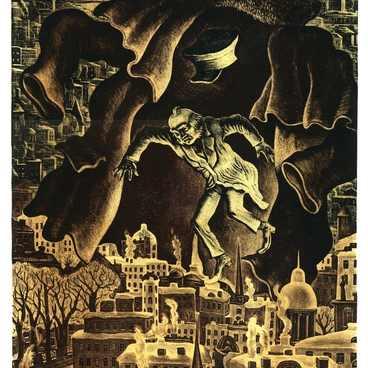
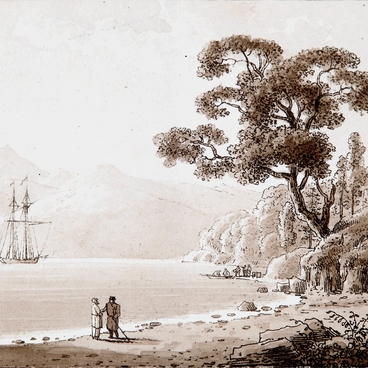
Viktor Sergeyevich Bibikov’s linocut “Oil Is Coming” was created in the 1930s. It belongs to the series “Oil Sails from Baku to Leningrad”, dedicated to the industrialization of the USSR. A master of graphic art, particularly color linocut, Bibikov combined documentary precision with the poetic celebration of progress characteristic of Soviet art of that era.
The 1930s in the USSR were a time of grand construction projects, Five-Year Plans, and unwavering faith in the power of human labor to transform the world. Oil — the “blood of industry” — became a potent symbol of this transformation. The development of Baku’s oil fields and the construction of the Volga pipelines were widely reflected in the visual arts. As a participant in exhibitions organized by the Association of Artists of the Revolution, Bibikov sought not only to depict technical achievements but also to convey the heroism of everyday life — how ordinary people were reshaping the nation.
“Oil Is Coming” is a dynamic linocut, rich in symbolism. In the foreground, the stern of a barge frames a view of the river. Thick black smoke billows from the funnel of the ship ahead — not merely a detail, but a metaphor for the driving energy of industrialization. The river curves leftward, drawing the eye into the distance. Sharp, rhythmic strokes define the waves, creating a palpable sense of motion. Along the banks stand wooden structures resembling oil rigs or temporary berths, beside which workers stand frozen in place. Their static yet tense poses convey intense concentration, as if captured in a fleeting moment of pause.
To the right, in the distance, rises a wooded hill. Its massive silhouette contrasts with the fragility of the human figures, underscoring the monumental scale of the transformation underway. Sunlight breaks through the clouds, casting rays that illuminate the river — a compositional device typical of Bibikov. The light symbolizes the hope for a bright future, one forged through hard but fruitful labor.
For this work, the artist chose linocut, a printmaking technique in which an image is carved into a sheet of linoleum and then inked and printed onto paper. Valued for its bold lines, strong contrasts, and relative speed of production, linocut was ideally suited to depicting industrial themes.
Interestingly, in his earlier works — such as the series “From the Mainland to the Arctic, to Franz Josef Land (1939)” — Bibikov employed similar techniques, though with a different emphasis: there, the focus was on humanity’s struggle against the elements; here, it is on their conquest of nature. “Oil Is Coming” is not merely a landscape — it is a hymn to an era in which man and machine moved as one, and rivers became highways to the future. Bibikov captured a moment when belief in progress outweighed doubt, and the soot staining the sky seemed not a pollutant, but a banner of victory.