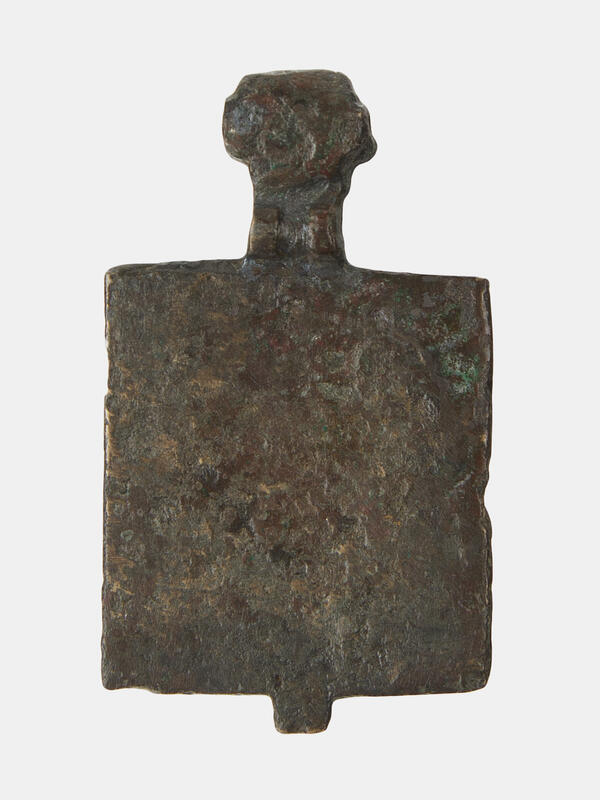
A pendant icon is a personal religious symbol for believers and baptized people. Like a cross, a pendant icon is worn constantly on the chest and suspended from a cord or chain. People address the icon when asking for help or expressing gratitude.
The tradition of wearing small pendant icons originated in Byzantium and became popular with wealthy Christians. The first pendants were made of bronze and decorated with enamel, precious stones, and forged patterns. The nobility and high clergy wore heavy gold icons with rich decoration, and ordinary parishioners had icons made of stone, bone, glass, and copper.
Pendant icons appeared in Kievan Rus along with the advent of Christianity in the 10th century. Princess Olga was the first to use this religious item as a sign of her faith. Having learned the art of Byzantine jewelers, Russian craftsmen made pendant icons with distinct traces of the Slavonic pagan past. The first pendant icons feature snake-like creatures, floral patterns, the Virgin Mary and the apostles.
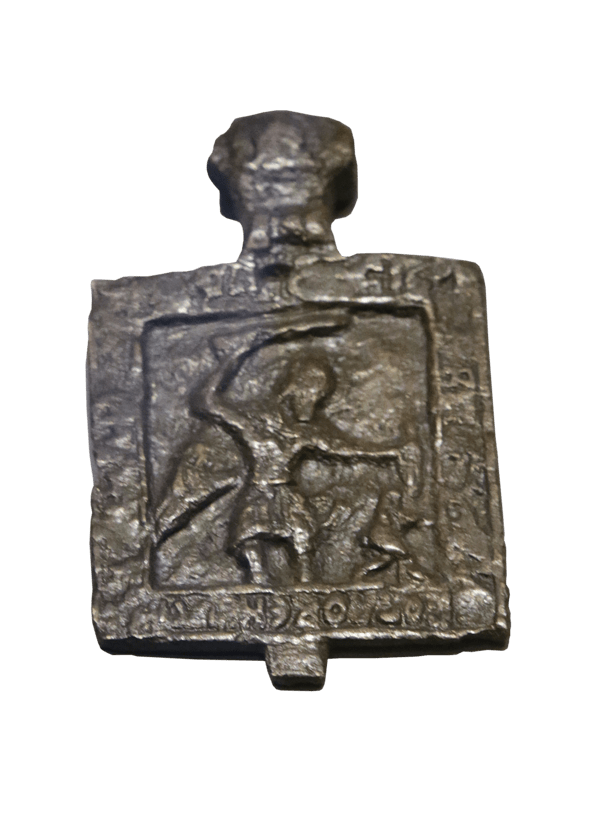
The icon from the collection of the Tula Kremlin Museum depicts the early Christian martyr Nikita Besogon beating a demon. Before the schism of the Russian Orthodox Church in the 17th century, he was the most revered Saint Nikita. With his left hand he grabs the demon’s ears, and he raises his right hand to strike him with a stick. The demon has wings, and there is a wide cloak fluttering behind the martyr’s shoulders. The saint’s head is surrounded by a halo of relief dots.
Nikita Besogon’s Day was celebrated on September 15 (28), simultaneously with the day of the Greatmartyr Nicetas the Goth, a Christian military leader who suffered for his faith. In the iconography of the Middle Ages, the images of two saints were often combined. The martyr Nikita was almost always presented with his hand raised to strike, but was armed either with a chain, a stick, a club, or a rope.
Legend has it that Nikita Besogon was the son of the Roman Emperor Maximian. When Nikita refused to accept paganism, his father imprisoned him in a dungeon, where a demon appeared to the young man in the guise of an angel and tempted him to renounce Christianity. Nikita did not believe the demon and defeated the evil spirit, who turned out to be Beelzebub.
Emperor Maximian kept his son in prison for several years, had him tortured, but each time Nikita remained unharmed. He preached Christianity, proving the power of his faith by the miracle of the resurrecting hundreds of people. Nikita died in Constantinople, glorifying the name of Christ.
The image of Nikita Besogon was depicted in icons, high reliefs, frescoes, wooden sculptures, and crosses made of metal and stone.