


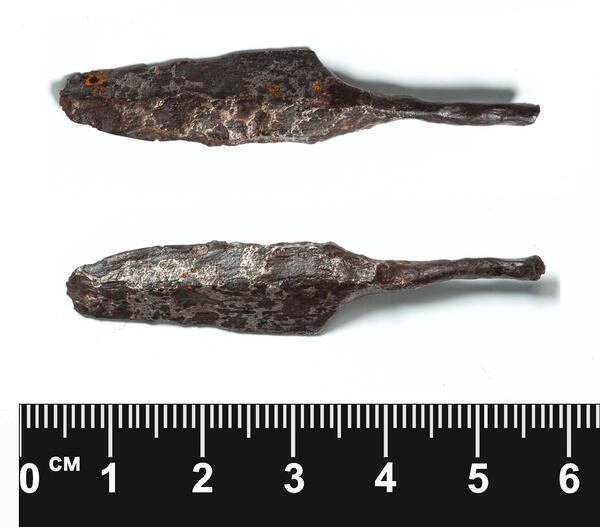
This arrowhead was discovered in 2009 during excavations conducted by the military-historical unit of the Upper-Don archaeological expedition of the State Historical Museum and the State Museum-Reserve “Kulikovo Field” to the south of the Monastyrshchino village, Kimovsky District, Tula Oblast, on the watershed between the Verkhodub and Orzhevik ravines.
This arrowhead has a tang for fitting into the arrow shaft. Flat arrowheads with tangs constituted the largest group of arrow points from the 8th through the 14th centuries in Old Rus and in Eastern Europe. They were used for hunting and warfare.
This arrowhead belongs to the type of rhomboid flat points with the flaring lower third of the blades. The lacking stop flange between the arrowhead and the shaft is a characteristic feature of these arrowheads. They appeared in the Kama region at the turn of our era and were widely used in the northern territories of Eastern Europe. Steppe nomads did not use this type of arrowheads, and they were quite uncommon in the south of Old Rus.
The Golden Horde main weapon was the bow and arrows. The Mongol also used composite bows that had an excellent ballistic performance.
The main weapon of the Horde attack is a bow with arrows. Their bows were also composite and were distinguished by exceptional power.
The structure of the bow was quite sophisticated. It consisted of a handle in the middle and two curved limbs. Layers of wood, boiled sinew, and horn were glued together to make the bow. The whole bow was called “kibit”. The bow was wrapped in birch bark that had been previously boiled in drying oil, and stored in a leather bow bag. In Rus, fletchers were called “luchniki”, and archers were called “streltsy”. Arrows were carried in a birch bark or leather quiver of the steppe type — a long narrow box. It was richly ornamented with appliqué designs.
An arrow consisted of several parts: a shaft, a head, fletchings, and a nock for engaging the bowstring. Most arrowheads were made from iron. They came in a variety of configurations: different situations during hunting and fighting required different types of arrows with each serving a specific purpose.
This arrowhead has a tang for fitting into the arrow shaft. Flat arrowheads with tangs constituted the largest group of arrow points from the 8th through the 14th centuries in Old Rus and in Eastern Europe. They were used for hunting and warfare.
This arrowhead belongs to the type of rhomboid flat points with the flaring lower third of the blades. The lacking stop flange between the arrowhead and the shaft is a characteristic feature of these arrowheads. They appeared in the Kama region at the turn of our era and were widely used in the northern territories of Eastern Europe. Steppe nomads did not use this type of arrowheads, and they were quite uncommon in the south of Old Rus.
The Golden Horde main weapon was the bow and arrows. The Mongol also used composite bows that had an excellent ballistic performance.
The main weapon of the Horde attack is a bow with arrows. Their bows were also composite and were distinguished by exceptional power.
The structure of the bow was quite sophisticated. It consisted of a handle in the middle and two curved limbs. Layers of wood, boiled sinew, and horn were glued together to make the bow. The whole bow was called “kibit”. The bow was wrapped in birch bark that had been previously boiled in drying oil, and stored in a leather bow bag. In Rus, fletchers were called “luchniki”, and archers were called “streltsy”. Arrows were carried in a birch bark or leather quiver of the steppe type — a long narrow box. It was richly ornamented with appliqué designs.
An arrow consisted of several parts: a shaft, a head, fletchings, and a nock for engaging the bowstring. Most arrowheads were made from iron. They came in a variety of configurations: different situations during hunting and fighting required different types of arrows with each serving a specific purpose.


