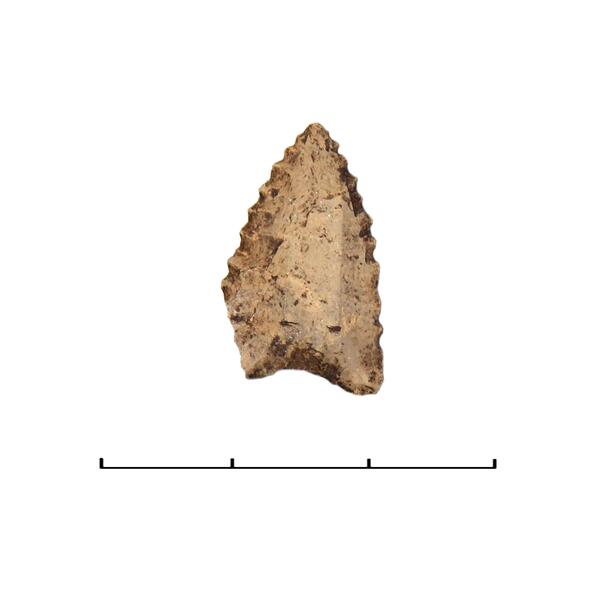
The arrowhead presented in the museum’s collection was discovered in the Borovyanka-XVII burial ground, in one of the ground burials, which, according to a set of grave goods and ceramics, dates back to the Andronovo time (Bronze Age, 14th–11th centuries BCE). The arrowhead was made of light brown silicified quartzite. It was created on a plate trapezoidal in the cross section. The edges of the blade are decorated with an equi-faceted toothed retouch and the notch of the haft element — with edge retouch. The arrowhead is triangular, symmetrical, stemless, with a concave haft element.
Making such arrowheads was a complicated procedure. A blank of the required size was chipped from the nucleus (raw stone), after which it was refined by retouching. Retouch is a method of processing stone by repeatedly striking a flake. With proper skill, making the arrowhead did not take much time. Then the arrowhead was inserted into a pre-dried split shaft, after which it was secured with a strip of raw leather, which compressed and hardened when dried.
Such weapons were widely used for hunting and less often — in combat encounters. The sharp cutting edge facilitated easier penetration into the victim’s body and caused profuse bleeding, while the teeth prevented the arrow from being extracted from the wound. Bronze arrowheads were used for battles. They had a greater penetrating power.
There are no deposits of stone in Western Siberia, the raw materials were transported from the Ural or Altai Mountains. This explains the small size of the tip: it was better to make a lot of small objects than several large ones that could get lost during hunting. For example, an animal that was not fatally struck by an arrow could run away with the arrow in the wound. However, no burial of a warrior or hunter could do without a knife and arrowheads — these items were necessary for the deceased to hunt in the afterlife. In addition, the quantity and quality of such items reflected the social status of the buried.
In the Omsk Irtysh region, stone for the
manufacture of arrowheads continued to be used until the end of the Bronze Age,
when people learned how to mine and process iron ore.