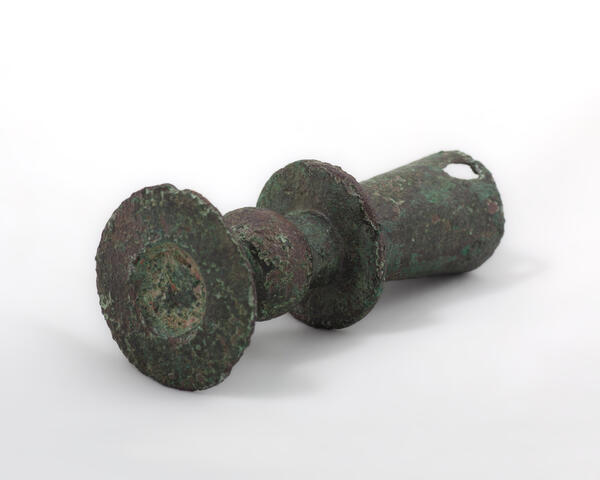
The object from the museum’s collection was found on the territory of the Kursk region during surveys conducted by the Middle Seym Expedition of the Institute of Archaeology of the Russian Academy of Sciences in 2008–2009, under the leadership of Oleg Alexandrovich Radyush. In 2010, the artifact was transferred to the collections of the Kursk Museum of Archaeology. It is associated with the Kyiv archaeological culture, whose bearers are considered by scholars to be the ancestors of the Slavs; in ancient chronicles, they are referred to as Veneti and Venedi.
The tip belongs to a group of items known as East European barbarian champlevé enamels. This enamel style spread across vast areas of Eastern Europe in the 2nd–4th centuries. Such decorations are most characteristic of the territory of the Dnieper and Desna regions from the 3rd to the 5th centuries. It was in these regions that this style emerged, based on the local Late Zarubintsy style and influenced by provincial Roman craftsmanship. Enameled objects were often part of the rich and colorful jewelry sets, found in treasure troves, such as the Bryansk hoard, found in 2010 near the village of Usukh in the Bryansk region. This indicates the presence of well-established aristocratic traditions and a culture of prestige among the Proto-Slavic population.
Similar horn designs developed in Europe no later than the 2nd millennium BCE. Typically, horns consist of a drinking vessel made of wood or hollowed-out animal horns, and a mouthpiece fitting, to which the top link of a chain is attached. The chains themselves consisted of several links, and for known horns of enamel style, link chains with hinges are characteristic. The lower part of the chain is attached either directly to the body of the horn in its lower part, or to the tip of the horn. Tips were usually made by casting during the Roman period. Enamel inlays decorated the chains and, in rare cases, the tips of drinking horns.
Chains for horns in all cases have hinges and decoration
similar to the details of the enamel pectoral chains. The mouthpiece fittings
of the horns were made of bronze sheets and have not always been preserved. The
bodies of the horns are not known at this time. Analysis of organic fragments
contained in the tip from Usukh showed that the horn itself was made of elm
wood.