Font
Color
Graphics
Изображение точки

To see AR mode in action:

1. Install ARTEFACT app for iOS or Android;

2. Find the exhibition «Peoples of the North»

3. Push the «Augmented reality» button and point your phone's camera at the exhibit;

Скрыть точки интересаПоказать точки интереса
Показать в высоком качестве

Nenets yagushka, braid, belt

0
Open in app
#1
Nenet’s broadcloth clothes — yagushka
#5
The national costume for centuries has been shaped by the worldview of the people, their culture, climatic conditions and craft opportunities. The nature of clothing, its design, material and cut help identify the geography, gender, social status and occupation of the owner. The northern costume must meet two main requirements — it has to be warm and practical. Such clothes take into account not only the harsh climate, but also the specifics of work and lifestyle.

The national clothes of the Nenets are still in demand. The Nenets costume as a part of material culture reflects the ways of human adaptation to the environment: winter in the tundra lasts up to eight months, and in summer people and animals need protection against insects and parasites.

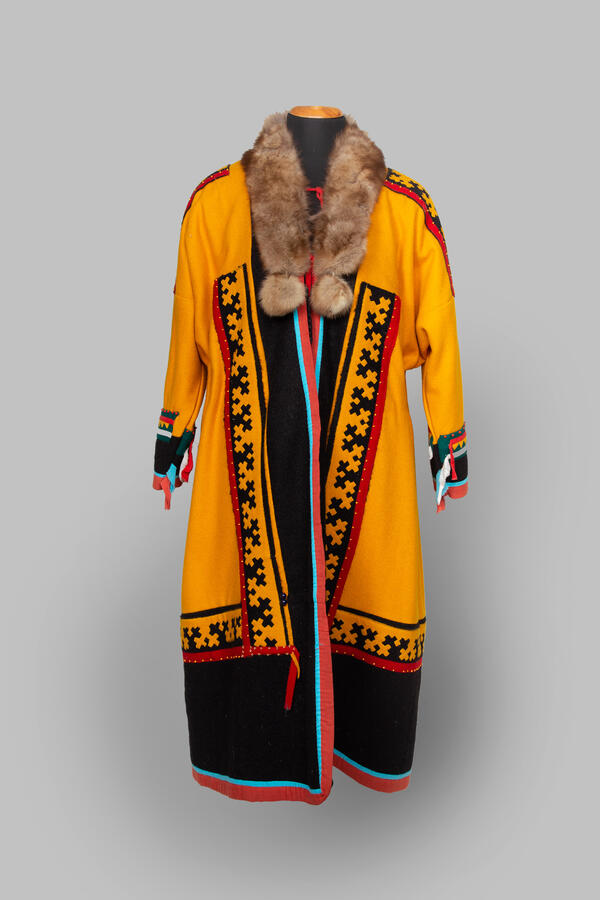
A yagushka, or panitsa, is a type of traditional Nenets women’s clothing. Unlike the men’s malitsa with a hood, which is put on over the head, the yagushka has a front opening. Women wrap the front panels of the yagushka one on top of the other and gird themselves tightly with a multi-colored belt. This version of a yagushka is well suited to nomadic living conditions: clothes can be quickly put on when leaving the tent, and it is also convenient to feed a child during “kaslaniya” — trips.

A yagushka is worn all year round: in winter, it is sewn from deer hides, in spring and autumn from cloth, and in summer from rovduga (rawhide). The back of the yagushka is cut out of one large piece of yellow cloth, and the black stripe of the hem and shoulders features an embroidered ornament called “half cedar branches”. The cuffs are decorated with a “chum” pattern, a symbol of a Nenets dwelling set up and heated by a woman. A sable collar with fur balls is an expensive decoration.

Red fabric straps are sewn to the sides — they are tied from the inside. All women’s yagushkas are sewn in the same style, but they look different, it depends on the wealth of the family and the skill of the needlewoman. Women put a lot of effort into the sacred ornament, which should protect and transform the wearer.

This elegant yagushka was donated to the Purovsky Museum in 2007 by Polina Gilevna Turutina, a native Nenets woman from the ancient Ayvasedo family. The yagushka belongs to festive wedding clothes; it was worn with a belt embroidered with beads.
#4
Name: Nenet’s broadcloth clothes — yagushka
Author: Polina Gilevna Turutina
Date of creation: the late 20th — early 21st centuries
№: 19059606 
Place of creation: Yamalo-Nenets Autonomous Okrug, Russia
Technique: fur, fabric, beads, sewing
Dimensions: 100×96 cm
#2
False Nenets braid
#7
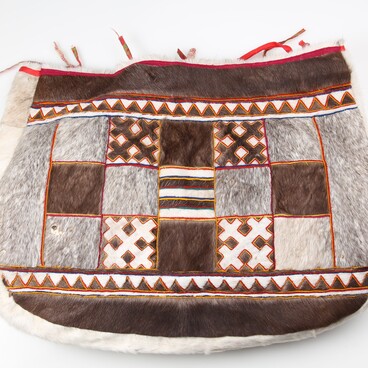
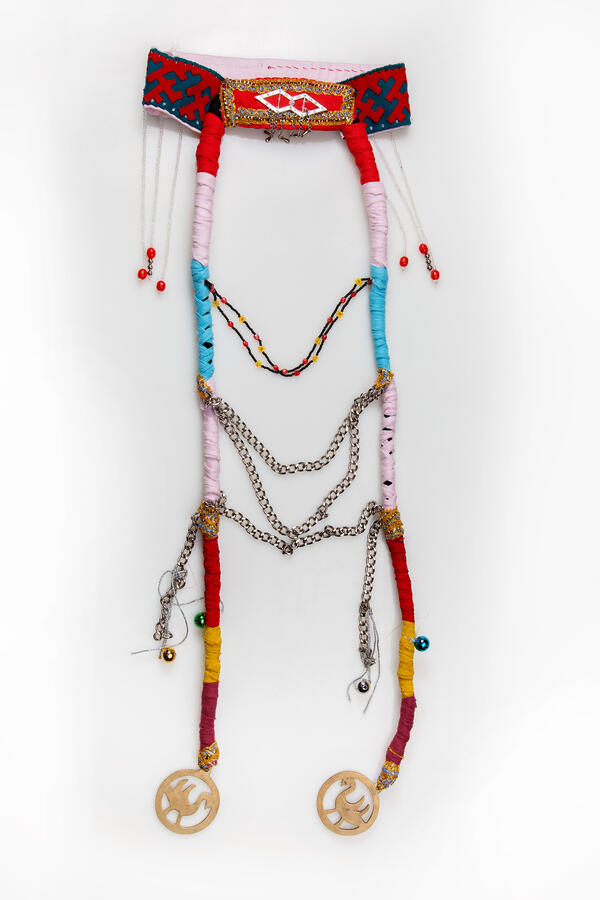
False braids are a characteristic Nenets female headdress and decoration. Long cloth bands and wool cords are attached to the ends of the plate, sometimes part of the winding is made of hair. Women part their hair in the middle, make two braids together with cloth plaits, and then tightly wrap a cord on top. When wearing this type of decoration, the hair braids are not visible.

Women wear false braids over a yagushka — traditional women’s clothing made of cloth or fur. Sometimes false braids are tucked behind a woolen belt. Metal pendants pull the braids down and keep them together, so they do not prevent women from doing household chores. Modern Nenets consider false braids a festive women’s decoration. On weekdays, women living in the tundra make two pigtails, and tie up the ends with a simple string.

False braids are decorated with metal pendants, rings, chains, plaques, beads and buttons. The braids are connected to each other by chains of colored beads and pendants. Among the people of the Yamalo-Nenets Autonomous Okrug, hair ornaments are common. The false braids are sewn from fabric, colored patches, threads and decorated with beads. Nakosniki are two long plaits of cloth strips, reaching below the knees and wrapped with colored woolen laces. In addition to being an adornment, nakosniki are considered a cult object and a talisman.

In ancient times, people believed that the chime of metal drives evil spirits away, hence the large number of brass and copper pendants, jewelry and rings. One set of jewelry was supposed to serve as a talisman for a person from early childhood to old age. It included earrings, rings for almost every finger, bracelets and amulets. Metal was considered a sacred material that cleansed a person and space.

Such jewelry rang at the slightest movement. The more adornments a young woman had, the more suitable she was for the role of a bride. The most important function of braid jewelry was signifying a person’s social status and age. By looking at the jewelry, it was possible to determine whether this jewelry was made for a man, a married woman or a young girl.

The false braids from the collection of the Purovsky Museum were made by Polina Turutina, a native Nenets, a connoisseur of Nenets traditions.
#6
Name: False Nenets braid
Author: Polina Gilevna Turutina
Date of creation: the second half of the 20th century
№: 19059624 
Place of creation: Yamalo-Nenets Autonomous Okrug, Russia
Technique: sewing, assembly, metal
Dimensions: 88×55 cm
#3
Nenets beaded belt
#10
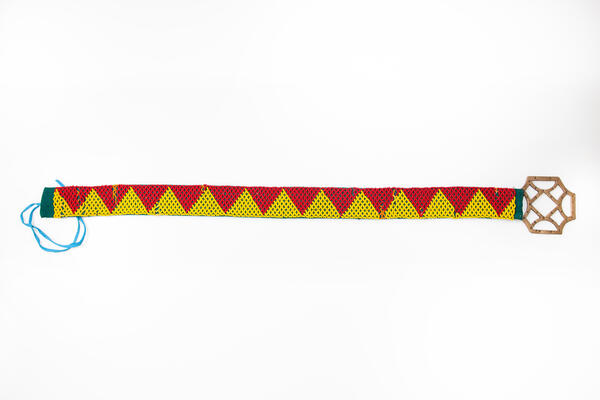
The belt is the key element of Nenets clothing at any time of the year. Men and women have worn different types of belts since their outerwear differed in cut: the men’s malitsa was put on over the head, and the women’s yagushka had a front opening. Women wrapped the right front part of the yagushka over the left one and pulled the belt tight. Both men’s and women’s belts were called “nee”, but they looked differently.

Men’s belts were heavy; they were sewn from strong deerskin and had bone buckles. A knife, a whetstone, a gunpowder flask, a pipe with a flint and other items were attached to the belt. Women wore braided belts without pendants; they served only to fix clothes. When children learned to walk, they got their first ribbon belts from their parents, who explained to the kids that the belt was their main assistant and companion, which would always support posture and protect the back, because the spine was just as important as the head. When children were one year old, the belts of boys and girls became different in design.

The women’s belt showed how well off the woman was. It was decorated with colored cloth and embroidered with beads. The belt from the collection of the Purovsky Museum features a “chum” ornament — this is a basic Nenets female pattern. It symbolizes the chum, a Nenets portable tent that women set up and make warm inside. The two main colors — yellow and red — symbolize fire, heat, blood and the birth of life.

Beads are one of the favorite ways to decorate Nenets clothing and household items. Their brightness, brilliance and variety of colors, as well as the tradition of handicraft, have become part of the northern way of life. The bright colors of beaded jewelry enliven northern landscapes, and sacred patterns symbolize folk myths and legends.

According to the Nenets, the belt is located between the top and bottom, connecting the sacred and the material. The Nenets have strict rules for handling the belt: it is forbidden to throw it, step on or step over it. The belt is a telltale sign: if it is worn improperly, the Nenets would not do business with a person like this. The buckle on the women’s belt symbolizes purity, and the belt itself symbolizes life and health. The Nenets believed that if a belt was lost, misfortune would befall the wearer.
#8
Название: Ненецкий ремень из бисера
Дата создания: вторая половина XX века
№ Госкаталога: 19059655
Место создания: Ямало-Ненецкий АО, Россия
Техника: шитье, вышивка бисером
Размеры: 90,9×9,9 см

Name: Nenets beaded belt
Date of creation: the second half of the 20th century
№: 19059655 
Place of creation: Yamalo-Nenets Autonomous Okrug, Russia
Technique: sewing, beadwork
Dimensions: 90,9×9,9 cm
#9
read morehide
00:00
00:00
1x

Nenets yagushka, braid, belt

0
Point your smartphone camera to open in the app
Share
VkontakteOdnoklassnikiTelegram
Share on my website
Copy linkCopied
Copy
Open in app
To see AR mode in action:
  1. Install ARTEFACT app for 
  2. iOS or Android;
  3. Find and download the «Paintings in Details» exhibition
  4. Push the «Augmented reality» button and point your phone's camera at the painting;
  5. Watch what happens on your phone screen whilst you flip through the pictures.
 
We use Cookies
Cookies on the Artefact Website. We use cookies to ensure that we give you the best experience on our website. If you continue without changing your settings, we'll assume that you are happy to receive all cookies on the Artefact website. However, if you would like to, you can change your cookie settings at any time.
Learn more about useHide
Content is available only in Russian

X

Нашли опечатку?...

%title%%type%