Font
Color
Graphics
Изображение точки

To see AR mode in action:

1. Install ARTEFACT app for iOS or Android;

2. Find the exhibition «Land of the Chudes»

3. Push the «Augmented reality» button and point your phone's camera at the exhibit;

Скрыть точки интересаПоказать точки интереса
Показать в высоком качестве

Printed boards, belt and fabric sample

0
Open in app
#12
Woodblock for textile printing
#9
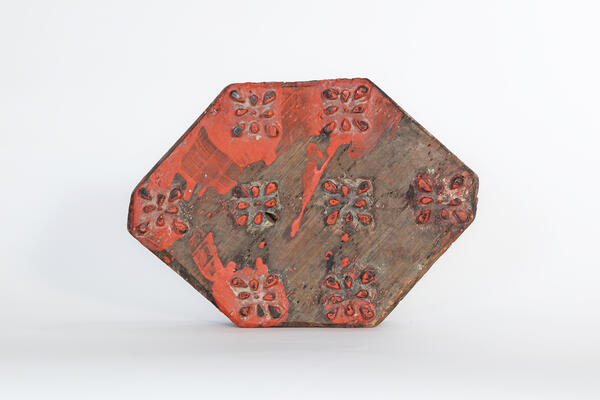
A woodblock for textile printing, or the so-called manera, is an element of one of the most ancient types of decorative and applied art. In Russia, woodblock printing for decorating fabrics has been known since the 10th century. Today this method has almost been replaced by industrial printing. The board with octofoils from the collection of the Komi-Permyak Museum was used to decorate fabrics for sarafans, towels, and tablecloths. It was handed over to the museum by its founder, the artist Pyotr Ivanovich Subbotin-Permyak. In total, the collection of the museum has 200 woodblocks for textile printing.

Subbotin-Permyak was the first to study dyeing craft and fabric decorating technologies in the Permyak region. He was the youngest of the nine children in a peasant family, living in the village of Kudymkar. Peter Ivanovich lived only 36 years, but made a great contribution to the education, development and study of the Perm Governorate. Peter Ivanovich worked as a teacher in Moscow, but, visiting his homeland, he spent all his free time collecting material related, as he wrote, “to the decorative patterns of the Permyak region, ” which are diverse in local handicrafts.

The material Subbotin-Permyak studied, processed, and described is collected in six albums, which are now kept in the museum. They contain more than 570 unique samples of embroidery, and the accompanying text describes the special features of textile printing in the Permiak region, and provides comments to the drawings. They encode the Ural nature, fauna and flora, pagan mythology, wood carvings of home decorations, Komi folk legends and fairytales.

Geometric and plant motifs are the most popular ones for Permyak culture; astral and animal motifs are less common. Flower rosettes, blossoms and leaves on branches, stems with buds are interspersed with fine patterns. A bird, a branch or a whole tree, as well as solar signs are often depicted on the border. In some Permyak printed designs there is a noticeable influence of Russian artisans, and others are inspired by the works of Tatar and Oriental craftsmen. The collection contains a lot of imported Russian woodblocks for textile printing with patterns from Russian towels, kokoshniks, silk half-shawls, kerchiefs and factory fabrics; there are elements of decorative embroidery in the Empire style.
#13
Наименование: Woodblock for textile printing
Дата создания: the 19th — the early 20th century
Техника: carving, assembling
Размеры: 14,5×14,5×14 cm
#14
Woodblock for textile printing
#5
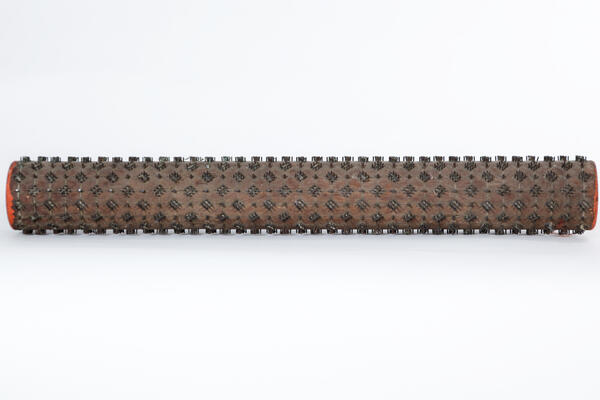
The so-called manera, or a roller-shaped woodblock, was used to create a pattern on cloth. Special handles were inserted on the sides to hold it. On its working surface is a geometric pattern made of copper pegs and plates in a chessboard order. The manera was donated to the museum by its founder, the artist and ethnographer Pyotr Ivanovich Subbotin-Permyak, who collected 570 samples of woodblocks for textile printing from all over the Permyak region.

Subbotin-Permyak was the first to study the dyeing craft and technologies of decorating fabrics in the Kama region. He made sketches of the patterns, explored their origin and meaning, talked to artisans. He was interested in everything connected, as he said, “with the ornamentika in the Permyak region”. Pyotr Ivanovich taught at the Stroganov Art and Industry School in Moscow and organized art workshops for children. He was able to combine in his art the features typical of the Kama region with those of Impressionism and the Russian avant-garde.

It was Russian craftsmen who introduced woodblock printing to the artisans of the Permyak region. The craft had its heyday in the late 18th — early 20th century. Perm artisans added to it some local folk features, a unique outlook, and a special attitude toward the symbols in nature and legends. In his workshop every dyer had several hundreds of woodblocks of different shapes: round, triangular, rectangular, square and roller-shaped ones. They consisted of one, two or three boards, fastened tightly with wooden nails. The blocks made in the early 20th century were fastened with metal nails. For durability the blocks were additionally fastened with a wedge: such fastening guaranteed that the blocks would not warp because of moisture. The pattern on the woodblocks was made of wooden and metal pins of 2–3 mm high, less often of plates, which were used to create a line in the pattern.

The centers of the woodblock printing craft in the Permyak region were located in large villages of Kudymkar, Peshnigort, Beloevo, Verkh-Inva, Karpovo, Oshib, Timino, Yurla, and Kosa. Woodblocks were most often made of birch, less often of linden and spruce. In his covering notes to the albums Pyotr Ivanovich Subbotin-Permyak wrote that “the dyeing industry is of exceptional importance for Permyaks. There are printers in a number of villages in the Permyak region”. Some of the woodblocks have preserved the marks with the names of the craftsmen.
#15
Наименование: Woodblock for textile printing
Дата создания: the 19th — the early 20th century
Техника: carving, forging, assembling
Размеры: 6,5×50 cm
#16
Woodblock for textile printing
#7
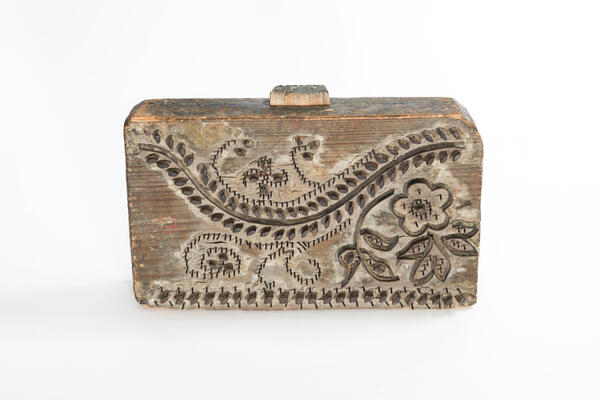
The woodblock on display in the Komi-Permyak Museum was brought by the museum founder Pyotr Ivanovich Subbotin-Permyak from an ethnographic expedition aimed at studying the decorative patterns of the Permyak region. This one-layer woodblock, or so-called manera, is of rectangular shape, with a wedge for the handle on the reverse side. On the obverse, copper plates, pins and wooden pegs set a floral ornament in the form of a flower with five petals and leaves. The bottom border is framed by a smoothly curved stem. Such a board was used to print a pattern on tablecloths and dubas — sarafans made of dyed canvas.

Printing with vat dyes — dyeing fabric in different shades of blue with light patterns — was widely used in the North and Central regions of Russia in the 19th century. At first, a craftsman applied the pattern to the fabric with the help of a woodblock, soaked in a special solution of copper vitriol or wax. It was called vapa and protected the pattern from being pigmented. The fabric was then dried and dyed in the main color by dipping it into a special vat. The printed patterns remained light due to the chemical reaction. The entire process took an experienced craftsman two to three hours.

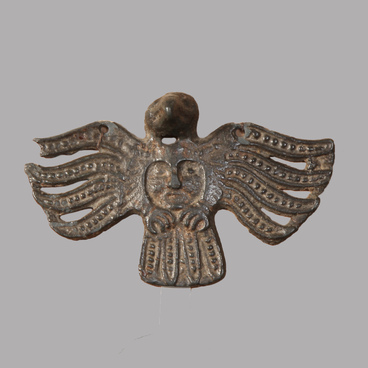
It was the village men, the “sinilshchiki” (from the Russian siniy — indigo), who carried out the toxic work. They sold their goods and woodblocks at all major fairs. Every printer gathered his own collection of patterns from dozens and hundreds of stamps. They made small woodblocks with vegetative and geometric patterns. There were also images of pagan solar signs and birds with their wings spread. The composition of the pattern usually had various elements alternating horizontally, vertically or in a chessboard pattern.

Mass vat dye printing was no longer used in the first third of the 20th century, when the Industrial Revolution brought about machine labor in place of manual work. The ancient art of manual textile printing with its lively and varied colorful patterns has left a rich legacy of high artistic value. As traditions are being revived, the woodblock printing craft is returning as a local specialty to some regions now; the hand-made items created with the help of ancient technology are beautiful and authentic souvenirs.
#17
Наименование: Woodblock for textile printing
Дата создания: the 19th — the early 20th century
Техника: carving, forging, assembling
Размеры: 4,5×21,5×13,3 cm
#18
Kushak belt
#11
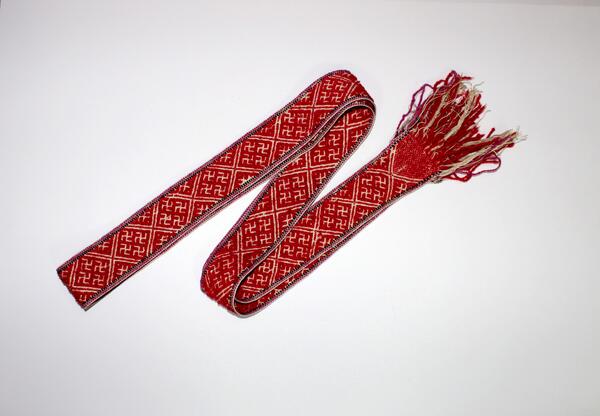
The kushak belt is an essential element of the Komi-Permyak folk costume and a cherished art piece used as an adornment on everyday clothing and as a cult item. Traditional Komi-Permyak belts were popular in the late 19th — early 20th century, however, they first appeared as part of the Permyak national costume several centuries before that.

There are two main types of belts — narrow and wide ones. The wide belt is called a kushak or an opoyaska, the narrow one is a telnik, a pokromka or a poyasok. A kushak is a men’s accessory; it was woven to a width of 5–15 cm and a length of 2.5–3 meters. A kushak was to encircle the waist twice, and its long ends were to hang freely. When going on a trip or to work, at any time of the year, a man would belt his outer clothing tightly with a kushak. Work tools and hunting or travel gear would be tucked into or suspended from it. Narrow belts were worn by both men and women, especially young ones. Lads wore them over a shirt, and girls used them over a sarafan. The pokromka and telnik were 3 to 5 cm wide and 1.5 m long.

Both young girls and elderly women were engaged in weaving belts. Wide belts were always made from home or factory spun yarns exclusively on a weaving loom. The kushaks had several functions: practical, aesthetic and magical. They embodied spiritual life of people, their culture and traditions. Belts were given as gifts on holidays, used in ceremonies, and tied for good luck.

To decorate their belts, Permyak people created special ornamental patterns, full of symbolism. The most traditional design is a red pattern on a white background. It is based on a geometric pattern of straight lines, triangles, squares, and rhombuses. Each detail has its name in Komi-Permyak and Russian: sonan — comb, perna — cross, radz — strainer, katsha kok — magpie foot, tupös — pancake, dzugan ser — yarn waste, baran sur — ram horn, kör sur — deer horn. The collection of woven belts of the Komi-Permyak Museum, including kushaks, pokromkas and telniks, includes over 550 pieces. Experts continue to study them in order to better understand the spiritual and material life of the Perm people.
#19
Наименование: Kushak belt
Дата создания: the early 20th century
Техника: hand weaving
Размеры: 252×65 cm
#20
A sample of printed canvas
#21
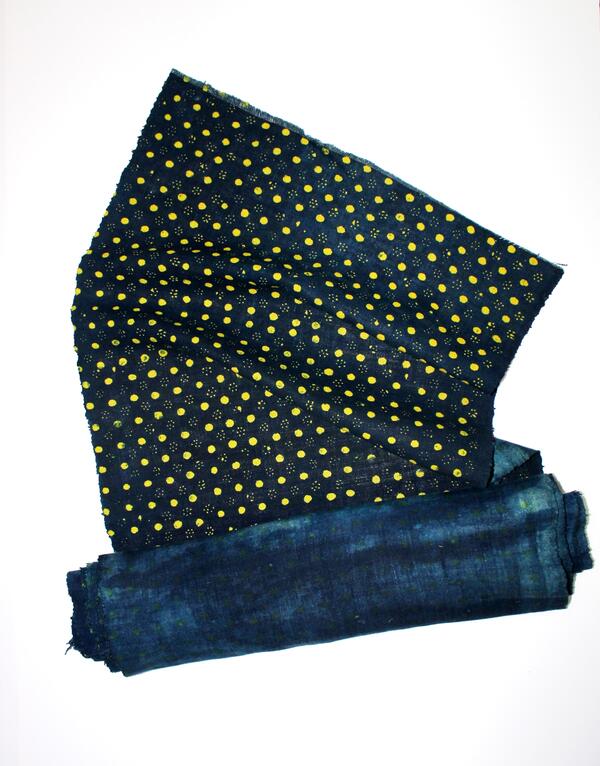
Printed fabric is any cloth that has a pattern on its surface. The name comes from an ancient technique, when a pattern was stamped on the cloth using wooden stencil boards. The dye was applied to the board, which was then placed on the fabric with the pattern downward and pressed with a special mallet. The dye absorbed well and the colored patterns appeared on the fabric.

A different technology involved a stencil to apply a special solution, vapa, to a white cloth, and then dipping the item into a vat with dyes. Copper sulfate, contained in vapa, protected the pattern from pigment and the design preserved its light color. The printing craft originated in India and then spread all over Europe. In Russia it survived until the 1930s, distinguished by a great variety of patterns and vibrancy of colors.

The Komi-Permyak Local History Museum named after Pyotr Ivanovich Subbotin-Permyak has a unique collection of woodblocks for textile printing, collected by the founder of the museum. More than 300 exhibits present the dyeing industry of the Perm Governorate of the 18th–20th centuries. The collection includes woodblocks, dubas sarafans, skirts, samples of printed canvases, linings of headdresses and outer garments. The six albums, compiled by Subbotin-Permyak, describe the symbolism and purpose of more than half a thousand patterns of woodblocks.

Woodblock printing is one of the few crafts that reached beyond one household. Artisans made and decorated fabrics for the whole village, sold them at fairs and bought woodblocks with new designs. Each craftsman could have several hundreds of them and usually used from one to five patterns for one piece. They used printed canvas to make tablecloths and towels; they sewed outer and festive Komi-Permyak women’s clothing. They particularly liked to print patterns on dubas sarafans, made of canvas. Printed fabric was also used on the lining of men’s zipuns and shaburs, on women’s shirts and headdresses.

The collection of the Komi-Permyak Local History Museum keeps printed fabrics with an indigo background, less often with a greenish one. The color scheme of the pattern is limited to a few intense colors: green, orange, yellow. Only three such rolls have survived, but the printed pattern is found on many finished items of clothing and household items.
#22
Наименование: A sample of printed canvas
Дата создания: the late 19th century
Техника: weaving, printing
Место создания: Syulkovo village, Perm Governorate, Russia
Размеры: 554×41 cm
#23
read morehide
00:00
00:00
1x

Printed boards, belt and fabric sample

0
Point your smartphone camera to open in the app
Share
VkontakteOdnoklassnikiTelegram
Share on my website
Copy linkCopied
Copy
Open in app
To see AR mode in action:
  1. Install ARTEFACT app for 
  2. iOS or Android;
  3. Find and download the «Paintings in Details» exhibition
  4. Push the «Augmented reality» button and point your phone's camera at the painting;
  5. Watch what happens on your phone screen whilst you flip through the pictures.
 
We use Cookies
Cookies on the Artefact Website. We use cookies to ensure that we give you the best experience on our website. If you continue without changing your settings, we'll assume that you are happy to receive all cookies on the Artefact website. However, if you would like to, you can change your cookie settings at any time.
Learn more about useHide
Content is available only in Russian

X

Нашли опечатку?...

%title%%type%