Font
Color
Graphics
Изображение точки

To see AR mode in action:

1. Install ARTEFACT app for iOS or Android;

2. Find the exhibition «Nomadic Horsemen Treasures»

3. Push the «Augmented reality» button and point your phone's camera at the exhibit;

Скрыть точки интересаПоказать точки интереса
Показать в высоком качестве

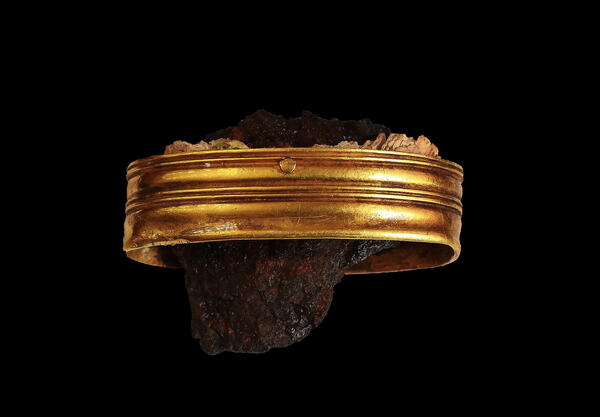
Sword crossguard coupler

Creation period
1st century BC
Dimensions
2,7х5,2 cm
Technique
forging, soldering
2
Open in app
#1
Sword crossguard coupler
#2
The sword crossguard was found in the BEra burial mound near the KOsika village in the YenotAyevsky District. This burial was opened and destroyed in 1984, when a water culvert trench was laid there. 
 
In 2015, scientists were able to find out when this artifact had been approximately crafted. M.Yu. Traister and B.A. Raev found a Greek dotted inscription in the crossguard lower part that adjoined the blade. It was not visible when the dagger was sheathed. 

The inscription was made with a punch — a special tool; in ancient times, convex-concave images and ornaments were embossed on yielding materials: metal, leather, and clay.

#5
‘238 (year) (Work? Corporation) by goldsmiths led by Bion, besides him, (also) by Bakhiy. The (weight) of good gold as measured by eclogist Guy is 8 drachmas, two obols, half an obol’.
#6
The text consists of three parts: it contains the date, the craftsmen and the gold weight confirmed by an eclogist — an official who was involved in tax assessment and tax collection. 
 
As for the date, the year is 238. It can refer to either the Seleucid era (from the fall of 312 BC) or the Pontic era (from 297 BC). Thus, according to the Seleucid era, the date falls to 74 BC, and according to the Pontic era, to 59 BC. It is difficult to decide in favor of one of the eras: the dagger was most likely crafted in Asia Minor or beyond its eastern borders, and both dates coincide with the dating of the burial. 
 
The crossguard is made in the shape of a straight gold holder rolled into an ellipsoid. It is decorated with five grooves: they encircle the object with two ribbons. A blade used to be coming from the crossguard holder; the crossbar has preserved traces of the wooden sheathing; traces of a bone sheathing are visible on the shaft of the handle. The sword from KOsika burial might not have a pommel or decorative top. However, it belongs to rare examples of ceremonial weapons. The buried person, most likely, was granted it either as a gift for service, or as booty during the campaign of the Bosporan king Pharnaces to Asia Minor in 49–47 BC. 
 
In 2005, the sword crossguard and other items were exhibited at the Astrakhan Steppe Treasures show at the National Museum of the Palazzo Venezia in Rome. 
#7
View in the State Catalogue
read morehide
00:00
00:00
1x

Sword crossguard coupler

Creation period
1st century BC
Dimensions
2,7х5,2 cm
Technique
forging, soldering
2
Point your smartphone camera to open in the app
Share
VkontakteOdnoklassnikiTelegram
Share on my website
Copy linkCopied
Copy
Open in app
To see AR mode in action:
  1. Install ARTEFACT app for 
  2. iOS or Android;
  3. Find and download the «Paintings in Details» exhibition
  4. Push the «Augmented reality» button and point your phone's camera at the painting;
  5. Watch what happens on your phone screen whilst you flip through the pictures.
 
We use Cookies
Cookies on the Artefact Website. We use cookies to ensure that we give you the best experience on our website. If you continue without changing your settings, we'll assume that you are happy to receive all cookies on the Artefact website. However, if you would like to, you can change your cookie settings at any time.
Learn more about useHide
Content is available only in Russian

X

Нашли опечатку?...

%title%%type%