Meissen china has been made at a factory where hard-paste porcelain was first produced in Europe. Crossed swords became a symbol of the manufactory in 1731.
The famous German Meissen manufactory was founded after the alchemist Johann Friedrich Böttger and the scientist Walther von Tschirnhaus managed to obtain a recipe for the first white porcelain in Europe. The history of the company began in January 1710. It managed not only to survive all the crisis periods, but also to gain worldwide fame with its porcelain products.
Kings, emperors, and princes willingly decorated their palaces and castles with Meissen china. It was in particular demand in Russia. The manufactory even established special periods when products were produced exclusively for the Russian market.
At first, the factory produced red stoneware: cups, glasses, bowls, cups and saucers, snuffboxes, and small haberdashery items.
Subsequently, under Johann Joachim Kändler, the artist became head of the modeling workshop of the Meissen Porcelain Manufactory in 1733, the company shifted its focus from decorative painting on smooth surfaces to sculpture and bas-relief. Kändler’s achievements are extremely valuable both in sculpture and in the field of shaping and modeling of dishes. Kändler developed a number of sculptural series and compositions, which then not only became firmly included in the assortment of most German factories, but also became popular far beyond the borders of Saxony. It was Kändler who laid the foundations of the Meissen modeling style, which is characterized by grace and cheerfulness.
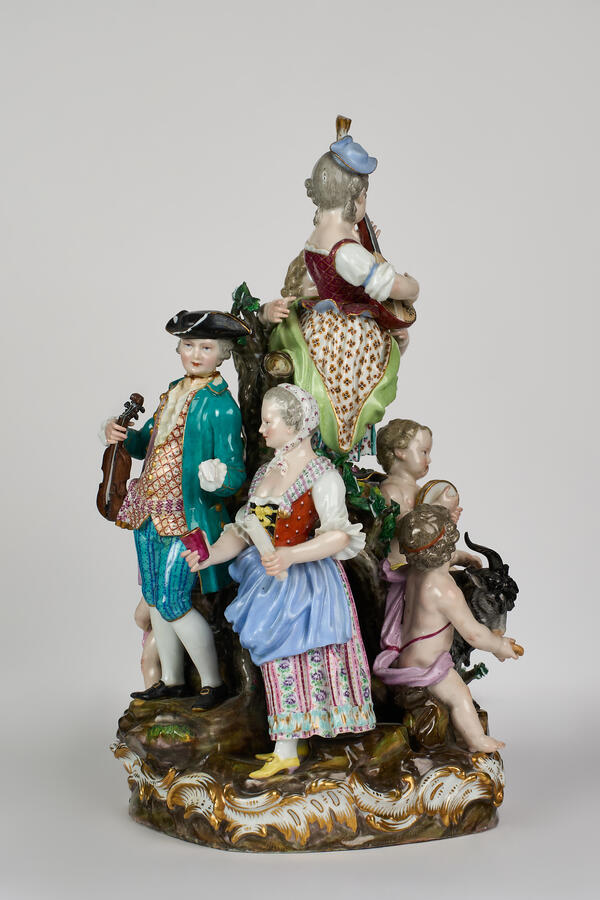
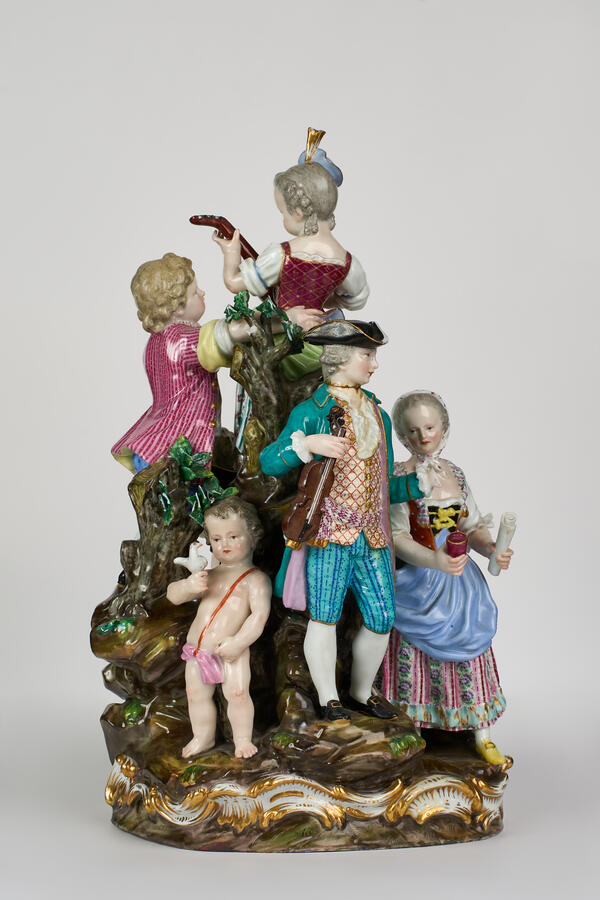
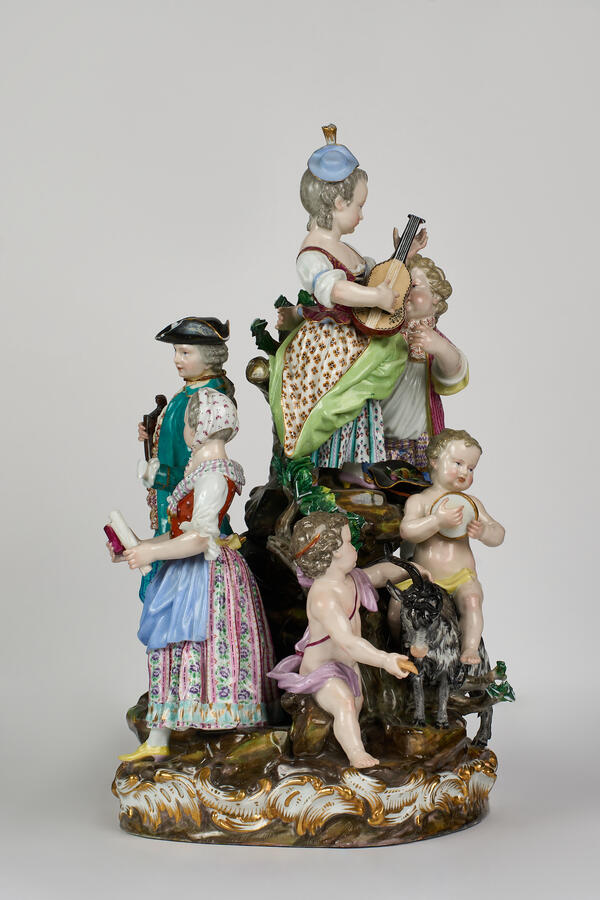
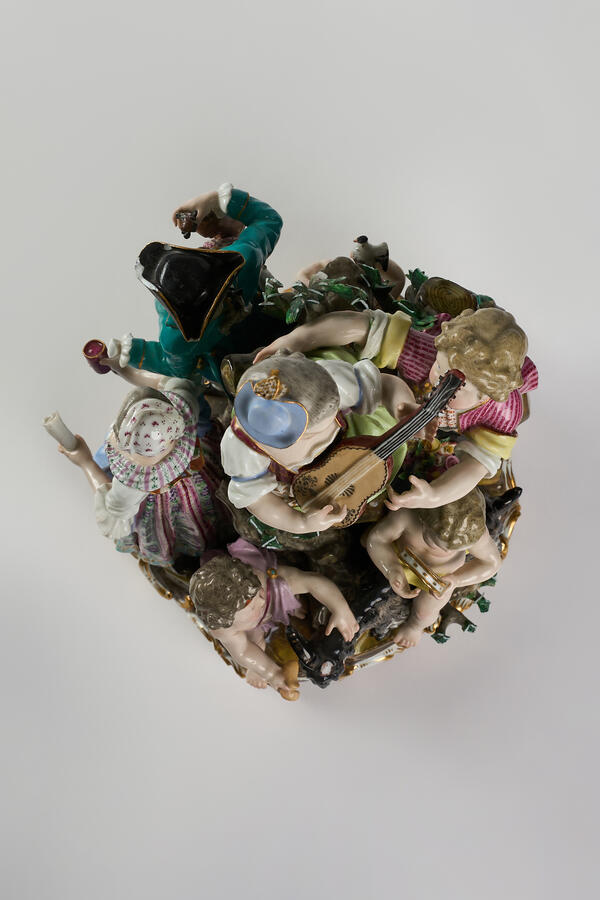
The pastoral plot is one of the most popular motifs in porcelain figurines. The sculpture presented in the Collection of Foreign Art depicts a group of seven figures. In the center is a young woman with a guitar. A young man in a purple shirt stretches out his arms to her. Below them is a young man in a green caftan with a violin and a woman with a cup in her hand. They are accompanied by a pair of putti (little boys), one of whom is depicted sitting on a goat.