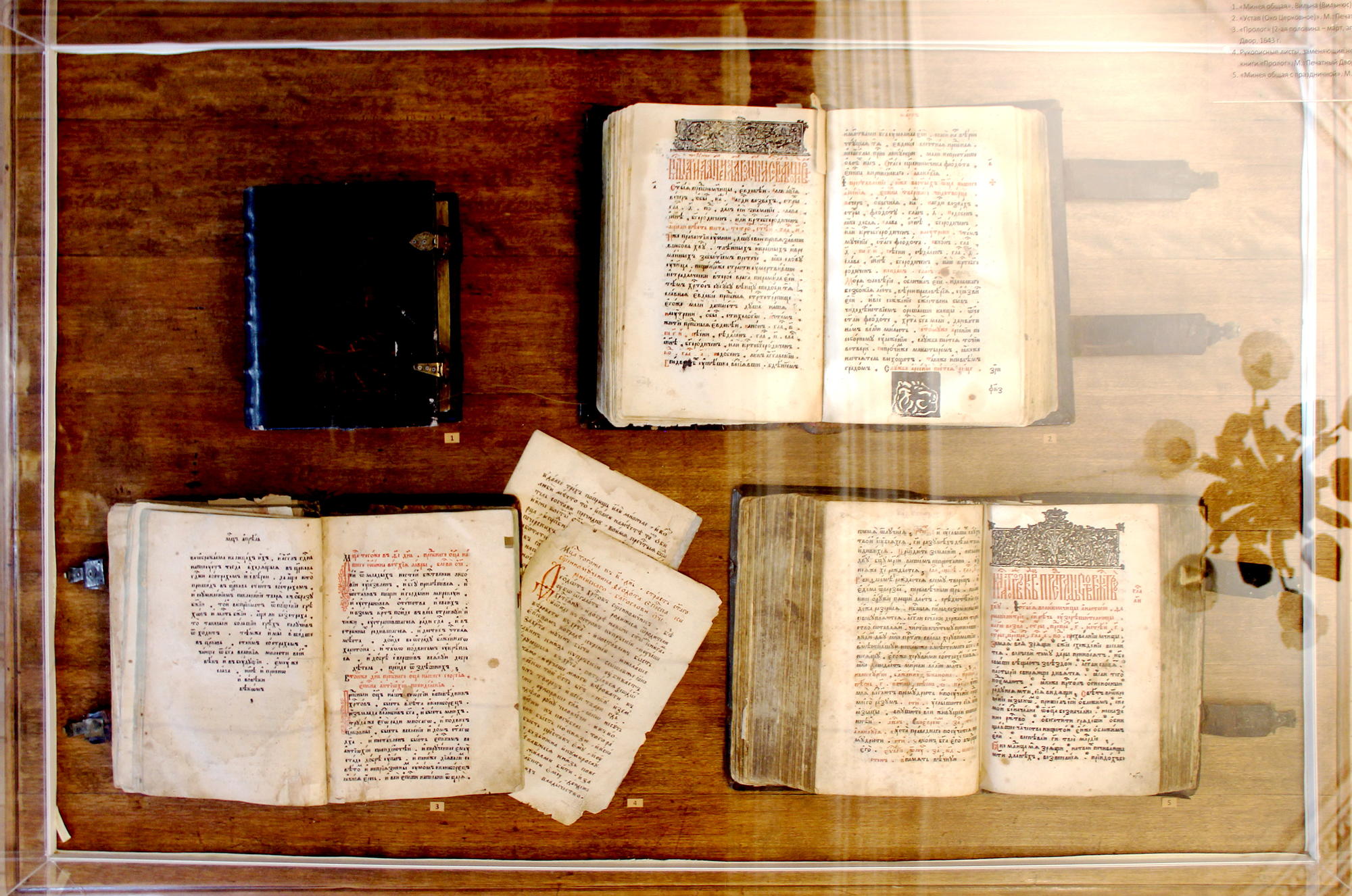
‘The Church Eye’ or the Big Constitution is a book gathering all of the most important church services, structured by hours and dates. It appeared in the Russian church in the 14th century while copies (replicas) of it were made up to the 17th century. After the 17th century, Church Eyes were printed in print shops. The Big Constitution from the museum is one of the latest printed versions. It was finalized at the times of Patriarch Joseph I and published in 1641 at Patriarch Joseph.


#1
The Church Eye
#11
#10
‘The Church Eye’ contains daily, weekly and festive services, which were celebrated at fixed calendar dates. The book consists of rules for celebrating holy days, guidelines for performing church rituals and detailed instructions. The Big Constitution solved the question of the right order of reading or singing prayers from the Prayer Book, Horologion or the Book of Eight Tones. With the help of ‘The Church Eye’ the paschal cycle (days for celebrating the Great Easter at different years) could be easily counted of.
#12
During divine services several church books could be used at the same time. The Big Constitution noted how to keep the right order of prayers in that case. Most of the book was devoted to these rules, however, the Constitution also contained disciplinary instructions: how to keep the fast by lay people and monks, how to pray in churches, monastic cells and before feasts.
#13
The first edition of ‘The Church Eye’ was printed in 1610 at the times of Patriarch Hermogenes. It was one of a few books published at the Time of Troubles. In 1633, the new Patriarch Philaret ordered to burn the whole edition of the Constitution in front of the people in Moscow as heresy. At present, the main book for determining the order of divine services is the Big Constitution of 1641.
#14
The binding of the ‘Church Eye’ is made of two wooden plates covered by leather. It is very well-preserved. The leather is ornamented with lining — a pattern pressed on the surface of the book cover. A special pattern mould was pressed to the smooth surface of the binding until a print could be seen. The Constitution was locked by metal clips ornamented with floral design. The book was renovated in the 19th century.
#26

#25
General Mineya with the Festive One
#2
The General Mineya is a book for divine services, in which prayers to prophets, saints and apostles are recorded. It is usually united, likes the presented exhibit, with the Festive Mineya — prayers, chants and the order of divine services in honor of Jesus Christ, the Most Holy Mother of God and the most revered saints in Orthodoxy.
#3
The word ‘Mineya’ means ‘month’ in Greek. Such books were used not only in church services, but in the reading of prayers at home and cells as well.
#4
Hermit priests usually prayed according to the Mineyas, telling special rosaries (chetkee — in Russian), hence the second name for the books of this type — rosaries (chetyeez). The first Slavic Mineyas appeared at the end of the IX-th century, they were compiled by the disciples of Cyril and Methodius — Clement of Orchid and Constantine of Preslav.
#5
The General Mineya is a collection of services with generalizing names: To the ‘Feasts of the Virgin’, to the ‘Feasts of the Lord’, to the ‘Reverend’, to the ‘Martyr’ or to the ‘Many Apostles’. It was supplemented by the Festive one, the chants and prayers of which had some peculiarities or contained texts missing in the other books. Such Mineya was used if there was the General Mineya in the church, but the more detailed, the Monthly one, was missing. The Festive Mineya was considered a type of the Monthly Mineya, or the Service Mineya, which consisted of 12 volumes, according to the number of months of the year. A volume contained services for every day.
#6
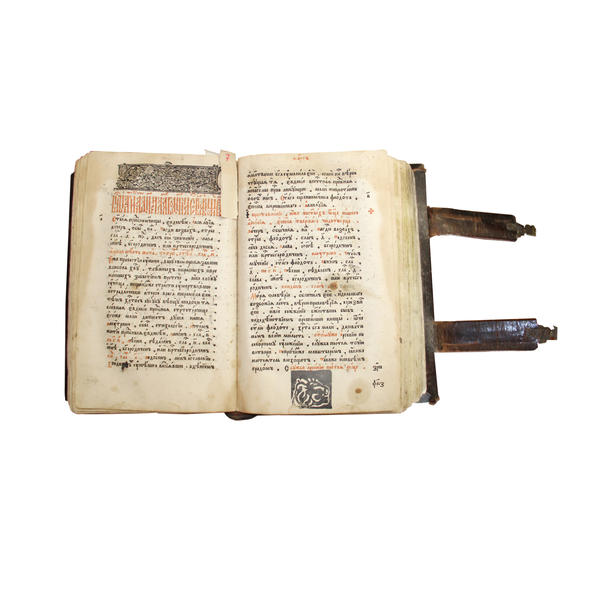
This is an ancient edition dating back to the pre-Patriarch Nikon period, that is, the time preceding the schism in the Russian Orthodox Church of the 1650-60s. This Mineya was printed in 1637 at the Moscow Printing Yard, the largest Cyrillic printing house of the XVII-th century. The first tsar of the Romanov dynasty, Mikhail Fyodorovich ruled at this time. Under him, the patriarch of the Russian Church was Joasaph I, who paid special attention to correcting and printing of church books and put in order the worship services as well.
The bookbinding is made of a board covered with embossed leather. The paper with traces of restoration of the XVIII-XIX-th centuries is decorated with ligature (ornamental script), patterned inserts and filigree — openwork mesh of fine twisted wire. Some of the pages contain examples of cursive writing: calligraphic, rounded writing of letters with typical broad strokes and ligature- the images of several letters conjoined into one sign.
#7
On the flyleaf of the book, there is a record of who owned the book and how much it cost: ‘This book of the General Mineya belongs to the Saratov commoner Osip Travkin. The price of this is eighty rubles.’
#15
#16
Prolog
#17
Synaxar, or Synaxary means collection in translation from Greek. That was the name for books containing biographies of saints, their instructive words and edifying stories. The Slavic version of the title, the Prolog, appeared when translators mistakenly translated the subtitle of the name of the book. All texts of the Prolog are associated with dates of the church calendar and are timed to them.
#18
Synaxaries contain explanations and descriptions of holidays and remembrance dates, information on what event or recollection is connected with them and why. Some of them relate to legends and stories about miracles performed by saints that were invented by people.
Prologs were intended to be read at the morning services in the church. The Russian Prolog was often edited, new lives of saints were added from time to time, so there are many editions.
#20
The oldest Prolog in the Slavic language appeared around the 12th century. The Greek text of the original, which contained biographical references about Byzantine figures Ilya Greek and Konstantin of Mokhisy, was immediately subjected to Slavic editing: they included in the book remembrance dates and religious edifying texts related to Russian and South Slavic saints.
#21
The appearance of the Prolog became an important event for the church and for the people. In fact, the synaxar became the textbook of life, which included all important topics affecting lay people, monks and married people. There were included texts about divine power and mercy, about fear of God, love for one’s neighbor, selflessness, honoring of parents and the church, about the order of services and compliance with it. There were also household guidance on how to raise children or fight alcoholism.
#22
Usually the Prolog consisted of two parts. In the first part there were readings for the autumn and winter months, and in the second — for spring and summer. Each volume could be issued in two books to separate the seasons, one from another.
#23
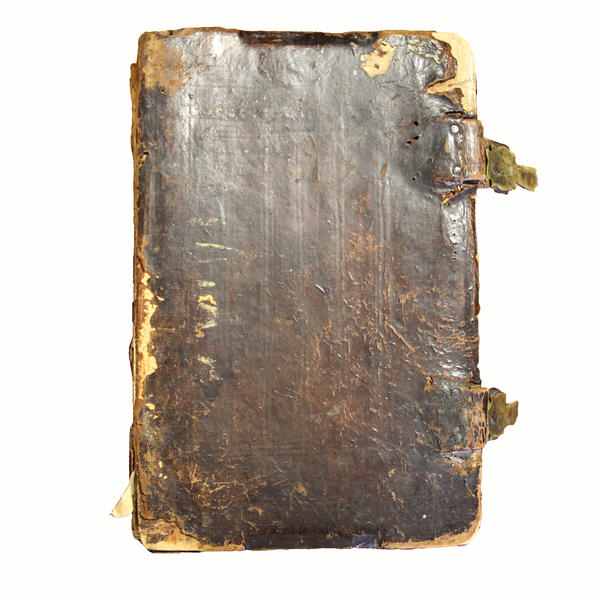
The book, preserved by the museum, is the second supplemented printed edition of the Prolog, published in 1643. Unlike the first edition printed a year earlier, about 40 texts about foreign saints were removed from it and more than 20 texts about Russian saints were added. The book also included a description of a battle of a war between Suzdal and Novgorod and biographies of the great Russian princes: Alexander Nevsky, Fyodor Smolensky, Mikhail Chernigovskiy. There is also the life of the Reverend Sergiy Radonezkiy, one of the most honored saints in Christianity.
#24
The synaxar has reached the present days in a damaged condition. The spine is torn off and first pages are missing. Wooden covers of the binding, covered with leather and decorated with embossment and metal clasps are preserved.
read morehide
00:00
00:00
1x
The Church Eye, General Mineya, Prolog
Creation period
1637 - 1643
Exhibition
1
 Point your smartphone camera to open in the app
Open in app
Share