Font
Color
Graphics
Изображение точки

To see AR mode in action:

1. Install ARTEFACT app for iOS or Android;

2. Find the exhibition «The Alexander Palace»

3. Push the «Augmented reality» button and point your phone's camera at the exhibit;

Скрыть точки интересаПоказать точки интереса
Показать в высоком качестве

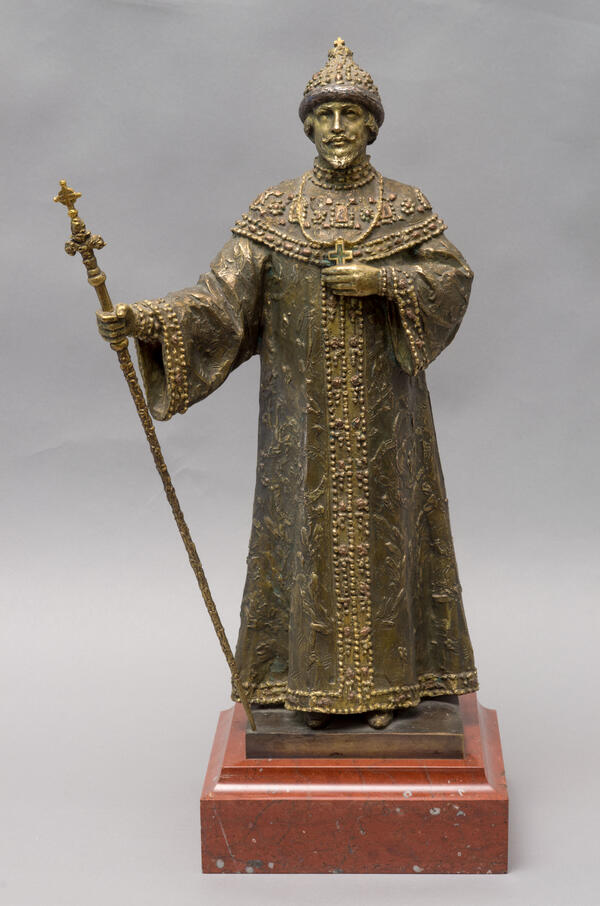
Sculpture “Mikhail Romanov”, Alexander III

0
Open in app
#1
Interior sculpture “Mikhail Romanov”
#2
In 1613, the Zemsky Sobor (Assembly of the Land) elected to the Moscow throne a representative of an ancient boyar family, the sixteen-year-old Mikhail Fyodorovich Romanov, who became the founder of a new dynasty. His accession marked the end of the Time of Troubles and opened a new page in the history of the Russian state.

Three centuries later, on February 21, 1913, Russia celebrated lavishly the anniversary of the Imperial House. The momentous event was marked by a number of magnificent ceremonies, embodied in all kinds of art, including visual arts and, in particular, sculpture.

The sculptural portrait of Tsar Mikhail Fyodorovich (1596–1645) is one of the works of art created to commemorate the 300th anniversary of the House of Romanov. The creator of the sculpture, Léopold Bernhard Bernstamm, was an outstanding portrait sculptor, who produced more than 250 images of Russian and European writers, musicians, and academics. His best works include busts of the writer Leo Tolstoy, the pianist and composer Anton Rubinstein, who was credited with opening the first Russian conservatory, the French novelist Gustave Flaubert, the composer Jules Massenet, and numerous monuments to Peter the Great.

The sculptor presented Tsar Mikhail Fyodorovich full-length, in ceremonial attire — wearing the ancient Monomakh’s cap, a royal cloak made of expensive fabrics, and with a royal staff in his right hand. This is not Bernstamm’s first work at the imperial court. Despite the fact that from 1885 the sculptor lived permanently in France, in early 1896, he was graciously received at court in Tsarskoe Selo. During that visit he made portraits of members of the imperial family and marble busts of Nicholas II and Empress Alexandra Fyodorovna that later served as prototypes for their sculpted images. In 1911, on the occasion of the centenary of the Tsarskoe Selo Lyceum, Bernshtamm created a monument to the outstanding graduate of the Lyceum, the great Russian poet Alexander Sergeyevich Pushkin.
#3
Наименование: Interior sculpture “Mikhail Fyodorovich Romanov”
Автор: Léopold Bernstamm
Дата создания: 1913
Место создания: St. Petersburg, Russia
Техника: bronze, marble; casting, embossing, patination
Размеры: 56×30×25 cm

#4
Portrait of Emperor Alexander III
#5
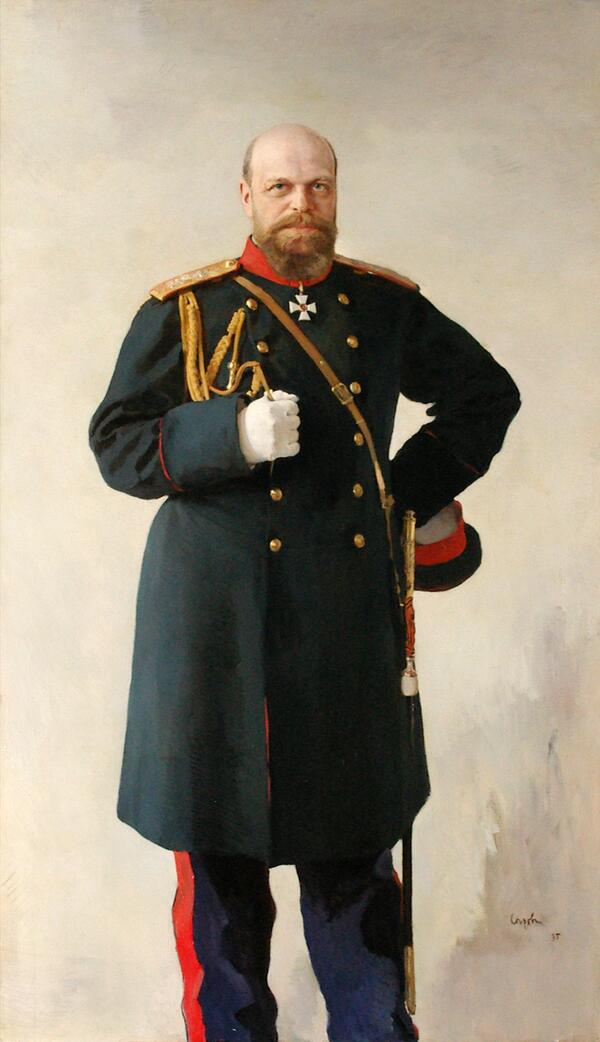
Portrait of Emperor Alexander III is a posthumous portrait of the sovereign created in 1895 by the Russian painter, graphic artist, and portraitist Valentin Serov. The portrait was commissioned by the Emperor’s brother, the governor-general of Moscow, Grand Duke Sergei Alexandrovich.

This was not the first such commission for Serov. In 1892, together with the artist Konstantin Korovin, he won a competition to paint a portrait of the family of Emperor Alexander III in memory of his lucky escape in a railway crash on October 17, 1888 near the Borki railway station. The portrait was commissioned by Kharkov nobility. His first group portrait “Alexander III and his family” took nearly two years to paint, and the six figures were almost life-size. This was followed by new commissions for portraits of members of the imperial family.

The artist’s visual memory, his experience of previous work on the family portrait, and photographs by Sergey Levitsky taken in 1883 helped him in creating this posthumous portrait. Levitsky was one of the first court photographers to have the right to photograph Alexander III.

Serov painted a powerful figure of the Tsar in a dark general’s tunic by the light wall. His fist in a white glove, forcibly clutching the axelbant cord, stands out against the background of the uniform. The hard stare of his gray eyes from beneath his high forehead is unwavering. The emperor looks cramped in the framework of the canvas. One gets the feeling that the sovereign is still ruling over Russia.

In 1895, the portrait was finished and handed over to the customer. The Grand Duke placed his brother’s portrait in the Kremlin. However, after the tragic death of Sergei Alexandrovich on February 4, 1905, his widow Elizaveta Feodorovna gave the portrait to Alexander III’s son, Emperor Nicholas II.

As the German invasion of Russia broke out in 1941, the portrait was evacuated to be returned after the war to the town of Pushkin (Tsarskoe Selo). For many years the portrait was kept first in the Central Storage Facility of Museum Collections, and then in the collection of the Pavlovsk Palace Museum. And it was only in 2010, on the occasion of the 300th anniversary of Tsarskoe Selo, that the portrait of Emperor Alexander III was returned to its original place in the State Study of the Alexander Palace.
#6
Наименование: Portrait of Emperor Alexander III
Автор: Valentin Serov
Дата создания: 1895
Место создания: Russia
Техника: canvas, oil
Размеры: 195×113 cm
#7
read morehide
00:00
00:00
1x

Sculpture “Mikhail Romanov”, Alexander III

0
Point your smartphone camera to open in the app
Share
VkontakteOdnoklassnikiTelegram
Share on my website
Copy linkCopied
Copy
Open in app
To see AR mode in action:
  1. Install ARTEFACT app for 
  2. iOS or Android;
  3. Find and download the «Paintings in Details» exhibition
  4. Push the «Augmented reality» button and point your phone's camera at the painting;
  5. Watch what happens on your phone screen whilst you flip through the pictures.
 
We use Cookies
Cookies on the Artefact Website. We use cookies to ensure that we give you the best experience on our website. If you continue without changing your settings, we'll assume that you are happy to receive all cookies on the Artefact website. However, if you would like to, you can change your cookie settings at any time.
Learn more about cookie useHide
Content is available only in Russian

X

Нашли опечатку?...

%title%%type%