Font
Color
Graphics
Изображение точки

To see AR mode in action:

1. Install ARTEFACT app for iOS or Android;

2. Find the exhibition «Natural History Museum of Tatarstan»

3. Push the «Augmented reality» button and point your phone's camera at the exhibit;

Скрыть точки интересаПоказать точки интереса
Показать в высоком качестве
#1
Chelyabinsk meteorite
#2
On February 15, 2013, residents of Kurgan, Tyumen, Sverdlovsk, and Chelyabinsk regions could observe the rapid fall of the bright superbolide — a large asteroid. Upon entering the dense layers of the Earth’s atmosphere, its diameter was about 17-20 meters, and its weight reached 7-13 thousand tons. At the altitude of 20-30 kilometers, the celestial body disintegrated with a series of explosions, similar to those observed by eyewitnesses of the Tunguska event. Because of these explosions, some buildings in Chelyabinsk were destroyed or damaged, and about 2,000 people were injured.

Some fragments, upon reaching the ground, fell like a meteor shower. The largest of them fell into Lake Chebarkul, 70 kilometers from Chelyabinsk and broke the ice creating an 8-meter-wide airhole. On October 16, 2013, a 540 kilograms fragment was lifted from the bottom of the lake. In total, more than 650 kilograms of fragments of the meteorite were found in the lake. Initially, people wanted to name the meteorite after Lake Chebarkul, but in the end, it entered the International Catalogue of Meteorites under the name Chelyabinsk.

The Chelyabinsk meteorite belongs to the class of the ordinary chondrites, stony celestial bodies that make up 87% of all such finds on our planet. According to the results of the preliminary analysis, its approximate age was established to be about 4 billion years. It is likely that the meteorite was a part of some larger body, for instance, a minor planet.

Estimates of the composition of the Chelyabinsk meteorite indicate about 10% of iron, as well as magnetic pyrite and olivine. There are also inclusions of glass in its composition: they were probably formed from silicate compounds under the influence of high temperatures when the superbolide entered the Earth’s atmosphere.

The largest fragment of the Chelyabinsk meteorite, which weighed more than 500 kilograms, is exhibited in the Nature and Ancient History Hall of the State Museum of the South Ural History. Smaller fragments are displayed in other Russian museums, including the Natural History Museum of the Republic of Tatarstan. Parts of the fragments were used to manufacture souvenir medals awarded to the President of the International Olympic Committee and to ten champions of the 2014 Winter Olympics in Sochi.
#9
Полное наименование: Chelyabinsk meteorite
Размеры: 3,5×2,7×2 cm
Коллекция: Natural History Museum of Tatarstan
Правообладатель изображений: Natural History Museum of Tatarstan
#3
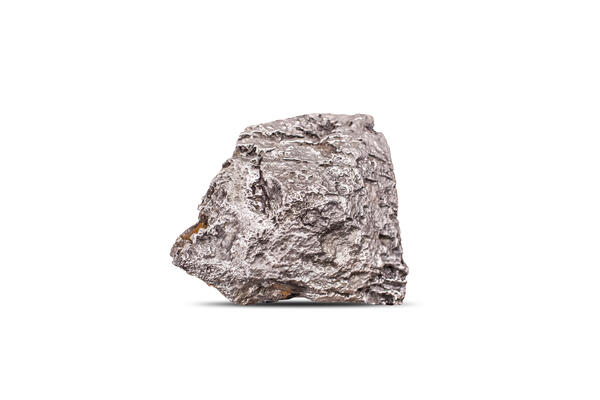
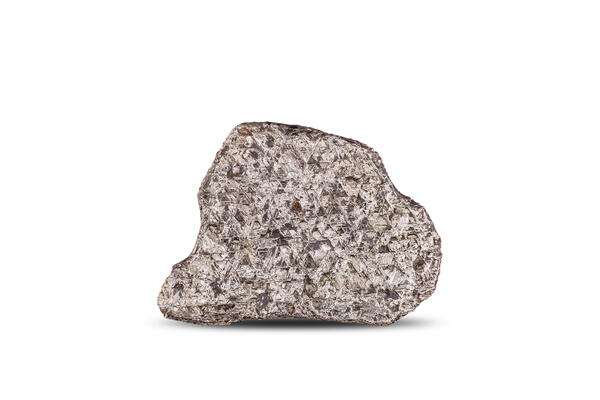
Muonionalusta meteorite
#4
The Muonionalusta meteorite is the oldest meteorite that is known to modern science. It is more than 4 billion years old and it fell 15,000 to 800,000 years ago. The numerous fragments of the bolide shattered over an area of about 400 square kilometers.

The first fragments of this meteorite were discovered in 1906, near the Sweden-Finland border. It was named after the Muonio River, which flows in this area. In 1909, Gustaf Högbom, professor of geology and mineralogy at Uppsala University, was the first to analyze the meteorite samples and determine that it is an octahedrite. Octahedrites are iron celestial objects, which contain between 6% to 13% nickel. Probably Muonionalusta used to be part of the core of a small planet. In total, scientists found more than 20 tons of its fragments on the banks of the Muonio River.

The iron-nickel alloy in the composition of this meteorite occurs in two forms — taenite and kamacite. Their crystals grew and gradually penetrated each other, thereby the so-called Widmanstätten figures appeared — a typical geometric pattern of straight lines and intertwined triangles. Usually, in meteorite fragments, such a pattern is visible on the cuts, but in the Muonionalusta they are visible even on the surface.

This meteorite is composed of 90% iron and 8.4% nickel. The rest is made up of iridium, gallium, and germanium. In addition, stishovite was discovered in Muonionalusta. Stishovite a type of silicon oxide, which is often found in stone meteorites. Thus, it was found for the first time in an iron meteorite.

Iron meteorites, which include Muonionalusta, rarely fall on Earth: they make up only 5-6% of all such celestial objects. Most often stone meteorites fall. In their composition, they resemble the Earth’s crust. Scientists believe that in total about 6 tons of such bodies per day or 2 thousand tons per year fall on Earth. But not all of them can be found: some of them sink into the oceans, while others end up in uninhabited deserts, forests, or arctic zones.

When meteorites enter the atmosphere, they begin to glow brightly. From the ground, it looks like a star is moving across the sky. This phenomenon is called a meteor shower.
#10
Полное наименование: Muonionalusta meteorite
Размеры: 3,5×2,7×2 cm
Коллекция: Natural History Museum of Tatarstan
Правообладатель изображений: Natural History Museum of Tatarstan
#5
Dronino meteorite
#6
This iron meteorite was named after the village of Dronino in the Ryazan Oblast, where its fragments were discovered. The Dronino meteorite may be one of the most ancient meteorites discovered in Russia. It fell near the town of Kasimov, which was founded in 1152 by Prince Yuri Dolgorukiy. The celestial object left a 30-meter-wide crater in the ground. Such an event near a large town could not go unnoticed. However, no known letopis (Russian chronicle) mentioned it. That is why scientists suggested that the meteorite fell much earlier than the 12th century when people had not yet lived in this area.

The Dronino meteorite is classified as an ataxite. Ataxites are relatively rare celestial objects, which contain up to 13% of nickel. They do not have the so-called Widmanstätten patterns, the characteristic geometric patterns on their surface.

Muscovite Oleg Guskov discovered the first fragment of the Dronino meteorite in the summer of 2000. He went into the forest to collect mushrooms and found a rusty piece of metal which weighed about 40 kilograms. Guskov gave a fragment of it for analysis to the laboratory of Meteoritics at the Vernadsky Institute of Geochemistry and Analytical Chemistry. There, scientists established that the metal truly was a meteorite.

In the spring of 2003, a scientific expedition with metal detectors set off near the village of Dronino. The researchers managed to find several thousand meteorite fragments; their total mass was about three tons. The largest of them weighed between 250 and 300 kilograms.

Up to 500 meteorites of various sizes fall to Earth annually, but only 10-15 of them could be discovered. The majority of them fall into the oceans or in the areas people do not live in — the deserts, tundra, impenetrable forests.
In terms of composition, meteorites are classified into stone, iron, or mixed. Stone meteorites are discovered most often; their structure resembles the Earth’s crust, while the iron ones probably used to be fragments of nuclei of minor planets. It is a tradition to name meteorites after the place where they were found or after the nearest settlement.

The most famous meteorite which fell on the territory of Russia is the Sikhote-Alin meteorite. It fell in the Ussuri taiga on February 12, 1947. More than six thousand of its fragments with a total weight of about 100 tons were found over an area of 35 square kilometers.
#11
Полное наименование: Dronino meteorite
Размеры: 10,5×10,5×6 cm
Коллекция: Natural History Museum of Tatarstan
Правообладатель изображений: Natural History Museum of Tatarstan
#7
read morehide
00:00
00:00
1x
Point your smartphone camera to open in the app
Share
VkontakteOdnoklassnikiTelegram
Share on my website
Copy linkCopied
Copy
Open in app
To see AR mode in action:
  1. Install ARTEFACT app for 
  2. iOS or Android;
  3. Find and download the «Paintings in Details» exhibition
  4. Push the «Augmented reality» button and point your phone's camera at the painting;
  5. Watch what happens on your phone screen whilst you flip through the pictures.
 
We use Cookies
Cookies on the Artefact Website. We use cookies to ensure that we give you the best experience on our website. If you continue without changing your settings, we'll assume that you are happy to receive all cookies on the Artefact website. However, if you would like to, you can change your cookie settings at any time.
Learn more about cookie useHide
Content is available only in Russian

X

Нашли опечатку?...

%title%%type%