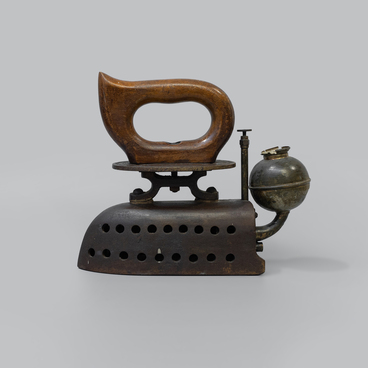
The manual coffee grinder from the Nizhny Lomov Museum of Local Lore was made in the 19th century. It has a small metal body and a rotating handle at the top. The compartment for ground coffee may have had a small drawer. The body was made of cast iron.
When coffee culture was just starting to develop, coffee beans were not ground before brewing. Later, people started using a mortar and a pestle to crush the beans. These devices were used not only for spices and cereals but also for coffee beans. For example, the Bedouins ground coffee beans with a mortar. This process was quite laborious and was therefore only undertaken by men.
The first manual coffee grinders emerged in the 15th century. Coffee beans were poured into hollow cylinders. Most often, they were made of wood. Inside, there were two abrasive elements between which the coffee beans were crushed. The elements were set in motion by rotating a handle at the top. Coffee beans began to be supplied to Europe in the 16th century. After that, coffee culture gradually began to spread. Even Pope Clement VIII gave his blessing to this drink in 1600. The first European coffeehouse opened in Venice in 1645.
In Russia, coffee was first mentioned in written documents in 1665, when a court doctor prescribed it as medicine for Tsar Alexis. Emperor Peter the Great became fond of coffee during his Grand Embassy in Holland. Nevertheless, it took some time for the first coffeehouse to appear in Russia. It opened only in 1740, during the rule of Anna Ioannovna, nearly a century after the first coffeehouse appeared in England.
The first European coffee grinders were inspired by Turkish devices. Due to their cubical shape, they were not very convenient to use. The devices were difficult to hold in hands and had to be fixed to a solid surface.
During Soviet times, the most popular coffee grinder was a square box with a rotating handle at the top and a drawer for storing the ground coffee. This type of design also became common in Europe.