Font
Color
Graphics
Изображение точки

To see AR mode in action:

1. Install ARTEFACT app for iOS or Android;

2. Find the exhibition «The Voronezh Region in the Great Patriotic War»

3. Push the «Augmented reality» button and point your phone's camera at the exhibit;

Скрыть точки интересаПоказать точки интереса
Показать в высоком качестве

Medallion, RGD-33, Soldier’s bag, Mosin’s rifle

1
Open in app
#1
Soldier’s death medallion
#3
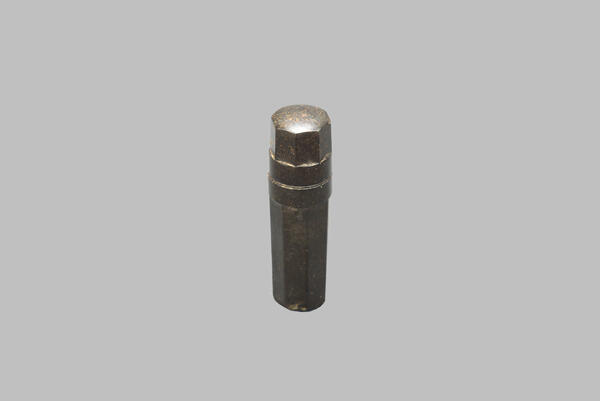
The death medallion in the Red Army was introduced by Order No. 856 of the Revolutionary Military Council from August 14, 1925. It was part of supplied equipment and in case of loss was replaced with a new one. The medallion was a rectangular case made of galvanized tin with an eye for a cord. Inside there was an insert made of paper (parchment or newsprint) — a form with the soldier’s personal information. Such a medallion was not sealed, and therefore the insert quickly became damaged.

The People’s Commissariat of Defense of the USSR by Order No. 138 from March 15, 1941 adopted the “Decree on personal accounting of losses and burials of the deceased Red Army personnel in wartime”. With it, new medallions in the form of a black ebonite (textolite) pencil case were introduced; they held an insert on parchment paper in two copies. The 40 by 180 mm insert consisted of two identical forms, one of which was to be withdrawn by the team that conducted the burial, and the other was to remain in the medallion with the body of the deceased fighter. The insert, intended for servicemen of the border guards’ units of the NKVD troops, had a slightly larger size — 53 by 280 mm — and a vertical green 5-millimeter-wide stripe along its entire length. The inserts removed from the medallions were used to establish the names of the dead and of those who remained on the battlefield, and to compile lists of losses. But in reality, in the difficult war conditions, this requirement was not fulfilled and the entire medallion was taken. In addition, Red Army soldiers were often given only one copy of the insert due to shortages. The form contained all the necessary information about the fighter. The medallion was quite airtight when closed with a tight twist. There was a special pocket on the waistband of the trousers, into which the capsule was sewn, as it was prescribed in the regulations.

Handmade medallions were most often made from a rifle cartridge plugged with an inverted bullet. Wooden and metal homemade pencil cases are sometimes found by archaeologists and search groups. The soldiers also used a wooden case from an anti-fog pencil, which was part of a gas mask bag. Notes in such medallions were usually also made by hand, although some had official forms in them.

In November 1942, by order No. 376 of the People’s Commissariat of Defense of the USSR “On the removal of medallions from the equipment of the Red Army”, the medallions were discontinued. Most likely, it was decided not to duplicate the information from the Red Army identification book, introduced in November 1941, and rely only on it.
#2
Name: Soldier’s death medallion
Date of creation: 1925
Place of creation: the USSR
#4
RGD-33 hand grenade
#6
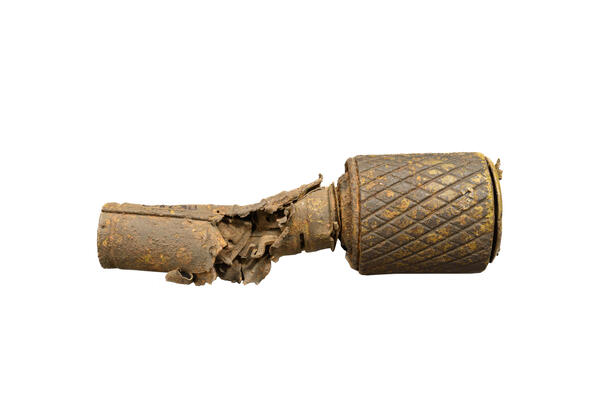
During the Russian Civil War and thereafter, Red Army soldiers carried the Rdultovsky offensive grenade, known as the model 1914 grenade. It weighed only 700 grams and its shape was similar to a bottle which was convenient. It also featured a fairly reliable safety mechanism and was quite powerful. In 1930, the grenade was modernized and became widely used by Red Army units at the initial stage of World War II.

In 1933, the Soviet designer Mikhail Dyakonov invented the RGD-33 offensive (high-explosive) and defensive (fragmentation) grenade. This grenade had much in common in shape and design with the model 1914/1930, however, it was more powerful and its manufacturing processes were much more advanced. Its distinctive feature was the presence of a defensive sleeve (“a jacket”). The sleeve was fitted over the grenade for throwing it from sheltered positions, which increased the radius of dispersed fragments from 25 meters to 100 meters, and their effective kill radius — from 5 meters to 25 meters. When the grenade with the “jacket” exploded, up to 2,400 fragments were formed.

The RGD-33 grenade had a tin body in which the explosive charge was placed. The handle was manufactured and stored separately. Inside it had an assembled trigger mechanism that ignited the fuse. The fuse was stored separately. When grenades were to be given to soldiers, the handle was screwed onto the body.

When the handle was screwed onto the central tube of the grenade body, the inner tube of the handle was attached to it in such a way that the handle was fixed (a locking mechanism did not allow the handle to unscrew). The outer tube of the handle could be pulled back and rotated to the right and left. It was fastened to the inner tube only by a locking spring and a bracket that slid along the grooves of the inner tube.

The assembled grenade was kept in a grenade pouch. The fuse was stored separately in a box. The percussion fuse was ignited only if the grenade was thrown. If a loaded and ready for throwing grenade accidentally fell out of a soldier’s hands, it did not detonate (even if the safety pin was pushed aside). It could be picked up and thrown again. Hence, it was convenient and safe to use.

Several million RGD-33 grenades were manufactured and used at the initial stage of the war. To destroy tanks, three or five grenades were tied together with twine or wire so that the handle of the grenade in the center was pointed in one direction, and the two other handles — in the opposite direction.
#5
Name: RGD-33 hand grenade
Author: Mikhail Dyakonov
Date of creation: 1933
Place of creation: the USSR
Dimensions: 20×7×6 cm
#7
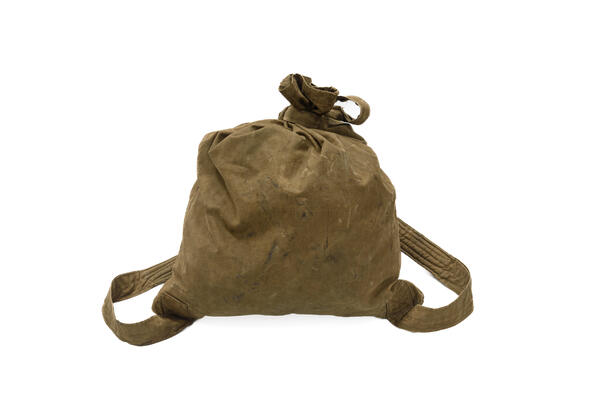
Soldier’s duffel bag
#9
The duffel bag has been popular for a long time. It was widely used by people of various professions and occupations to carry a variety of belongings. The simplest materials were used for a hand-made duffel bag: any bag suitable in size and a rope (a belt or a drawstring) about 1.5 m in length.

Small round objects (potatoes or small stones) were placed in the corners of the bag, after which the ends of the rope were tied to the corners (the objects placed in the corners prevented the rope loops from falling off the corners). The bag was filled with various things, after which a loop was made from the middle of the rope and the bag could be closed at the top.

During the Russo-Turkish War of 1877–1878, calf leather satchels (modeled after Western analogs) which were used by soldiers turned out to be heavy and uncomfortable, so many military units replaced them with bags made of waterproof sailcloth.

In 1882, in the Russian Imperial Army, a “duffel and food bag” made of sailcloth was officially adopted for storing and transporting (carrying) the property of a serviceman instead of a satchel. In 1889, bags were abolished in the Guards infantry, foot artillery and engineer troops, and in return, satchels of the 1874 model were reintroduced; grenadier and army infantry soldiers used duffel bags and new boot covers.

The pre-revolutionary duffel bag remained practically unchanged and was used in the Soviet Red Army from 1918 until the 1950s, after which it was slightly modernized. A large outer pocket was sewn on the back of the bag, designed for small things and personal hygiene items, in the lower part there was a small flat pocket for an identification plate (indicating the owner of the bag), and canvas straps were on the sides to tie a rolled-up greatcoat to the bag. This design of the duffel bag has been in use until our time.

The Soviet army duffel bag was made of durable cotton fabric treated with a waterproofing agent for tents. The straps for hanging additional things onto it were made of tarpaulin, the buckles were made of aluminum alloy.

The duffel bag consists of the bag itself with an outer pocket sewn onto it, and a wide strap attached to the bag, four pairs of short straps for attaching external load and an additional chest belt for fixing straps when walking. At the top, the bag can be closed with a drawstring.
#8
Name: Soldier’s duffel bag
Date of creation: the 1930s
Place of creation: the USSR
Dimensions: 60×45 cm
#10
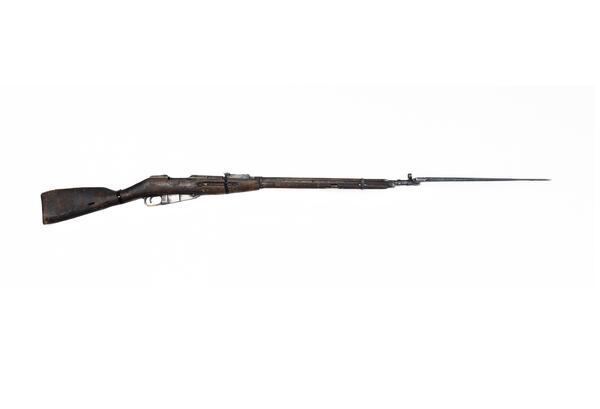
Mosin’s rifle
#12
The rifle presented in the exhibition was designed by Captain of the Russian army Sergei Ivanovich Mosin.

In 1883, Mosin designed his first magazine-fed rifles. He improved the Berdan rifle by attaching an eight-round magazine to it. On April 16, 1891, a prototype of a “repeating” rifle with a fixed magazine of the three-line-caliber was approved (a line is an obsolete unit of measurement, three lines are equal to 7.62 millimeters). Its complete cycle of operation included four steps. It was mainly based on Mosin’s design and designated as the “3-line rifle of the 1891 model.”

In addition to the standard rifle intended for infantry soldiers, variants for Dragoon and Cossack units were also produced — those had a shorter barrel. In 1907, a carbine version was put into production. This type was used by soldiers of special forces and auxiliary units.

The 7.62mm rifle of the 1891 model is a magazine-fed rifle with a rotating bolt that uses symmetrical locking lugs on the bolt head.

The rifle was modernized for the first time in 1910 as the Russian army had adopted in 1908 a new 7.62mm cartridge with a pointed bullet that had improved ballistics. The modernization consisted mainly in the introduction of a new sight mount.

In 1930, the Dragoon rifle underwent a more thorough redevelopment. In 1922, it became the main weapon of the Red Army’s rifle units. New iron sights with crosshairs were fitted on it, the design of the front sight was changed and new snap rings were introduced to attach the barrel to the buttstock in a more reliable way. The way of fixing the spike bayonet was also changed. This rifle was put into mass production and was in service with the Red Army prior to and during the Second World War.

Before the war, large batches of 7.62mm rifles of the 1891/1930 model were sent to the Second Spanish Republic. 500,000 rifles and 862 million rounds of ammunition were delivered as well. Even more rifles were sent to China.

The 1891/30 model was distinguished by high reliability, accuracy, simplicity and ease of operation. It consisted of only 42 parts compared to 70 or more in other rifles, which facilitated its mass production. In total, more than 12 million rifles of the 1891/1930 model and carbines developed from this model were manufactured during the war years.
#11
Name: Mosin’s rifle
Author: Sergei Mosin
Date of creation: 1891
Place of creation: the USSR
Dimensions: 173,8×11×4,5 cm, caliber — 7.62 mm
#13
read morehide
00:00
00:00
1x

Medallion, RGD-33, Soldier’s bag, Mosin’s rifle

1
Point your smartphone camera to open in the app
Share
VkontakteOdnoklassnikiTelegram
Share on my website
Copy linkCopied
Copy
Open in app
To see AR mode in action:
  1. Install ARTEFACT app for 
  2. iOS or Android;
  3. Find and download the «Paintings in Details» exhibition
  4. Push the «Augmented reality» button and point your phone's camera at the painting;
  5. Watch what happens on your phone screen whilst you flip through the pictures.
 
We use Cookies
Cookies on the Artefact Website. We use cookies to ensure that we give you the best experience on our website. If you continue without changing your settings, we'll assume that you are happy to receive all cookies on the Artefact website. However, if you would like to, you can change your cookie settings at any time.
Learn more about useHide
Content is available only in Russian

X

Нашли опечатку?...

%title%%type%