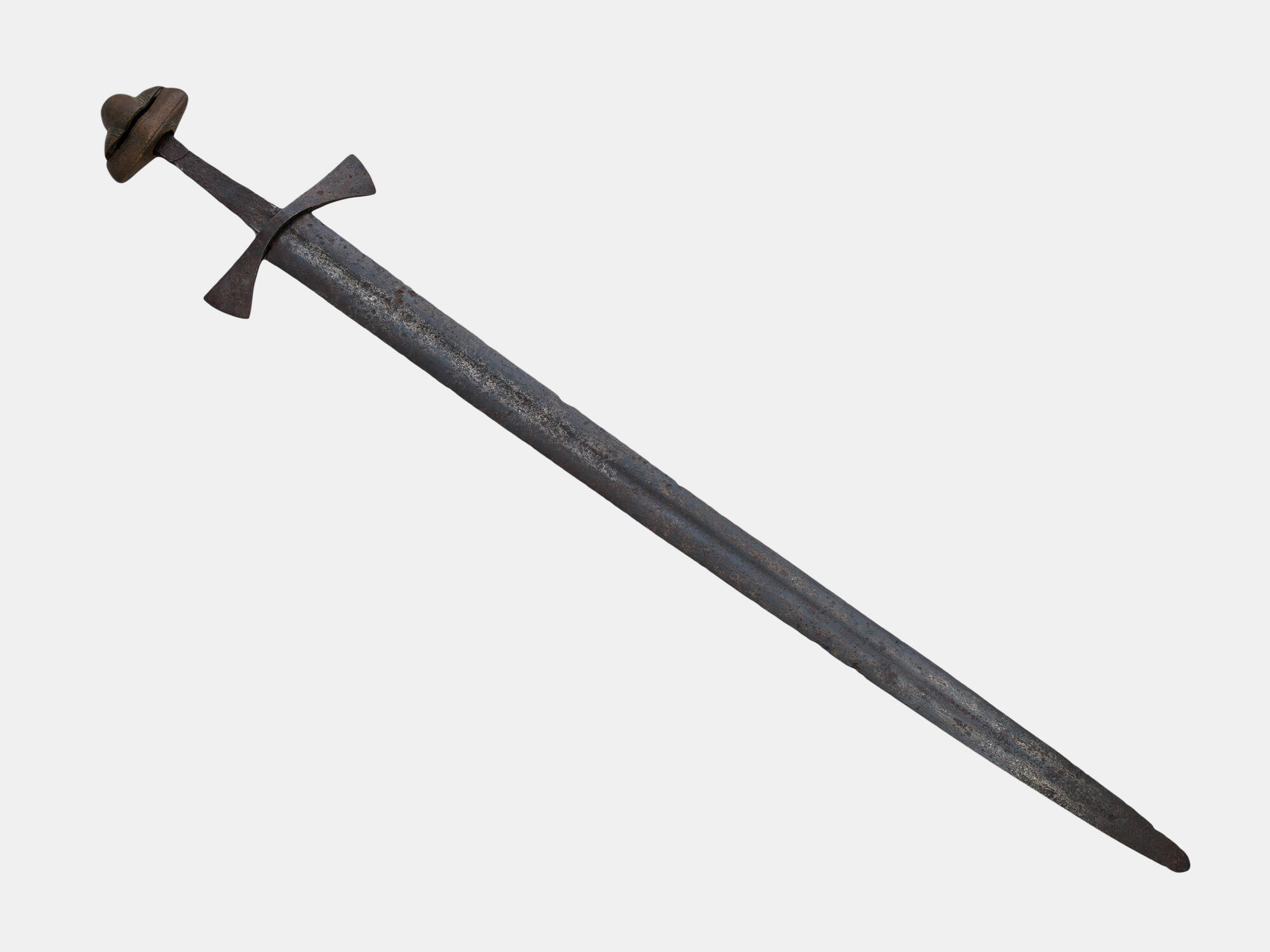


The exhibition presents an iron sword with a straight double-edged blade. The ends of the cross-guard are turned downwards, the hilt is made of iron, and the pommel is bronze. The rim of the hilt and the scabbard have not been preserved. The sword was discovered by chance near the village of Vozdvizhenskoye, Tonshayevskaya Volost, Kostroma Governorate.
In the broadest sense, the term “sword” means any long weapon with a straight blade.
Modern Russian military historians use a narrower definition of a sword: it is an offensive weapon with a double-edged straight blade with a length of more than 60 centimeters, designed primarily for cutting. The sword could be used for both offense and defense by a professional warrior, often from a noble family.
Swordsmanship required years of practice and special physical training. In addition, the sword as an expensive and prestigious weapon was a symbol of high social status. A distinctive feature of a sword is its versatility.
In the High Middle Ages (the 11th–14th centuries), when cities and crafts were growing, the level of blacksmithing and metallurgy increased. That time was marked by Crusades and wars. The role of cavalry increased and armor became more widespread. Jousting tournaments, duels and buhurts (jousting tournaments during which two groups of knights armed with blunted weapons fought against each other) were extremely popular. Battles often took place in confined spaces (castles, houses, and narrow streets). All this had an influence on sword designs.
Swords of this period are commonly called
Romanesque, or knightly. In appearance, they correspond most to the idea of the
European sword that is rooted in the mass consciousness; they are most often
depicted in medieval miniatures and represented in sculpture. Their blades are
longer, thicker and narrower; the fuller (groove on the blade) is narrow and
deep. The blade noticeably tapers, the hilt lengthens, and the pommel, on the
contrary, becomes smaller and at the same time more diverse in shape. The
cross-guard expands, providing better protection for the hand — a sign of the
developing art of fencing.


