Font
Color
Graphics
Изображение точки

To see AR mode in action:

1. Install ARTEFACT app for iOS or Android;

2. Find the exhibition «Land of the Chudes»

3. Push the «Augmented reality» button and point your phone's camera at the exhibit;

Скрыть точки интересаПоказать точки интереса
Показать в высоком качестве

Burial mask, Whip handle, Fragment of a comb

1
Open in app
#8
Burial mask
#2
The burial mask is one of the world’s first known cult works of applied arts. They were made of clay, plaster, wood, cloth, whalebone, metals and precious stones in various cultures. The burial mask of the Egyptian pharaoh Tutankhamun, made of gold, turquoise and glass paste, is an example of one of the most famous and luxurious masks in the world.

Burial masks should be distinguished from death masks: the latter were casts taken from the face of the deceased in order to preserve their appearance for posterity. There are several basic versions explaining the purpose of burial masks. They may have served to protect the appearance of the deceased so that decay would not affect his face. Furthermore, the burial mask was the barrier between the worlds of the living and the dead and prevented the soul from coming back. Lavish and elaborately crafted masks emphasized the person’s social status so that they could occupy an equally noble position in the afterlife.

Various burial masks are found in the burial sites of the Lomovatovsky culture in the Perm Territory, including, probably, those that reflect the real features of the deceased’s face. Such masks are discovered in the burials of the 9th — early 11th centuries in the Rozhdestvensky, Ogurdinsky, Bayanovsky, Redikorsky, Zaposelsky, Plyosinsky and a number of other burial sites of the pre-Ural region.

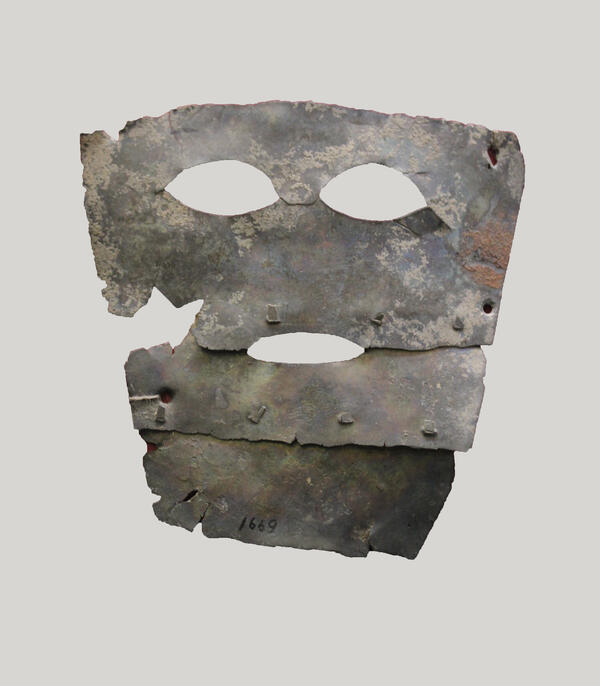
The mask from the collection of the Komi-Permyak Local History Museum consists of three thin plates with oval holes for the eyes and the mouth. The plates are attached to each other with metal rivets. The edges of the mask are rough and jagged; through holes were made in the upper corners, presumably to fasten the mask to the head of the deceased.

The mask was discovered during the excavations conducted by the Perm State University at the Plyosinsk burial ground, a monument of the Lomovatov culture in 1961. A total of five burial masks were found there, different in size, shape, manufacturing method and condition. According to the archaeologist and Doctor of Science in History Andrei Mikhailovich Belavin, such masks were used when burying the social elite. This is confirmed by the abundant grave goods found in the burials.
#9
Полное наименование: Burial mask
Дата создания: the 7th–9th centuries
Техника: сasting, forging, riveting
Размеры: 12,2×7,5 cm
#10
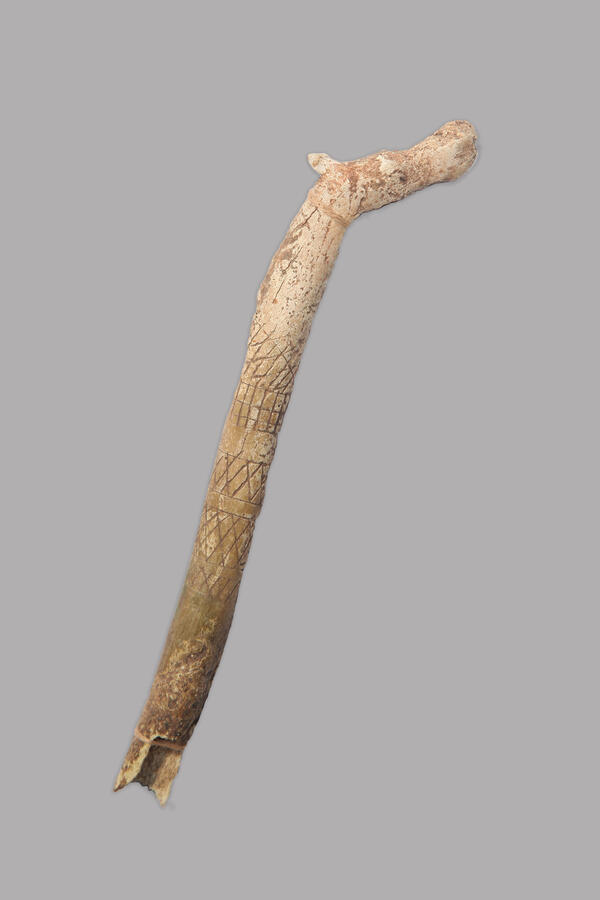
Whip handle
#4
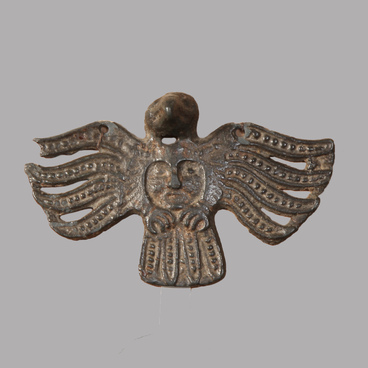
The horse is one of the most popular motifs of decorative and applied arts all over the world. The ancient population of the Kama region had a cult of the horse as early as the Ananyino culture, which is dated to the 9th–3rd centuries BC. The images of this animal are often found in the sacrificial complexes and bone beds of the Upper Kama region. This bone handle with an image of a horse’s head was found in a male burial of the Plyosinsky burial ground in the Komi-Permyak district 60 years ago.

The horse in the Finno-Ugric mythology is a sacred animal of the sun god, a symbol of light, joy, good luck and renewal of nature. The Mansi people have an old myth about how seven sons of the “White Old Man”, the supreme god Num-Torum, were at odds over ruling the Earth. The brothers began to fight each other, and the creator himself came down to the Earth to restore order. He told the sons that he who would be the first at dawn to ride up to his heavenly palace, where free horses graze, and tie his horse to the silver pole, would be the chief among them and over all people.

The youngest son of the god, the rider Mir-Susne-Hum, “the man who oversees the world”, proved to be the most agile and swift. It was he who became the patron of people and the mediator between the worlds of the living and the dead. The faithful companion of the young god, the horse, became the main sacred animal, whose images were intended to propitiate the god. As agriculture and farming developed, the significance of the horse increased even more.

In the Udmurt legends there is a radiant creature “burdo-val” — a horse that grows huge wings during the night. Its master was banned from seeing them, so he had to warn the horse of his approach by whistling. One day the man forgot to do that, and burdo-val lost his wings forever. The Komi-Permyaks believed in the legend about a warrior Pera, who ascended to the supreme deity En, the sun god, riding a mighty silver horse.

The image of a horse is often found on talismans, amulets, as well as personal items: handles, bone combs, two-horse rattle pendants. Most items were found not during archaeological excavations, but as so-called hoards or as single accidental finds, which suggests their popularity in everyday life.
#11
Полное наименование: Whip handle
Дата создания: the 7th –9th centuries
Техника: carving
Размеры: length — 17 cm
#12
Fragment of a comb
#6
Combs were an item of mass use in the Early Middle Ages. They were used to keep hair tidy and comb out parasites, as well as to serve as an auxiliary tool in spinning and weaving. Finno-Ugrians took care of their hair, so most often not only women, but also men, had personal combs.

The combs were made of wood, animal horns and mammoth ivory. Bone carvers were highly rated, and people identified the status of the comb’s owner by the complexity of the pattern on the comb. A broken comb was not usually disposed of but repaired or used in some other way. For example, chipped teeth of a comb could be carefully cut off and used as a tool to apply a pattern on earthenware in a pottery workshop. Later combs were made of copper and bronze always with a through hole to suspend them from a belt.

Combs with images of animals in the Perm animal style served as charms and amulets. Items featuring horses, moose, birds and bears are referred to as zoomorphic and are most often found in women’s and men’s burial complexes. For the deceased women, the comb was fixed in the right plait, while for men it remained on the belt.

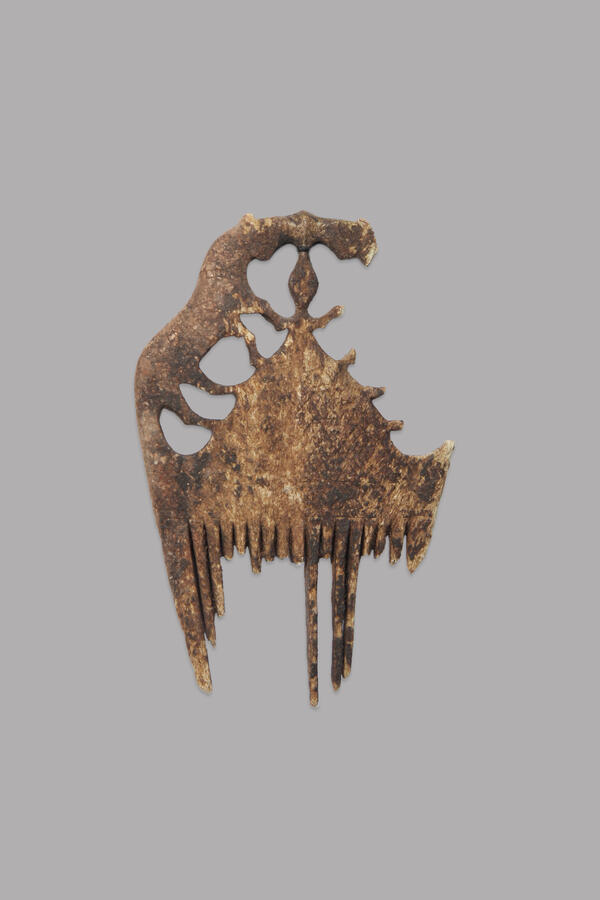
The most popular image in the decor of bone combs is a horse, hence its name —the horse comb of the Kama type. The cult of the horse for the peoples of the Great Perm was the most important one, this animal was highly valued as a protector, messenger and helper. The Mari people had the following proverbs about horses: “A horse is a man’s wings”, “A household without a horse is like a man without a head”. The motif of paired horses is common both to Slavic and Finno-Ugrian cultures, and it survived until the early 20th century in peasant bronze and copper combs, wood carvings, embroidery and house decorations.

A fragment of a comb from the collection of the Komi-Permyak Local History Museum was found 62 years ago in a man’s burial during excavations at the Plyosinsky burial ground in Perm region, a monument of the Lomovatovsky culture. The fragment is badly worn, the bone is darkened, some teeth and the top are chipped off. The comb is decorated with a figure of a schematically depicted standing horse.
#13
Полное наименование: Fragment of a comb
Дата создания: the 7th–9th centuries
Техника: bone carving
Место создания: Perm Territory, Russia
Размеры: 7×5,5 cm
#14
read morehide
00:00
00:00
1x

Burial mask, Whip handle, Fragment of a comb

1
Point your smartphone camera to open in the app
Share
VkontakteOdnoklassnikiTelegram
Share on my website
Copy linkCopied
Copy
Open in app
To see AR mode in action:
  1. Install ARTEFACT app for 
  2. iOS or Android;
  3. Find and download the «Paintings in Details» exhibition
  4. Push the «Augmented reality» button and point your phone's camera at the painting;
  5. Watch what happens on your phone screen whilst you flip through the pictures.
 
We use Cookies
Cookies on the Artefact Website. We use cookies to ensure that we give you the best experience on our website. If you continue without changing your settings, we'll assume that you are happy to receive all cookies on the Artefact website. However, if you would like to, you can change your cookie settings at any time.
Learn more about useHide
Content is available only in Russian

X

Нашли опечатку?...

%title%%type%