Font
Color
Graphics
Изображение точки

To see AR mode in action:

1. Install ARTEFACT app for iOS or Android;

2. Find the exhibition «Neighbors. The Forest Nenets people»

3. Push the «Augmented reality» button and point your phone's camera at the exhibit;

Скрыть точки интересаПоказать точки интереса
Показать в высоком качестве
#1
Oksana Ayvasedo
Malitsa
#2
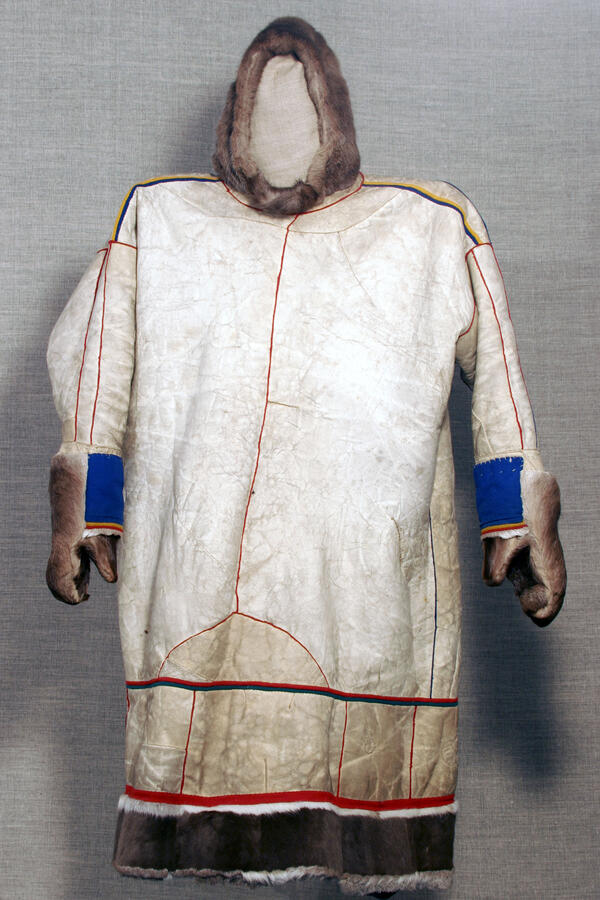
The harsh climate of the North of the Western Siberia dictates its terms to local people. One needs here warm windproof fur outfit and footwear fit for a nomadic way of life. Traditional Forest NEnets clothing is made of processed reindeer skins. Different types of clothing require skins of reindeer of different age. The Nenets use reindeer fur since old times because of its excellent thermal qualities.

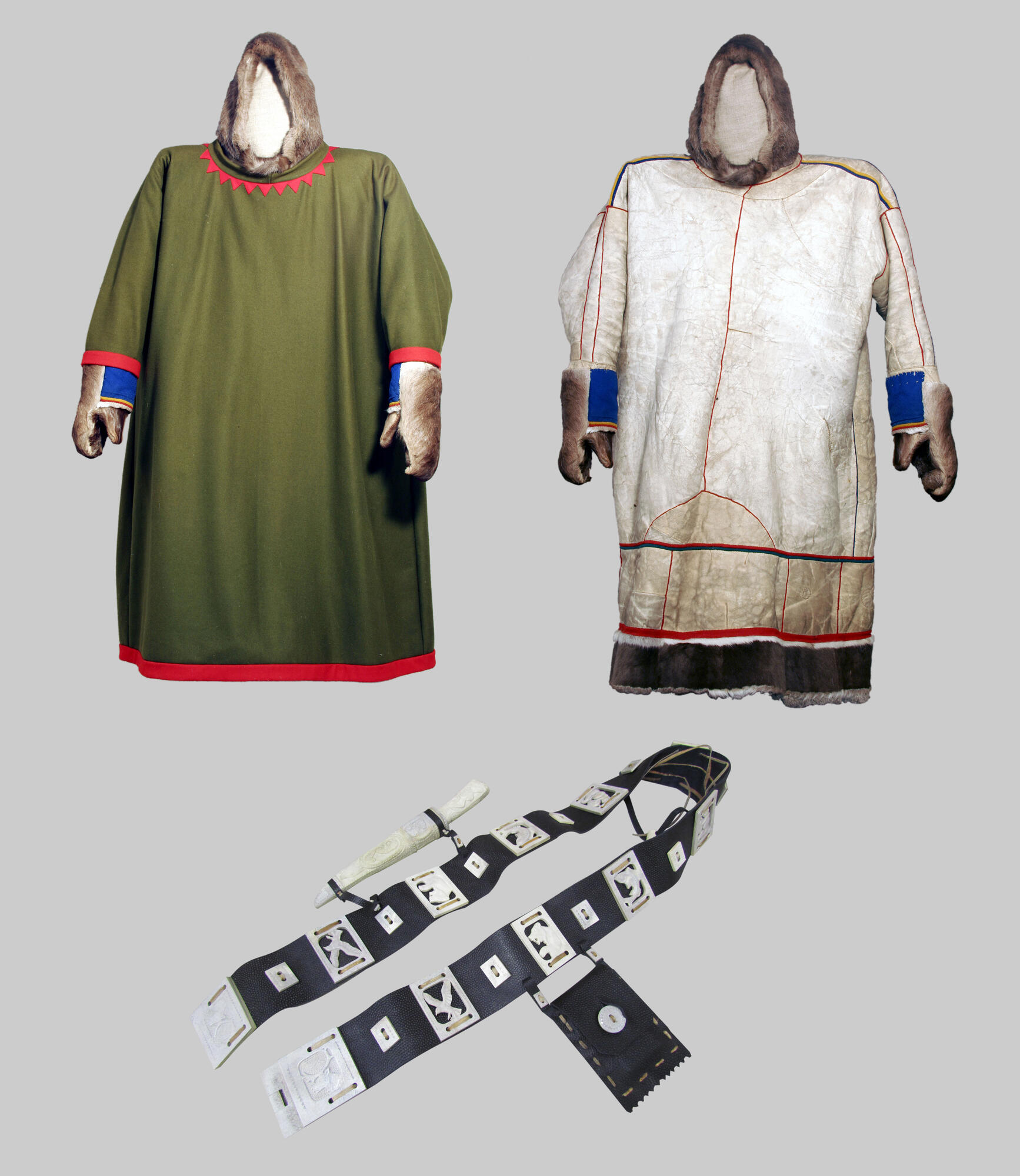
Only women are engaged in tailoring. The clothing is sewn with threads made of reindeer legs and back tendons. A winter ‘mAlitsa’ coat is a close upper garment with fur inside. The design of this coat is like of a loose knee-long shirt. Every mAlitsa has a doubled hood that serves as a hat for its owner. At the bottom, this coat is edged with a strip of dark fur about twenty centimeters wide. The edging has fur both outside and inside to make the bottom of the coat heavier. Another practical reason is that fur repels snow thus protecting the hem from moisture and prolong the life time of a mAlitsa. Above the edging, three strips of cloth of yellow, green and red color are attached as an additional decoration.

The feature of the Forest Nenets malitsa is a seam in the front. According to many researchers, it proves that earlier a male clothing was of an open type. All main seams including the central one are decorated with strips of red cloth. Mittens made of kamus – a reindeer legs skin – are sewn to the sleeves with fur out. There are slots at the wrist level, so that one could pull out the hands.

A mAlitsa is worn straight on the body. Adjacent to a body, long and hollow reindeer piles create a special microclimate and keep warmth. Fur also absorbs excessive moisture as it touches the skin. Its main upper part always stays clean and keeps preserving warmth.

The fur malitsa in the museum exposition was made by Oksana Ayvasedo, a Khanymey village resident.
#3
Full name: Male winter coat ‘malitsa’
Author: Oksana Pachepovna Ayvasedo
Date: the 2nd half of the 20th century
Technique: handmade
Place: Khanymey village
Dimensions: 130×112×65 cm
Collection: Ethnography, the Forest Nenets people
Copyright: Gubkinsky Museum of the Development of the North
Goskatalog Number: GMOS OF-292/2
#4
Khovku Pyak
Malitsa overshirt
#5
A mAlitsa, a done up male coat made of processed reindeer hides with fur in, is the most well-known item of the NEnets clothing. This coat helps surviving the severest frosts. A malitsa is worn straight on the body. Adjacent to a body, long and hollow reindeer piles create a special microclimate and keep warmth. Fur also absorbs excessive moisture as it touches the skin. A mAlitsa coat is worn with a composed belt made of reindeer leather with a knife in a scabbard, a grindstone in a special poach, an awl and small bone harness details attached to the belt.

For a long time, many NEnets put a cloth shirt over a mAlitsa coat to protect it from dampness, dirt and sunrays. It has the same design as a mAlitsa. The front and the back parts are cut out of a solid piece of cloth, they get a bit wider at the bottom, the front part is somewhat shorter, the sleeves are wider at the shoulders. The overshirt doesn’t have a hood, men put on a doubled mAlitsa hood if necessary.

To make a mAlitsa overshirt, the Forest NEnets use cloth of traditional colors – blue, green or red. Neck, cuff and lap parts are decorated with a contrasting ornament. Cloth patterns technique is the same as of fur ornaments. Two contrasting pieces equal in shape mirror each other and are sewn together with fine whip stitches. Additionally, they use applique, sewing a contrasting ornament over the cloth of a basic color.

Each color of the clothing has its meaning by the Forest Nenets. For instance, green is the color of grass, spring and summer, red means fire, warmth or blood, the beginning of life. Those who wear clothes ornamented with red strips carry fire, warmth and light with them.

A malitsa overshirt in the museum exposition was provided by Khovku Pyak, a Dyanki-Koy camp resident. It is made of traditional green cloth decorated with red ornament. A contrasting strip is sewn to the cuffs and the lap, the neck has a triangular ornament.
#6
Full name: Malitsa overshirt
Author: Khovku Ilmovich Pyak
Date: the 2nd half of the 20th century
Technique: handmade
Place: Dyanki-Koy camp
Dimensions: 130×65×112 cm
Collection: Ethnography, the Forest Nenets people
Copyright: Gubkinsky Museum of the Development of the North
#7
Sergey Ledkov
Male belt
#8
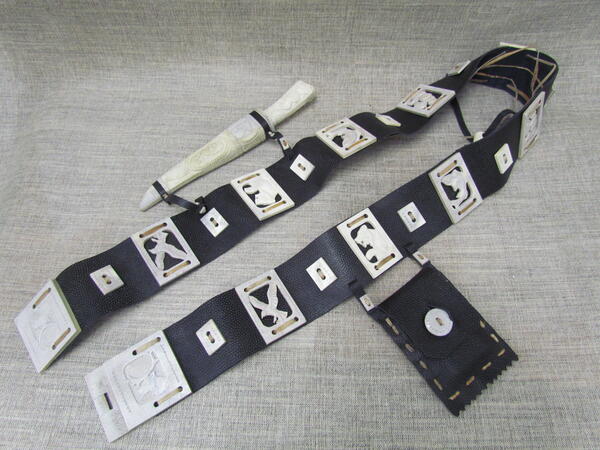
Any time of the year, a belt tied up around the waist over a mAlitsa, a winter coat made of processed reindeer pelts, is the main part of a man’s outfit. The base of a belt is made of raw reindeer skin and decorated with copper or carved bone plates, variously shaped overlays or buttons. There’s nothing redundant on the belt, only the most necessary items are attached to it.

On the right side, a knife with a scabbard is tied up by a chain or a leather strap. It is the key item by any NEnets, boys learn how to handle it at the early age. The knife is needed to cut a reindeer carcass, to make a sledge and surely it is used as a piece of cutlery. It is placed on the right because a man gets on a sledge from the left side. A grindstone in a smart leather case is attached to the left of the belt; amulets like reindeer antlers, animal fangs, paws or claws, bullet casings hang in the middle. A bear’s fang is considered to be the strongest amulet. The Forest NEnets believe it brings luck at hunting and protects its owner from evil spirits.

Setting off for hunting, a man can also tie up to his belt some other tools: an awl, a plane for round details, wood sticks with notches. The latter serve as some kind of a notebook. An awl is used to adjust the harness, it’s impossible to untie the belt knots without it especially when it is rainy or frosty.

There’s a heavy copper or bone buckle with a carved pattern fastening a belt in the front. Men pride themselves upon these buckles and like showing them off. Overlaid belt decorations are placed on the outer side and attached with leather straps.

Gubkinsky Museum of the Development of the North shows a male belt with all decorative elements including the buckle, the scabbard and the handle of the knife made of reindeer antlers. The belt was provided by a craftsman Sergey Ledkov.
#9
Full name: Male belt
Author: Sergey Vasilievich Ledkov
Date: the beginning of the 21st century
Technique: handmade
Dimensions: 123×6×0,4 cm
Collection: Ethnography, the Forest Nenets people
Copyright: Gubkinsky Museum of the Development of the North
Goskatalog Number: GMOS OF-5001
read morehide
00:00
00:00
1x

Malitsa, Malitsa overshirt, Male belt

0
Point your smartphone camera to open in the app
Share
VkontakteOdnoklassnikiTelegram
Share on my website
Copy linkCopied
Copy
Open in app
To see AR mode in action:
  1. Install ARTEFACT app for 
  2. iOS or Android;
  3. Find and download the «Paintings in Details» exhibition
  4. Push the «Augmented reality» button and point your phone's camera at the painting;
  5. Watch what happens on your phone screen whilst you flip through the pictures.
 
We use Cookies
Cookies on the Artefact Website. We use cookies to ensure that we give you the best experience on our website. If you continue without changing your settings, we'll assume that you are happy to receive all cookies on the Artefact website. However, if you would like to, you can change your cookie settings at any time.
Learn more about useHide
Content is available only in Russian

X

Нашли опечатку?...

%title%%type%