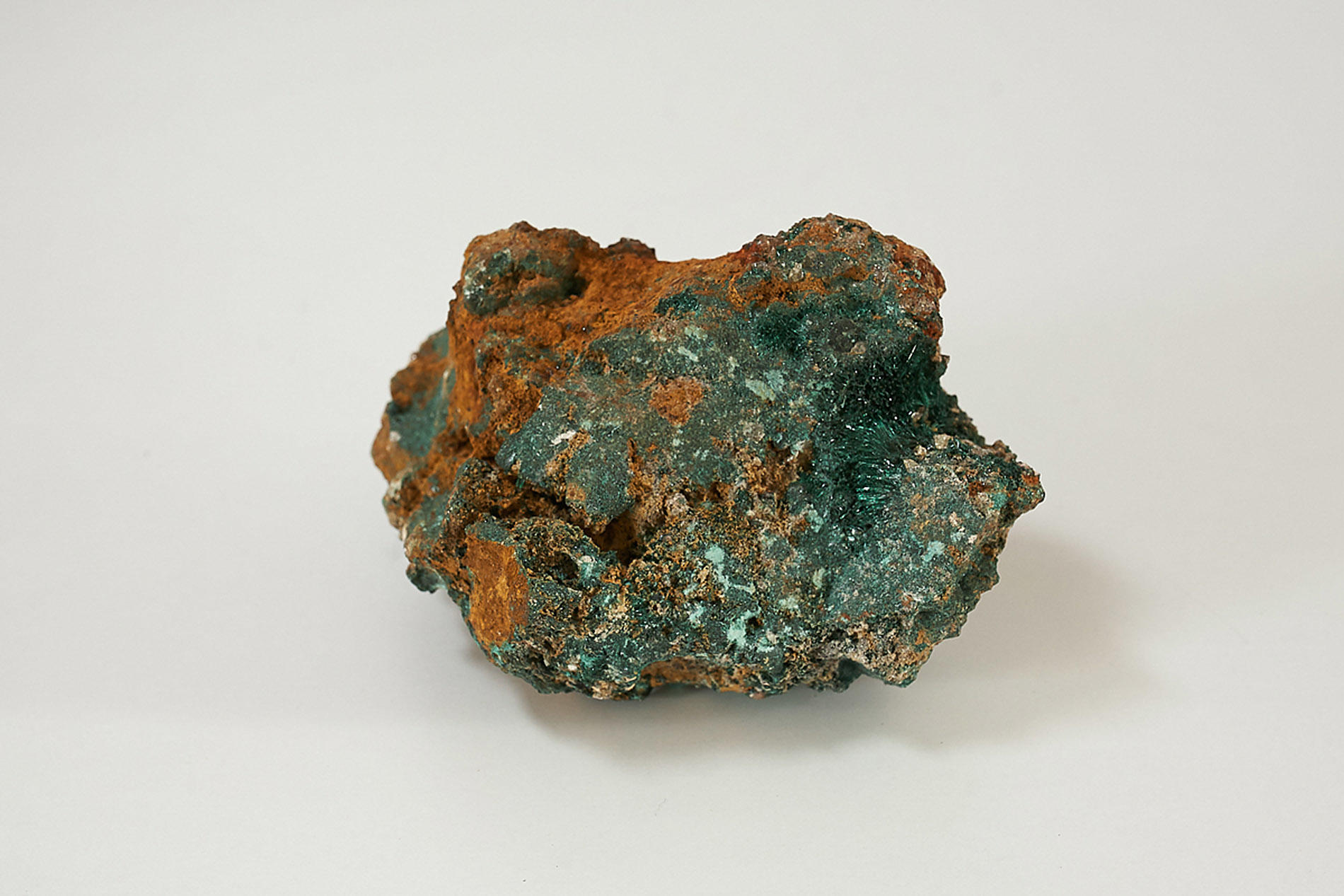


Malachite is a mineral belonging to the carbonate class. It is one of the most beautiful ornamental materials donated to us by nature. It got its name for its surprisingly bright emerald green hue reminiscent of the color of mallow leaves. In the past, malachite was used as a source of copper. Now that its deposits in Russia are almost exhausted, it seems to be barbaric.
Malachite is a faithful companion of copper ore and appears in places where copper gets oxidized by water penetrating from the outside. Sulfur pyrites and other compounds decompose, and the released copper reacts with carbonic acid from the surrounding limestone. The dissolution process leads to the generation of voids where malachite forms.
This is the only green stone endowed with a fantastically beautiful pattern. The polished section reveals a magnificent pattern of light and dark concentric rings of different thicknesses or lines forming a fancy ligature. Someone will see sea waves in it, and someone, wondrous flowers. Single color samples are extremely rare.
This happens because the mineral grows unevenly. Crystallites begin to form at scattered points called crystallization centers. From these centers, fine ‘needles’ start to protrude in all directions. Under ideal conditions, a flawless sphere with a radiant structure would be obtained. Geologists are lucky to find those sometimes.
However, in practice the orbs developing on the walls of the underground cavity come into contact with each other sooner or later, and the subjacent nuclei are enlarged faster, freely spreading their rays.
The color of the stone astonishes the viewer with its rich modulations. One sample can offer a whole array of shades, from soft turquoise to dense, rich green, smoothly turning into each other. The mineral is opaque, only very small crystals can be slightly transparent. Raw stone has a pleasant glass luster.
Depending on its texture, malachite is divided into several types. There is ‘plush’ malachite whose surface resembles velvet even after polishing; there is also radiant, fine-grained, ribbon, zonal concentric (or ‘peacock eye’) and kidney-shaped malachite.
Radiant varieties are characterized by their dark green tone and thin needle-like structure. Fine-tiled stone is distinguished by a pattern similar to birch leaves, and is valued higher than others. Due to the depletion of the Ural copper mines, there are few gems of this type left today.
Malachite came into fashion at the turn of the 18th and 19th centuries, and the 1830’s are considered the “malachite era” in the history of Russian stone-carving art. The Hermitage collection includes about two hundred artworks made of this mineral.
In the 19th century, the Urals mines yielded about 80 thousand tons of malachite annually. It was there that giant malachite lumps were discovered. Currently, malachite reserves exist only in one deposit, Korovinsko-Reshetnikovsky. All hopes for a revival are now associated with this deposit.
Malachite is a faithful companion of copper ore and appears in places where copper gets oxidized by water penetrating from the outside. Sulfur pyrites and other compounds decompose, and the released copper reacts with carbonic acid from the surrounding limestone. The dissolution process leads to the generation of voids where malachite forms.
This is the only green stone endowed with a fantastically beautiful pattern. The polished section reveals a magnificent pattern of light and dark concentric rings of different thicknesses or lines forming a fancy ligature. Someone will see sea waves in it, and someone, wondrous flowers. Single color samples are extremely rare.
This happens because the mineral grows unevenly. Crystallites begin to form at scattered points called crystallization centers. From these centers, fine ‘needles’ start to protrude in all directions. Under ideal conditions, a flawless sphere with a radiant structure would be obtained. Geologists are lucky to find those sometimes.
However, in practice the orbs developing on the walls of the underground cavity come into contact with each other sooner or later, and the subjacent nuclei are enlarged faster, freely spreading their rays.
The color of the stone astonishes the viewer with its rich modulations. One sample can offer a whole array of shades, from soft turquoise to dense, rich green, smoothly turning into each other. The mineral is opaque, only very small crystals can be slightly transparent. Raw stone has a pleasant glass luster.
Depending on its texture, malachite is divided into several types. There is ‘plush’ malachite whose surface resembles velvet even after polishing; there is also radiant, fine-grained, ribbon, zonal concentric (or ‘peacock eye’) and kidney-shaped malachite.
Radiant varieties are characterized by their dark green tone and thin needle-like structure. Fine-tiled stone is distinguished by a pattern similar to birch leaves, and is valued higher than others. Due to the depletion of the Ural copper mines, there are few gems of this type left today.
Malachite came into fashion at the turn of the 18th and 19th centuries, and the 1830’s are considered the “malachite era” in the history of Russian stone-carving art. The Hermitage collection includes about two hundred artworks made of this mineral.
In the 19th century, the Urals mines yielded about 80 thousand tons of malachite annually. It was there that giant malachite lumps were discovered. Currently, malachite reserves exist only in one deposit, Korovinsko-Reshetnikovsky. All hopes for a revival are now associated with this deposit.