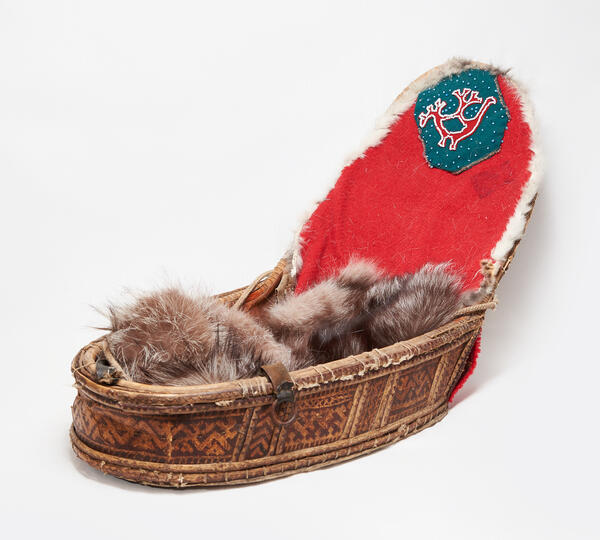
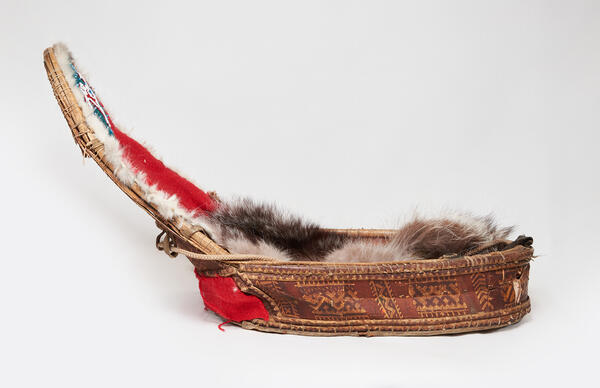
In the Khanty household, when a baby was born, it stayed together with the mother in a separate dwelling for the first few days. The baby was placed in a temporary birch bark cradle. Only after some time (after the umbilical cord fell off) it was “relocated” and the mother began using two permanent ones.
The night cradle (etn ont’t, sakhan) was a birch bark box with rounded edges, a low backrest or without it at all, with ties that were put over the baby’s body and an arc for creating a canopy with a blanket. The day cradle (hat-levin ont’t) was made of birch bark or wood and fitted with a high patterned backrest so that the baby could sit. The backrest was lined with pieces of hide.
Until the age of three, the baby almost never left its cradle. It was suspended from the ceiling of the dwelling with belts, and in summer from an inclined pole or a tree at a height where flies would be less bothersome and snakes would not be able to crawl in. The mother could simply hold the cradle on her lap during feeding times, carry it on her back when walking on foot, and put it on her sled during trips.
Birch bark panels were inserted into the cradle and were changed as the child grew. They were filled with moss or crushed and dried birch dust in cotton bags. Such bedding smelled nice and absorbed moisture well.
There were many beliefs associated with the cradle. The soiled bedding from a baby girl’s cradle was brought outside under a birch tree, and one from a boy’s cradle — under a pine tree, and the tree had to be alive and grown, but not young and growing, “otherwise the child will swing from the wind.” The cradle was never passed over the threshold, but was carried in headfirst. A good cradle, in which a healthy happy child grew, was kept and passed on to other babies; if the baby died, the cradle was left in the forest under a tree.
In the first months of the newborn’s life, it was swaddled in worn soft clothing items and covered with a blanket made of rabbit skin. Birch bark knee pads were used, as they were believed to prevent the legs from curving; boys also had a birch bark thigh pad to keep their clothes dry. Bibs were sewn from pieces of rovduga, soft leather or fabric, and birch bark ones were decorated with embossing. The baby’s first shirt was sewn during the first three to four months, and before it left the cradle, it received a full set of clothes that were similar in pattern to adult clothing.