Font
Color
Graphics
Изображение точки

To see AR mode in action:

1. Install ARTEFACT app for iOS or Android;

2. Find the exhibition «Neighbors. The Forest Nenets people»

3. Push the «Augmented reality» button and point your phone's camera at the exhibit;

Скрыть точки интересаПоказать точки интереса
Показать в высоком качестве

Bow, Gunpowder box, Buckshot bag, Sunglasses

0
Open in app
#1
Rasha Ayvasedo
Bow and arrows
#2
Like for any other business, the Nenets have a special ecological calendar for hunting. Its year is not equal to a traditional year but it is divided in two – the first half-year is winter, the second one is summer. In a winter year, they hunt for squirrel, sables, hares, otters, ermines, foxes and polar foxes, wolverines, bears, wild reindeer. Men ski to the taiga, and when they go for a long trip, they ride reindeer. In summer, water and forest birds are hunted.

Handmade bows and arrows, traps and knives used to be the main hunting tools by the Forest NEnets up to the end of 19th – beginning of 20th century. As guns became more accessible, primitive weapons were used less often. But children and juveniles still hunt small fur animals and birds with bows and arrows. The Forest Nenets children get practical hunting skills while playing, imitating adult-hunters from an early age. By seven, boys can already bag by themselves.

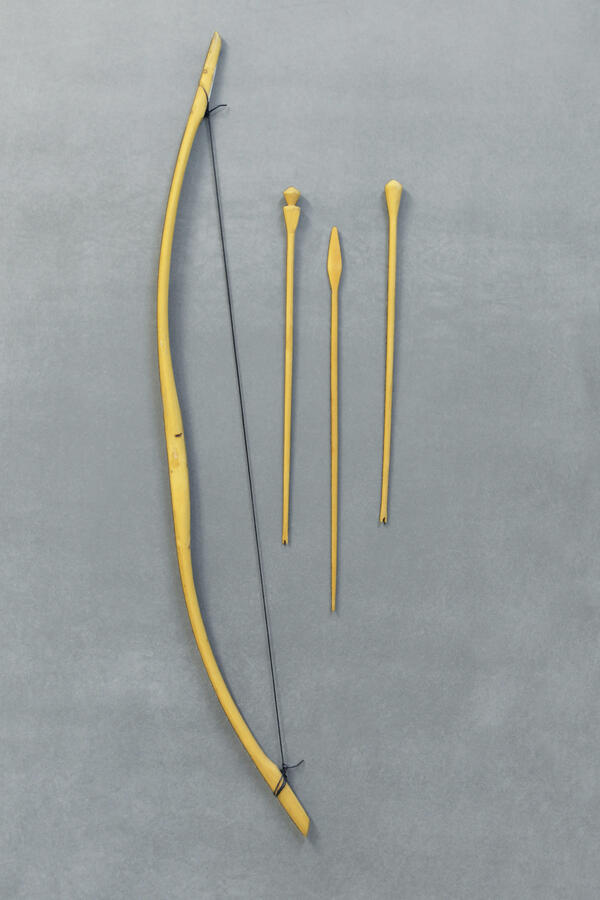
Usually two types of trees are used to make a hunting bow – conifer and deciduous trees. The string is made of twisted thick reindeer tendons, because they are very strong. Arrowheads of different forms are made of wood, bone or metal. When hunting birds, they use arrows with two-pronged heads, for big animals go arrows with faceted heads and for squirrels and other small game go blunt-headed arrows.

A boy’s first bow is handmade by his father of flexible willow twigs, often with a simple line as a bow-string. Toy arrows are lighter and shorter than the real hunting ones, but a boy is still able to shoot a target with them. At the age of six or seven, a boy can easily handle a knife and make a bow and arrows by himself. As a child grows up, his bow is several times modified and upgraded, turning into a real weapon gradually. By ten, a boy’s bow is the same as of an adult, only smaller.

The museum exposition displays a bow with arrows made by Rasha Ayvasedo, a Chaselka camp resident.
#3
Full name: Bow and arrows
Author: Rasha Vladimirovich Ayvasedo
Date: the 2nd half of the 20th century
Technique: handmade 
Place: Chaselka camp
Dimensions: 127×10×3 cm
Collection: Ethnography, the Forest Nenets people
Copyright: Gubkinsky Museum of the Development of the North 
#4
Konstantin Vello
Gunpowder box
#5
Hunting is one of the main traditional Forest NEnets activities. Since long ago, they hunted fur and ungulate animals. Together with reindeer husbandry and fishing, hunting is an important part of their lives as it allows to provide for the family with food and pelts for clothes. Like all other Northern peoples, the Forest NEnets used available natural materials to craft hunting tools. They made bows, arrows and traps of wood. Since the early times, aboriginal Siberian hunters have been brave and lucky providers able to sneak right up to a beast.

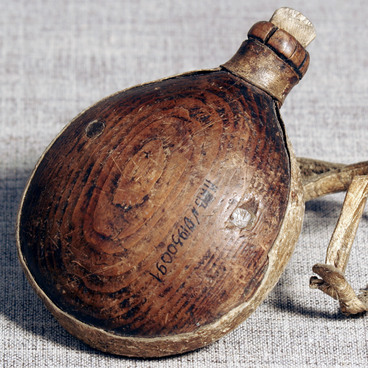
After Siberia was annexed by the Russian Empire, another type of guns spread among the NEnets, flintlocks and percussion rifles. They were loaded with buckshot and powder. Items for loading were attached to every hunter’s belt, there was a special bag for buckshot made of rovduga (reindeer suede) or leather and a wooden box for gunpowder. These bags were tied up to a belt with leather straps. A gunpowder box was an oval-shaped wooden vessel like a flask.

The gunpowder box displayed in GUbkinsky Museum of the Development of the North exposition was provided by Konstantin Vello, a resident of Tarko-Sale town in Yamalo-Nenets Autonomous Okrug. This box consists of two symmetrical parts connected with wooden dowels. The junction is covered with a strip of rOvduga, reindeer suede. Rovduga is a waterproof and durable material, so it effectively protects the box from water and prevents the powder from getting soaked when it rains. The edge of the neck has a bottle-like roller with a rovduga strap under it for density. The neck of the box is tightly closed with a wooden cork. This item was made in 1980s and used by its owner for hunting for many years. It can be seen by the darkened color of the box and the chipped neck.
#6
Full name: Gunpowder box
Author: Konstantin Iklaevich Vello 
Date: 1980s
Technique: chiseling
Place: Tarko-Sale town
Dimensions: 10×8×5 cm
Collection: Ethnography, the Forest Nenets people
Copyright: Gubkinsky Museum of the Development of the North
Goskatalog Number: GMOS OF-1828
#7
Konstantin Vello
Buckshot bag
#8
Since the early times, aboriginal Siberian hunters have been brave and lucky providers able to sneak right up to a beast. Like for other Northern peoples, hunting is one of the main activities for the Forest NEnets. It provides food for the family and pelts for clothes which must be especially warm in the severe climate.

In the recent past, the Forest NEnets used available natural materials to craft hunting tools. They made bows, arrows and traps of wood. Another type of tools spread among the NEnets only after Siberia was annexed by the Russian Empire. It was then when flintlocks and percussion rifles became popular among the Northerners. Items for loading were attached to every hunter’s belt, there was a special bag for buckshot made of rovduga (reindeer suede) or leather and a wooden box for gunpowder. This box was tied up to a belt with leather laces.

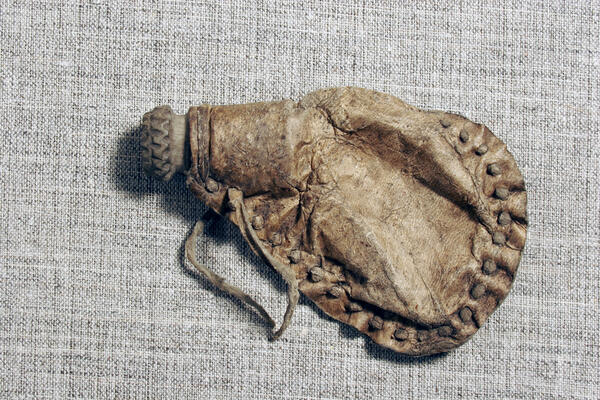
A bag for buckshot was small and thick, made of reindeer suede with thin rovduga laces inserted at the sides. Upper outer part of this bag was covered with carving and decorated with traditional Nenets ornaments. The neck of this bag was usually an empty part of a reindeer antler.

The buckshot bag in Gubkinsky Museum of the Development of the North exposition was provided by Konstantin Vello, a resident of Tarko-Sale town in Yamalo-Nenets Autonomous Okrug. It is not that big, only seven by twelve centimeters. It is a leather oval asymmetrical vessel-bag, narrow at the top. It consists of two parts seamed together with a thin rovduga lace. A fine ornament is carved on the upper part, possibly a ‘taking-off duck’ type. At the neck there is a lace to attach the bag to a belt. This item was made in 1970s and used by its owner for hunting for many years.
#9
Full name: Buckshot bag
Author: Konstantin Iklaevich Vello
Date: 1970s
Technique: handmade
Place: Tarko-Sale town
Dimensions: 12×7×7 cm
Collection: Ethnography, the Forest Nenets people
Copyright: Gubkinsky Museum of the Development of the North
Goskatalog Number: GMOS OF-1827
#10
Vladimir Pyak
Sunglasses
#11
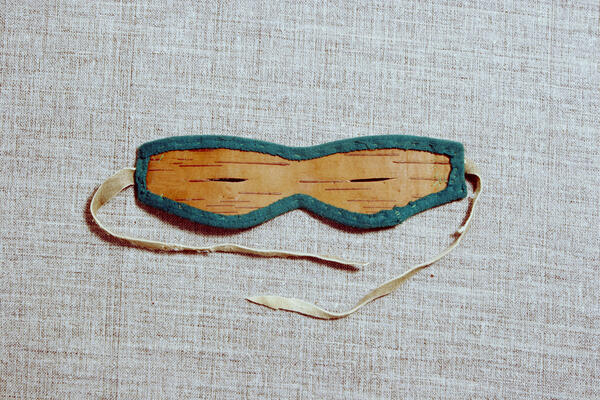
Today the NEnets still use the same type of sunglasses that was invented about two thousand years ago. It was the Northern peoples who first learned how to protect their eyes from excessive sunlight. From the old times, they handmade sunglasses of available natural materials for this.

Everyone who has been in the Tundra or the Arctic shores in early spring knows how blindingly bright the snow under the sunrays is, how difficult it is to do without sunglasses in April and May here. Indigenous peoples of the North use traditional sunglasses (sometimes called snowglasses in literature) to prevent snow blindness. There’s no glass or any other transparent material in its construction. They protect the eyes in another way: there are narrow and long holes for eyes, so narrow that they significantly reduce the bright stream of light coming from spring sunlit snow and ice. The Tundra inhabitants make sunglasses of reindeer skin or the upper layer of birch bark. Edges are covered with cloth or hare or squirrel fur. They are fixed at the back of the head with reindeer skin strings. Blanks are usually cut out fitting the form of its future owner’s face.

These protective glasses are worn tight to the face, so that the light only penetrates through the holes cut for the eyes. Slots are that narrow not only to reduce the amount of perceived light but also to improve the eyesight. The wider the slots are, the large is the field of vision. Despite many Forest Nenets wear manufactured sunglasses today, traditional snowglasses are still in use.

The glasses displayed in the ethnographical exposition of Gubkinsky Museum of the Development of the North were provided by the Forest Nenets Vladimir Pyak, a Dyanki-Koy camp resident. They are made of birch bark and edged with green cloth. Like other colors by the Forest Nenets, this color has a specific meaning, the green is the color of grass, spring and summer, awakening to life.
#12
Full name: Sunglasses
Author: Vladimir Igrumovich Pyak 
Date: 2000
Technique: handmade
Place: Dyanki-Koy camp
Dimensions: 20×7×0,5 cm
Collection: Ethnography, the Forest Nenets people
Copyright: Gubkinsky Museum of the Development of the North
Goskatalog Number: GMOS OF-1810
read morehide
00:00
00:00
1x

Bow, Gunpowder box, Buckshot bag, Sunglasses

0
Point your smartphone camera to open in the app
Share
VkontakteOdnoklassnikiTelegram
Share on my website
Copy linkCopied
Copy
Open in app
To see AR mode in action:
  1. Install ARTEFACT app for 
  2. iOS or Android;
  3. Find and download the «Paintings in Details» exhibition
  4. Push the «Augmented reality» button and point your phone's camera at the painting;
  5. Watch what happens on your phone screen whilst you flip through the pictures.
 
We use Cookies
Cookies on the Artefact Website. We use cookies to ensure that we give you the best experience on our website. If you continue without changing your settings, we'll assume that you are happy to receive all cookies on the Artefact website. However, if you would like to, you can change your cookie settings at any time.
Learn more about useHide
Content is available only in Russian

X

Нашли опечатку?...

%title%%type%