Boats were an integral part of the way of life of the peoples living in the Amur region and at the Okhotsk Sea coast. They were very diverse and were used at least six months a year, from May to October. And nowadays, the boat remains the most important means of transportation for the indigenous small-numbered peoples of Khabarovsk Krai.
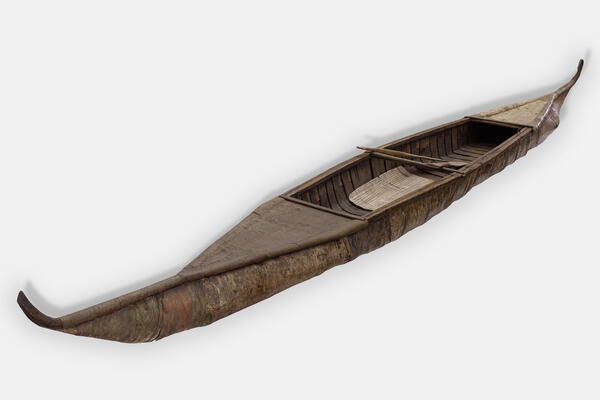
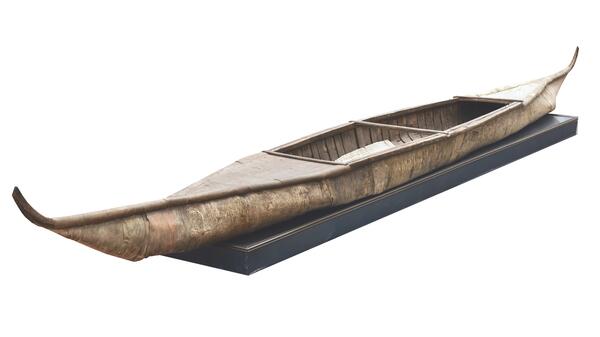
It was used to hunt, fish, go picking wild crops, sail to get fuel, and travel between villages by river and sea. In the past, a birch bark frame boat was one of the common types. The Nanai people called it dzhai and dyai, and the Russians called it an omorochka.
The Nanai birchbark boat differed from the Evenki dyai by its sharp and curved ends. The omorochka was known for its fast speed; it was light enough to be carried on the shoulders of one person and was highly maneuverable. Such a boat was used to stalk wild goats. The safety of birch bark boats was also important when overcoming high waves.
Making a boat was a team effort. The wooden frame was covered with birch bark. For this purpose, birch bark was collected in advance, in July, and after some time it was steamed in hot water or boiled. After that the birch bark became elastic again.
Pieces of birch bark were glued with spruce resin, stitched and fastened with sinew threads or roots of osier-bed. The birch bark cover was made of two layers, the sides of the boat were made of larch and bound with wooden nails and resin. The most difficult thing was to shape the side, bow and stern. Then came the last stage: most of the bow and stern were covered with pieces of birch bark.
The omorochka was used mainly on shallow rivers. Rowing was done with a two-bladed oar, but when it was necessary not to make noise, the two small single-bladed oars were used. In shallow water they were steered with small poles. A sail was occasionally used.
The size of the boat
varied greatly, but the length of about 6 meters prevailed, with the greatest
width (in the middle) of 0.7 meters and a depth of 0.3 meters. In the 20th
century birch bark boats began to be replaced by small boarded shuttles.