Font
Color
Graphics
Изображение точки

To see AR mode in action:

1. Install ARTEFACT app for iOS or Android;

2. Find the exhibition «Masterpieces of the Andrei Rublev Museum»

3. Push the «Augmented reality» button and point your phone's camera at the exhibit;

Скрыть точки интересаПоказать точки интереса
Показать в высоком качестве

Icon lamp

Creation period
1860
Place of сreation
Saint Petersburg, the Russian Empire
Dimensions
13,5x12,7 cm
chain length — 50.5 cm
Technique
silver, glass; stamping, gilding
1
Open in app
#1

Light as a symbol of the divine presence marked the most gracious places in the church. The icon lamp was used in the décor as an illuminating device for spotlighting, most importantly, the revered icons in the iconostasis and on the choir galleries. Spotlighting during the service created a unique atmosphere of deep sorrow with a ray of devout hope.

A luminary in the form of a bowl suspended on chains is known as a “censer” (“kadilo”). Terracotta and copper censer lamps of various shapes were found in large numbers in Christian catacombs. In Russian-language sources, the censer is referred to using various terms, including “lampada”, “svescha”, “sveschnik”, and “svecha”. Large luminaries made up of several candles or lamps are called “polikadilo” (from Greek πολύς — “many” and κανδήλα — “candle”) and “panikadilo” (from Greek πάς — “whole” and κανδήλα — “candle”).

Byzantine bronze and silver censers of the 5th–7th centuries, suspended on three chains, were made in the form of hemispherical, cylindrical, or shaped vessels, vases with a tray or with small legs. The tray and legs were necessary to install the lamps on a plane to fill them with oil and change the wick.

In the early 12th century, Russian hegumen Daniel reported that during his pilgrimage to Jerusalem he saw censers in which oil was poured and wicks were put in tin holders. He also placed on the tomb of the Lord “his” censer “from the whole Russian land”. At the iconostasis above the holy gates, the censer was usually suspended on a cord, which allowed it to be lowered and raised as necessary.
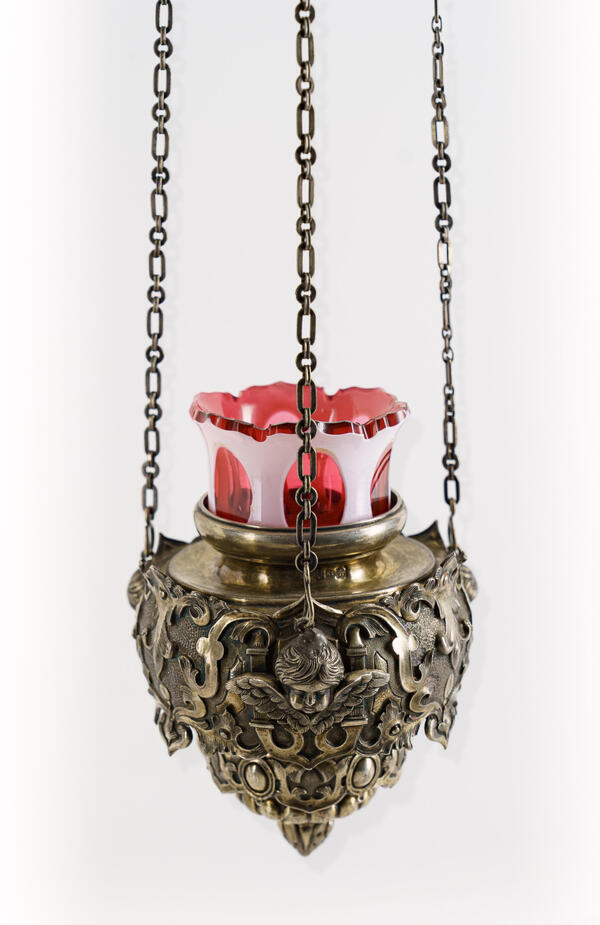
The displayed icon lamp has an enlarged middle part of the body decorated with a relief vegetative pattern. The décor of the lamp, as well as that of most church adornment items associated with the liturgy and church architecture, symbolized paradise, the heavenly realm, where the divine service is performed by the host of God’s angels. Hence the motif of the basket and wicker and the arch-shaped relief curls. The top is crowned with a smooth rim, and the bottom ends in the form of a stylized bud. The smokebox (a part of the metal structure that catches the products of combustion) is decorated with scallop ornaments. The chain is made up of oval and round links.

#3
Icon lamp
#2
read morehide
00:00
00:00
1x

Icon lamp

Creation period
1860
Place of сreation
Saint Petersburg, the Russian Empire
Dimensions
13,5x12,7 cm
chain length — 50.5 cm
Technique
silver, glass; stamping, gilding
1
Point your smartphone camera to open in the app
Share
VkontakteOdnoklassnikiTelegram
Share on my website
Copy linkCopied
Copy
Open in app
To see AR mode in action:
  1. Install ARTEFACT app for 
  2. iOS or Android;
  3. Find and download the «Paintings in Details» exhibition
  4. Push the «Augmented reality» button and point your phone's camera at the painting;
  5. Watch what happens on your phone screen whilst you flip through the pictures.
 
We use Cookies
Cookies on the Artefact Website. We use cookies to ensure that we give you the best experience on our website. If you continue without changing your settings, we'll assume that you are happy to receive all cookies on the Artefact website. However, if you would like to, you can change your cookie settings at any time.
Learn more about useHide
Content is available only in Russian

X

Нашли опечатку?...

%title%%type%
