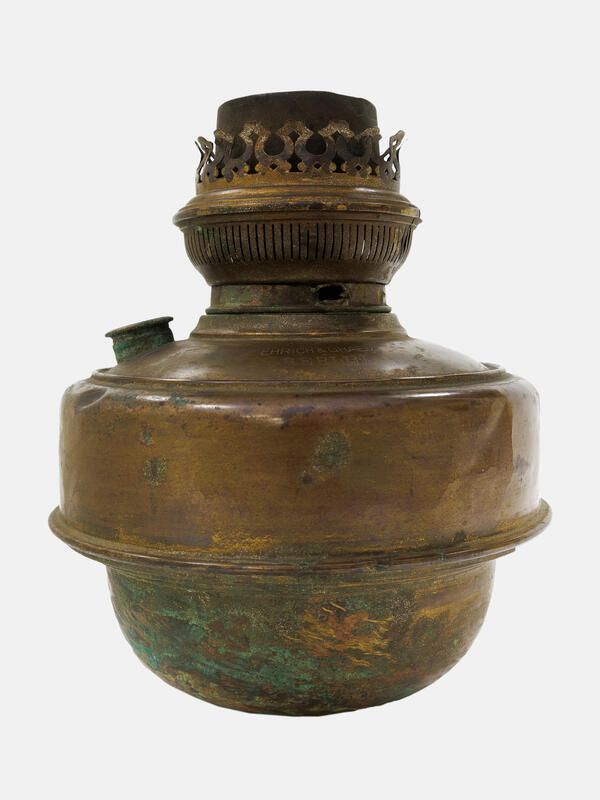
The kerosene lamp on display is believed to have belonged to the Chekhov family. It was donated to the museum by Valentina Chekhova, the widow of the writer’s nephew, Sergey Chekhov. At the bottom of the lamp, there is a stamp that reads, “Ehrich & Graetz. Berlin. Miracle lamp. Patent.” The glass chimney and lampshade have been lost.
A kerosene lamp is a type of lighting device that uses kerosene as a fuel. The first kerosene lamp was designed by the Polish pharmacists Ignacy Łukasiewicz and John Zeh in Lviv in 1853. During that time, oil and grease lamps were most often used for lighting. However, they burned dimly and produced a lot of smoke. Kerosene lamps were considerably brighter and immediately became widespread throughout Europe.
In 1900, around 25 thousand lighting devices were manufactured in Russia, and by 1908, the number had grown to almost 65 thousand. A traditional kerosene lamp consisted of a metal kerosene tank, a burner, a glass chimney, a metal protective frame, and a wick-adjustment mechanism.
For easy-to-assemble kerosene lamps, Russian craftsmen used porcelain and glass vases — their body contained the fuel tank, above it was a burner, and the metal structure supported the lampshade which diffused the bright light.
The design of the lamp remained unchanged for a century: kerosene was poured into the tank, a cotton wick was dipped into the tank on one end and clamped by an adjustment mechanism in the burner on the other end, with air entering from below. The burner was placed above the fuel tank because the wick absorbed kerosene easily. A glass chimney was placed on top of the burner to provide a proper draft and prevent the flame from being blown out. Lamps were equipped with a frame that made them easy to carry and fix.
The widespread introduction of electric lighting gradually made kerosene lamps and lanterns obsolete, although they remained in use in Russian villages until the Great Patriotic War. Nowadays, they are used as an emergency light source during power outages, as well as at campsites.
Anton Chekhov’s father had a soft spot for kerosene lamps: whenever he saw a beautiful lamp, he could not resist buying one. Legend has it that even when the family was on the verge of poverty while living in Moscow, Pavel Chekhov could go to a shop to buy forks and return with another lamp.