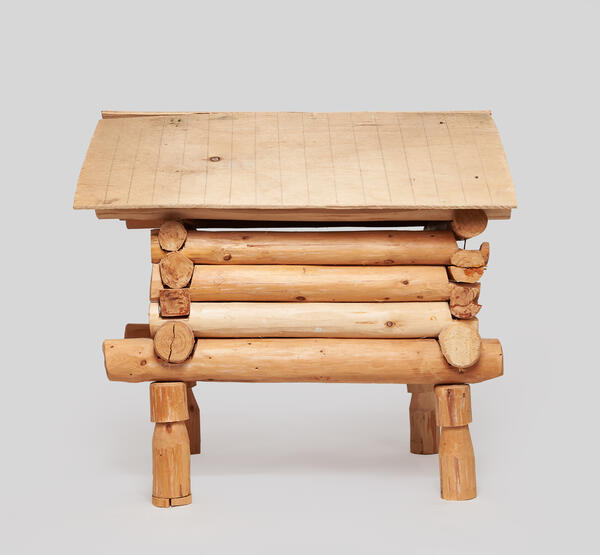
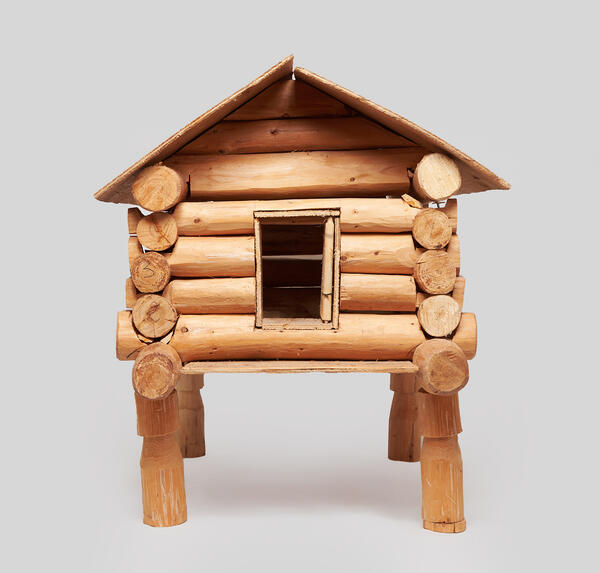
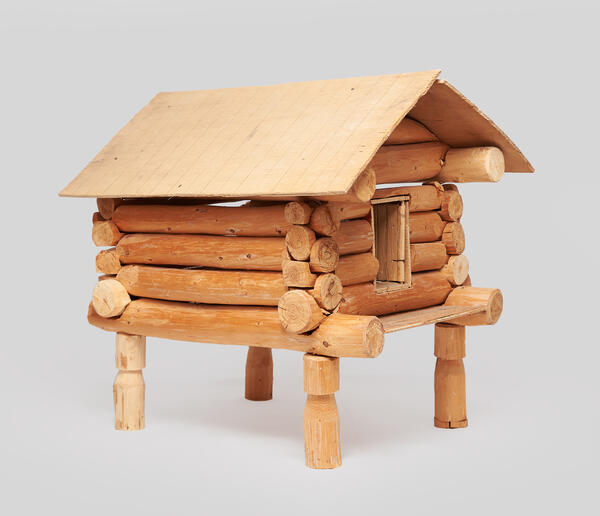
Khanty barns “on hen’s legs” — storehouses — are some of the characteristic structures of this people.
Similar buildings were erected near camps and fishing grounds, where people moved to work for many months. In summer and autumn, the storehouses were filled with food supplies: groats, grain, fish and meat, dried berries and mushrooms. Hunting and fishing equipment was also stored there: weapons, cartridges and gunpowder, warm clothes, “morda fish traps, nets, stretching frames for hides, grass for wrapping legs instead of footwraps, dishes, rawhide belts, ropes, threads, birch bark boxes, axes, knives, awls, and punctures for birch bark” (Vladislav Kulemzin, Nadezhda Lukina, “Meet the Khanty”).
A Khanty storehouse (also called “labaz”) is a wooden cabin, about three-by-three meters, necessarily made of logs. The logs were adjusted loosely one to the other and generously covered with moss. Thus, excellent ventilation was created inside the room, thanks to which the stocks did not rot.
To protect against dampness, freezing temperatures and wild animals, the structures were raised above the ground. To do this, strong two-meter poles were driven into the ground, deep recesses or wooden rings were made on them, so that it would be impossible for rodents to climb up. If for some reason it was not possible to install the poles, strong living trees were used: bark was removed from the trunks, making them unsuitable for climbing, and the tops of the trees were cut down. The storehouse was placed on top of the trunks.
In addition to these barns for household needs, the Khanty also set up sacred structures of somewhat smaller sizes, but raised higher above the ground. They were always placed on the eastern side of the camp — closer to the rising sun. Wooden ancestral idols and various objects of worship were kept in such buildings. Not only the inner space was revered, but also the areas around it.
It was possible to enter the storehouses — both utility and sacred — and take something from there only after dark, before dusk. Only men were in charge of them; if a woman needed to get close to a storehouse, she always covered her head. People believed that if she violated the prohibitions, the whole family would be punished.