The exhibition of the Tanais Archaeological Museum-Reserve features a large Alan gray clay jug from the Late Bosporan period, which was produced in the Lower Don region or the Central Caucasus.
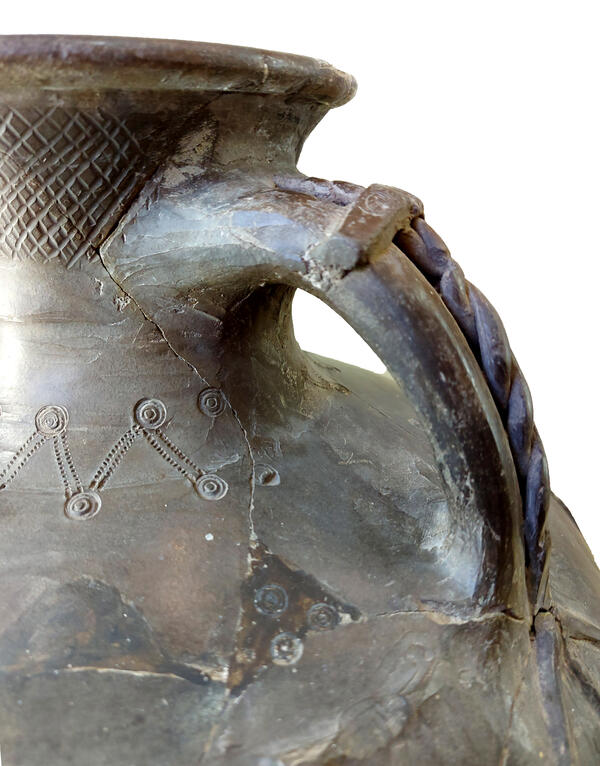
The jug has a thick rim that is bent outward and rounded. The neck is flaring at the top and smoothly turns into an ovoid body at the bottom. The base is concave, and the handle is slightly curved and flaring at the top. With its upper end, the handle is attached to the middle of the neck through a hole, while the lower end is attached to the center of the shoulder. Opposite the handle, the neck and rim form a short tubular spout that protrudes to the side and slightly upward. On the flat top edge of the spout, there are two small, symmetrically attached round elements. The handle consists of two parts, round in cross-section. Along its entire length, there are two intertwining oval bands placed in a longitudinal groove in the center of the handle, rising noticeably above the edge of the groove. The upper part of the handle is adorned with a narrow, transverse attached element with its ends bent towards the sides of the handle and smoothed. The top of the neck is decorated with a wide, horizontal stripe of narrow-meshed, polished, thin and oblique mesh that extends to the sides of the spout. In the middle of the neck, there is a thin, horizontal bead. At the bottom, there is a horizontal, broken zigzag made up of two thin, parallel lines. Where the lower end of the handle meets the body of the jug, the shoulder is adorned with a horizontal attached bead with shallow longitudinal fingerprints. From this line, 17 vertical beads, without fingerprints, extend downwards along almost the entire height of the jug. Three of these beads start from a single point located on the vessel’s axis of symmetry, which passes through the middle of the handle and the spout. Another three begin from a point on this axis, opposite to the above-mentioned one, in the middle of the handle’s lower end where the intertwined bands end. The vessel has a gray outside surface, with a greenish tinge in some places, carefully polished to a shine.
The jug was used to store various liquids and was
likely especially appreciated by its owners.