

#1
Dolls of Voronezh, Ostrogozhsk, Rossoshka
#2
#10
#8
For many centuries, Russia lived a peasant lifestyle. Closely connected with the earth, which nourished him, the ploughman, in many ways, was himself part of nature. His clothes completely corresponded to the specifics of his daily life.
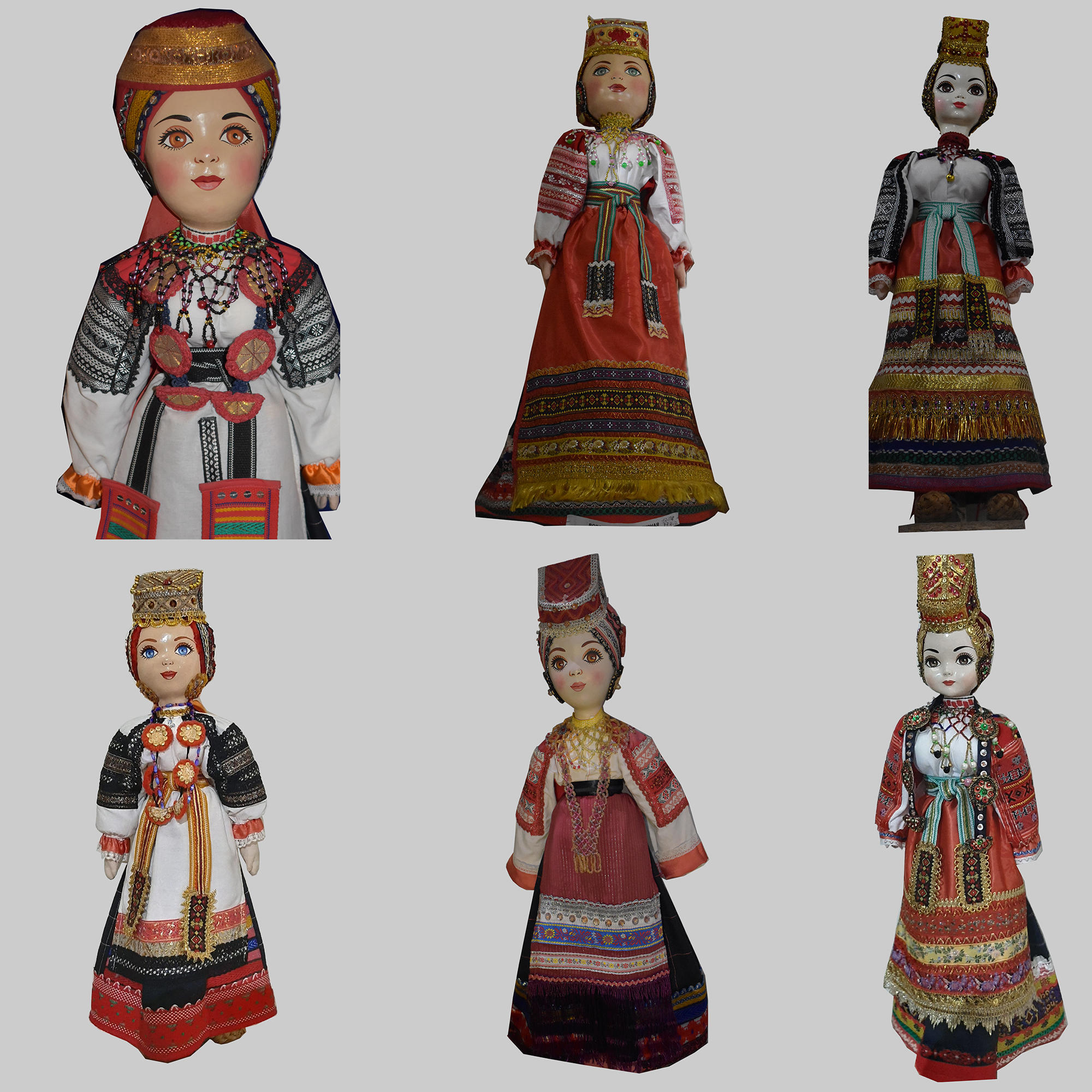
In the Voronezh Region, we can see a lot of various versions of garments, due to the region chaotic settlement pattern. It was populated by service class people, descendants of illustrious families, emigrants from Ukraine, Streltsy and Cossacks. From the 18th century, they started granting lands to Boyar families and nobility. Peasants with big families moved in from other Russian provinces and Ukraine.
The Voronezh Province population wore costumes made from fabrics manufactured from hemp or nettle. Wool was used more rarely. Hemp was the most popular crop in this part of the country. Oil from this plant, which they started to extract much earlier that sunflower oil, was consumed everywhere in the region.
For traditional costumes, the color is important, its symbolism reveals the aesthetic perception of clothes by people. Thus, clothes of inhabitants of this part of Russia always contained the white, black and red colors. Black, which symbolized the earth and tranquility, was especially popular in the Voronezh Province. We observe this color of joy and agriculture both on maiden sarafans (pinafore dress) and upper garments.
Shirt sleeves embroidered with black threads testify to the traditions dating back to high antiquity. Historians who studied this region say that this is a kind of gratitude to the black lavish earth, which, since old times, nourished the peasant and his family.
Until today, many people in the Voronezh Province keep ancient peasant garments inherited from their ancestors. Especially precious are holiday clothes with headdresses embroidered with gold. In the difficult years of famine, they were exchanged for food.
From the 17th century, mass migration of Ukrainians to the Voronezh Province started. So, despite some similarity with other regions in the South of Russia, many distinctive phenomena of artistic nature can only be observed here. They are especially evident in studies of the traditional costume specific features.
Women wore shirts elaborately embroidered with woolen threads. In most cases, embroidery was placed on the sleeves and the front, sometimes, the shirt was decorated with golden threads. On top of the shirt, a homespun woolen skirt (poneva) was worn.
#9
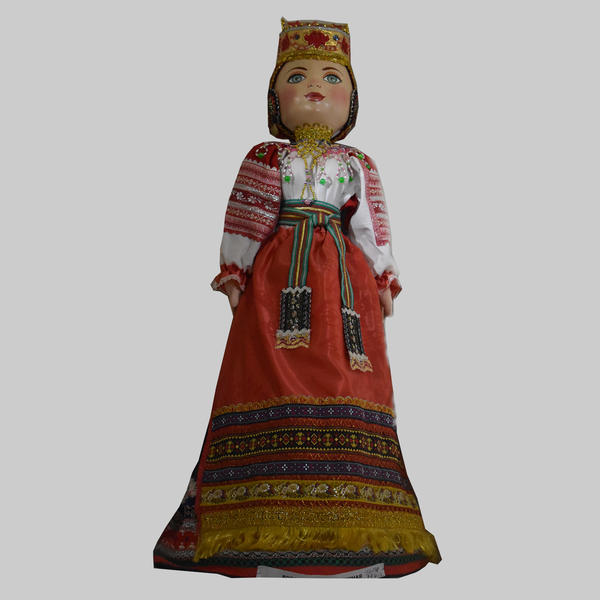
Full name: Souvenir Voronezh Doll in Soroka
Author: Valentina Yakovlevna Gorbacheva
Date: 20th century
Dimensions: 82 cm
Collection: Old Fashions
Copyright: Boguchar District Museum of Local History
Restorers: Valentina Gorbacheva
Goskatalog Number: 16046106
Author: Valentina Yakovlevna Gorbacheva
Date: 20th century
Dimensions: 82 cm
Collection: Old Fashions
Copyright: Boguchar District Museum of Local History
Restorers: Valentina Gorbacheva
Goskatalog Number: 16046106
#3
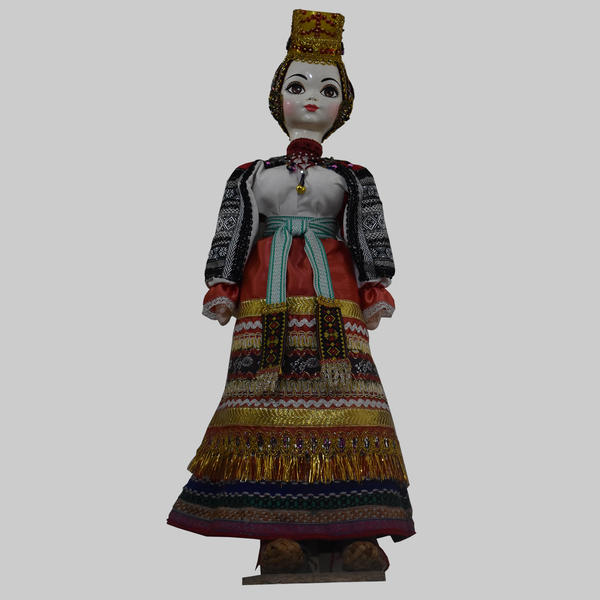
Doll in old costume from Rossoshki village
#12
#11
The Repyevsky district folk costumes combined traditions and characteristics of various ethnic groups whose representatives lived in its territory. The Repyevsky district inhabitants stand out from other Voronezh residents by their dialect, customs, and clothing. All the variety of national costume elements is presented in Repyevka festive outfits.
Repyevsky fashionistas preferred to sew clothes not from homespun canvas, but from expensive factory fabrics: wool, brocade, silk, chintz, satin. Vegetable dyes with unified shades were gradually replaced by aniline-based paints with a wide range of colours.
In the Repyevsky district villages, the peculiarity of clothes decoration was in using rhombic and square cross-embroidered ornaments. Clothing elements with shiny accessories, beads and embroidery gave the festive clothes a bright and spectacular look. The costume was complemented by colorful edging belts, beads, and in the village of Rossoshki woven beads monists were also worn over clothing.
The village men’s casual and festive costumes practically did not differ. Men’s national attire included ''sharovary'' (wide trousers), boots and a ''kosovorotka'' with an embroidered collar (a shirt with a collar fastening at side). Girls and boys until adolescence ran in the same homespun shirts as long as they touched the ankles.
In most villages in the Repyevsky district, women’s costumes included a ''ponyova'' - a kind of homespun woolen skirt. In different villages, ponyovas differed in colour. Most often, they were made of a dark blue checkered fabric. By the color of the strips dividing the tissue into cells, one could understand in which village the item was sewn. At the Ivanovsky farm, women wore plain black ponyovas with multi-coloured cross-stitch embroidery.
In the last century, national costumes began to be widely used in folk song concerts. In this regard, traditional clothing was enriched with brighter colours: intense red, crimson, burgundy. Particular attention was paid to the appearance of women’s headdresses. Massive ''sorokas'' (magpies) of bizarre shapes, decorated with embroidery, beads, shiny details, attracted attention, looked expensive and spectacular.
At the beginning of the 20th century, in the village of Rossoshki, traditional clothes with ponyovas were gradually replaced by more modern outfits. Embroidery continued to be used, but plant patterns replaced geometric ornaments. Leaves, flowers, stems, buds were also embroidered with a cross. Floral ornaments adorned shirts and sweatshirts.
Young girls began to wear checkered skirts and after marriage they no longer put on a ponyova. In the Voronezh and the neighboring Belgorod regions, the black colour of skirts and aprons, practical for everyday wear, firmly entered into fashion.
Ponyovas were completely absent in the costumes of the villages Butyrki and Ust-Muravlyanka. In these villages they preferred to wear skirts made of heavy cloth. Their appearance resembled homespun items, but they were sewn from purchased factory-made threads. Such skirts were commonly called ‘Kursk’.
#13
Full name: Souvenir Voronezh Doll in Soroka
Author: Valentina Yakovlevna Gorbacheva
Date: 20th century
Dimensions: 82 cm
Collection: Old Fashions
Copyright: Boguchar District Museum of Local History
Restorers: Valentina Gorbacheva
Goskatalog Number: 16046106
Author: Valentina Yakovlevna Gorbacheva
Date: 20th century
Dimensions: 82 cm
Collection: Old Fashions
Copyright: Boguchar District Museum of Local History
Restorers: Valentina Gorbacheva
Goskatalog Number: 16046106
#4
Doll in Ostrogozhsk Costume
#14
#15
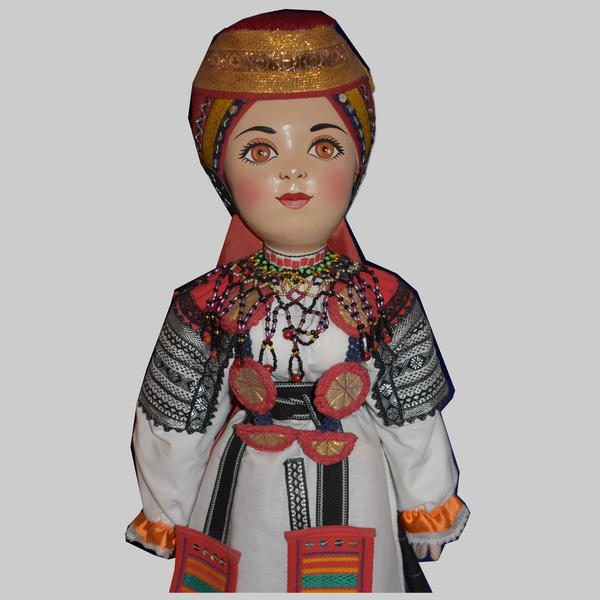
The festive costume on this doll is representative of a traditional gown worn by Voronezh-Belgorod border zone inhabitants, although it is displayed in the museum as clothing from the Russian Trostyanka village in the Ostrogozhsk district.
A woman’s age is encoded into the ornaments on a skirt (ponyova) and a white shirt, with a decorative pattern corresponding to a specific age group. The same approach was applied to the shirt’s embroidery pattern: one design was intended for weddings, another for festive days, and still another for Sunday church services.
The doll’s black-checkered ponyova contains a proshiva (insertion) of smooth, black fabric. Meanwhile, the skirt is decorated with carpet embroidery. Although both festive ponyovas and everyday clothing were embroidered on the back, sides, and bottom, the festive variants featured much more complex threading and embroidery patterns. A person’s village could also be identified by the ponyova’s colour palette.
A shirt, sometimes called a stanushka (from the Russian word stan, meaning “figure”) always served as the basis for a female costume. Shirts were originally sewn from rough, homemade sheets of flax or hemp, but later gave way to more delicate fabric purchased from travelling merchants. A white sheet would be embroidered delicately into geometric shapes using black thread.
Nearly a dozen different shirt designs were popular. Some featured coloured dots, or peretkankas, embroidered on the collar. Others were decorated with multi-coloured poliki weaving at the base, with a similar pattern woven into the back and shoulder line.
While white was generally used as the main colour, red shirts were also common. Festive fabrics were often whitewashed with ashes to make them brighter; however, this was normally unnecessary for the sheets used to make everyday clothes.
Festive and regular shirt styles also differed by sleeve length, with the sleeves on a commonplace durochka (an unkind name meaning “stupid girl”) stopping just below the elbow. This was a practical design, which allowed women to go about their housework unencumbered. For example, mixing dough, tending to animals, or working in the vegetable garden. Finally, long-sleeved and reinforced bloshnitsy could be worn day or night without an underskirt.
Costumes worn in this region were often punctuated by a gribatka, or necklace, made of interconnected circles of gold or silver thread. This design symbolised the Sun’s restless journey across the sky and was worn by men, women, and young girls. Gribatkas differed by shape, colour, and makhra, or fringe length. They are still produced today, using modern thread and other materials.
#16
Full name: Doll in Ostrogozhsk Costume from Voronezh Governorate
Author: Valentina Yakovlevna Gorbacheva
Date: 20th century
Dimensions: 77 cm
Collection: Old Fashions
Copyright: Boguchar District Museum of Local History
Restorers: Valentina Yakovlevna Gorbacheva
Goskatalog Number: 16046131
Author: Valentina Yakovlevna Gorbacheva
Date: 20th century
Dimensions: 77 cm
Collection: Old Fashions
Copyright: Boguchar District Museum of Local History
Restorers: Valentina Yakovlevna Gorbacheva
Goskatalog Number: 16046131
#5
Doll in a Costume from Ostrogozhskiy Parish
#17
#18
National clothes perfectly reveals people’s cultural traditions. In Russia, there were several women’s folk costumes types, characteristic of certain provinces and regions. Each women’s clothing type (complex) was distinguished by the number of objects that it contained, the silhouette, cut and the time of appearance. The North Russian and South Russian versions of costumes had the most obvious difference.
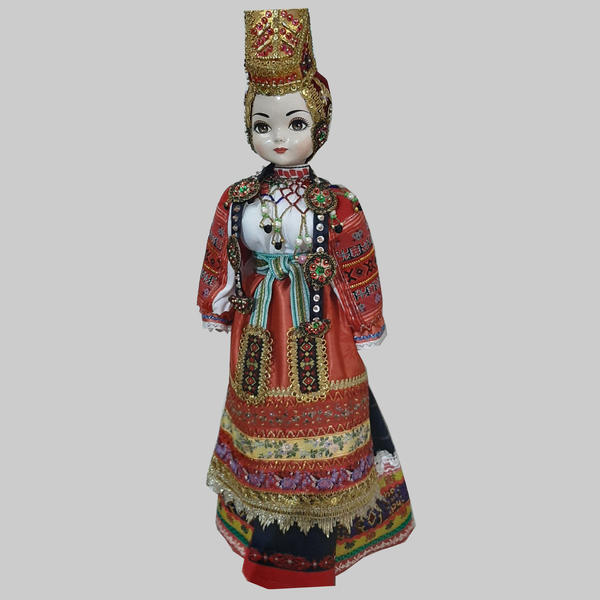
Representative of the southern Russian region, ponyova belongs to the most ancient Russian women’s clothing type. It was mentioned for the first time in the 10th century. The word ‘ponyova’ in ancient times meant a woven fabric. The modern concept of ponyova as a skirt made of dense fabric began to appear later. The literal translation of ''ponyova'' (''to understand, to embrace'') is a female loincloth. Ponyova could be both swinging / open and close, when the edges of panels touched, tied with a waist cord.
Ponyova was worn over a shirt and consisted of several panels, usually woolen. The most common fabric version was black cloth with checkworks embroidered with coloured threads. An interesting fact is that only married women wore ponyovas. Young village girls wore shirts. For them, there was a whole rite of ''jumping into ponyova'', when for one day they put on a ''woman’s'' skirt, declaring themselves brides.
In Southern Russian provinces, in addition to ponyova, a traditional clothing set included: a shirt with decorated shoulder and sleeve parts, an apron, a belt (''pokromka'')), a breast-collar, a headwear (''soroka'', i.e. magpie), bast or leather shoes. Regular ponyovas were intended for daily wear, their decoration was not given as much time and material as ceremonial, festive versions of this clothing type.
Every region developed its own traditions of decorating ponyovas. Verkhnesosensk products were distinguished by unusual, looped threads overlapping, while Korotoyak skirts - by large folds. The Sapozhkovsky district costumes necessarily included a white woolen shushpan - a caftan-''navershnik'', and Rossoshansky ponyovas in the last century were actively used only during ceremonial events.
Festive clothes were richly decorated with embroidery, lacing, stitching stripes, lace inserts, sequins, beads. The main colours in clothing were red and white. Shades of red could range from dark to light. So, in the north of Russia, red in women’s costumes could go into deep crimson tones. In the southern regions, preference was given to orange-red shades. Ponyova-skirts were more often made of dense dark blue and black fabrics, giving its owner’s figure splendour and confidence.
The most striking decorations were ponyovas in the Belgorod region and the Voronezh province villages. From century to century, ancient ornaments were embroidered on ponyova-skirts and aprons' bottoms, on shirt sleeves, bearing a semantic load. They included magical symbols of Indo-European origin. The most expensive ponyovas were decorated with a meander - a repeating, winding ornament of a clear form.
#19
Full name: Doll in a Traditional Costume in Soroka from Ostrogozhskiy Parish in Voronezh Governorate
Author: Valentina Yakovlevna Gorbacheva
Date: the 20th century
Dimensions: 62 cm
Collection: Boguchar District Museum of Local History
Copyright: Boguchar District Museum of Local History
Goskatalog Number: 16046128
Author: Valentina Yakovlevna Gorbacheva
Date: the 20th century
Dimensions: 62 cm
Collection: Boguchar District Museum of Local History
Copyright: Boguchar District Museum of Local History
Goskatalog Number: 16046128
#6
Doll in Dress of Ostorogozhsky District
#20
#21
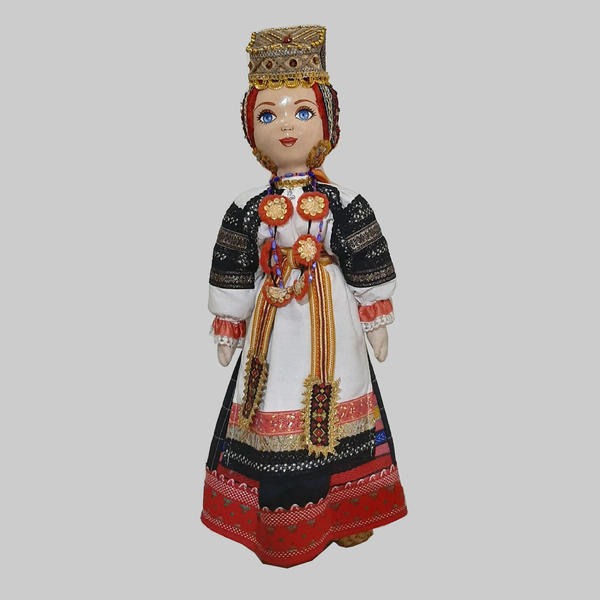
Folk costumes of Ostrogozhsky District in Smolensk province have their own characteristics. Some elements are not found in clothes of women from other areas and are rightfully considered the cultural heritage of Ostrogozhsky villages. Using the example of a doll made by master Valentina Gorbacheva, one can see that local women in the 18th and 19th centuries dressed with special chic and grace, which were also characteristic of everyday dresses.
The traditional dress of women from Shubnoy village in Ostrogozhsky District, consisted of a homespun red striped woolen skirt, a white shirt with lace trim and a white curtain (apron) with lace trim. The outfit was complemented by a belt made of braid, the edges of which were decorated with embroidery and beads.
Even in the festive version, the Ostrogozhsky women used white shirts made of dense canvas, the sleeves of which were picked up and decorated with wide black ornaments. It could be embroidery, but braids were most often used to create elaborate patterns. The richer the decoration of the sleeves and the whiter the shirt, the higher that woman’s place was in the hierarchy of wardrobes. Casual shirts, as a rule, had minimal decoration and were sewn from a greyish rather than snow-white fabric. It is worth noting that the sleeves on such shirts were often short so that the clothes did not hinder movement and did not interfere with work.
In general, in the 18th century in the Ostrogozhsky district, there were more than 10 different styles of women’s shirts. The most common option is a ‘flea fleece’ made of grey coarse fabric without decoration with long sleeves and a long hem, which simultaneously served as a dressing gown or nightgown.
Depending on the status of the woman, the shirt was complemented with a sundress or poneva - a woolen skirt. Sundresses were mainly worn by unmarried girls or widows, but married women had to wear ponevas. They were sewn from a very dense homespun cloth, mainly woolen. In a festive performance a scarlet with yellow or white checkered skirt was worn, and dark woollen with red checkered ponevas were worn casually.
But any skirt, both festive and casual, was always complemented by a curtain (apron). It was embroidered with special care on the bottom edge, using braid, beads or coloured threads. Embroidery was considered to be the most complex and time-consuming decoration and had a sacred meaning. Young women used symbols such as the tree of life, earth, flowers, so that as many children as possible could be born in the family. Older women decorated the curtains with stylized animals and plants - a symbol of fertility. More often, rhomboid patterns representing the pagan god of the sun were used.
Ostrogozhsky women paid special attention to accessories and certainly complemented their wardrobe with long beads made of glass or wood, massive earrings and woven belts. For their manufacture, multi-coloured braid was usually used, but in some cases - ribbons or trimmings of fabrics, from which wide festive sashes were created.
#22
Full name: Doll in Traditional Dress of Ostorogozhsky District of the Voronezh Province
Author: Valentina Yakovlevna Gorbacheva
Date: 20th century
Dimensions: 62 cm
Collection: Boguchar District Museum of Local History
Copyright: Boguchar District Museum of Local History
Goskatalog Number: 16046100
Author: Valentina Yakovlevna Gorbacheva
Date: 20th century
Dimensions: 62 cm
Collection: Boguchar District Museum of Local History
Copyright: Boguchar District Museum of Local History
Goskatalog Number: 16046100
#7
Doll in a national Ostrogozhskiy costume
#23
#24
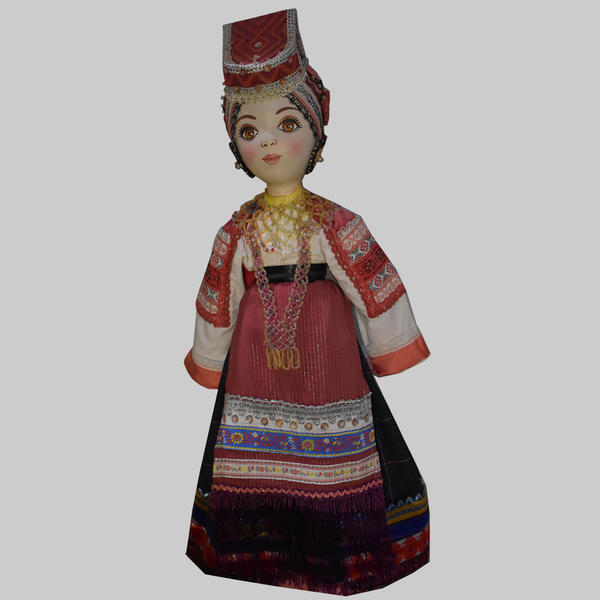
This big-eyed doll with a blush on her white face is wearing the Ostrogozhskiy district festive female costume. Every detail of a traditional gown has an ethnographic value. The costume base is a white shirt made of a homespun fabric with a sleeve gathered to the bottom, decorated with a white lace and a scarlet ribbon. She has a black-stitched woolen ponyova skirt over her shirt. The white ''curtain'' / ''veil'' (apron) at the bottom is richly decorated with lacing. A belt tightly encircling the doll’s waist - called “pokromka” - is also made of lacing. It slightly expands to the bottom, the ends are edged with gold lacing and decorated with bright geometric ornament.
We see on her head an example of the most luxurious folk dress - ''soroka'' - made of red fabric with beads and sparkling lacing. On the doll’s neck there is a traditional ''gribatka'' – an ornament of circles sewn together with gold and silver threads, a circular ''monist'' (necklace) complements the image. The doll is shod in neat bast shoes.
The festive folk costume colour palette consists of bright shades. Orange occupies a special place in it, or, ''yellow-hot'', as it is called in the Ostrogozhskiy district, due to its similarity to the hot sun colour. Crimson and pale pink colours in the outfit symbolize sunsets and sunrises, and underlined with green or blue, they seem even brighter, as if they were burning.
The symbol of all vegetation is green, it reminds of crops on peasant fields, generous garden beds, lush grasses of numerous Russian meadows, splendid tree crowns in gardens and dense forests, and leafy groves. Green symbolizes freedom, peace and abundance, however it is used in folk costumes not as actively as scarlet or red.
Yellow in a costume symbolizes short-term separations, ultramarine – rivers, seas and skies, as well as fidelity and chastity. White means death and mourning. Cold blue is rarely used, and only in the form of thin stripes or beads. Blue which means fear, bad weather and bloodlessness, emphasizes the brightness of red.
Black symbolizes eternal peace and rich lands, it is often and willingly used in the Voronezh region costumes - festive ponyova-skirts, for example, are always black. This helps emphasize the rhythm of colour combinations, multi-colour and shine of lacing, beads, gold and silver threads which decorate the gown. Black does not muffle other colours, thanks to it the joyful sound of bright colours becomes only more distinct.
In every element of festive attire thought out to the smallest detail, we feel not only a hand of a master and an innate taste, but also an aspiration to beauty and harmony.
#25
Full name: A doll in a national traditional costume from Ostrogozhskiy parish of Voronezh governorate
Author: Valentina Yakovlevna Gorbacheva
Date: the 20th century
Dimensions:
61 cm
Collection: Boguchar District Museum of Local History
Copyright: Boguchar District Museum of Local History
Goskatalog Number
: 19546098
read morehide
00:00
00:00
1x
Dolls of Voronezh, Ostrogozhsk, Rossoshka
Exhibition
0
 Point your smartphone camera to open in the app
Open in app
Share