

#1
Куклы Смоленска, Казачка, Девушка с косой
#2
#5
#6
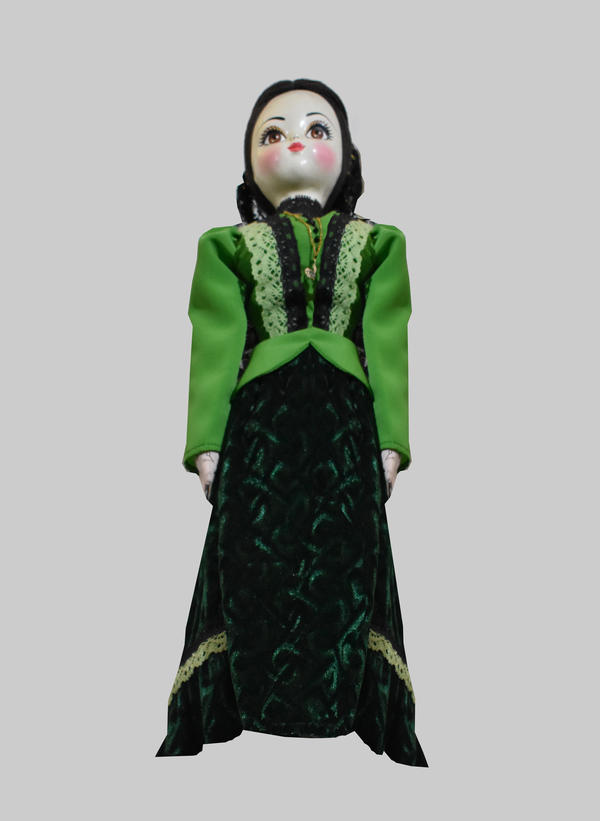
The Don Cossacks have always dressed brightly and originally, but elegantly at the same time. Various historical events influenced their way of life, and the traditional Cossack costume has been modified many times, but at all times it has been distinguished by beauty and restraint. An integral part of the life of Don Cossacks was the art of war, which was naturally reflected in the Cossack men’s costume. Elements of military uniforms can be found in the Cossacks’ everyday clothes. A vivid example of this is the trouser braids - wide stripes on the sides of the Turkish-type trousers.
The red braids are a symbol of Cossack brotherhood; they epitomize courage and free spirit. According to some researchers, the braids were borrowed by the Cossacks from the Scythians, but the people have opted for a different version. In the 14th century, the king granted the Cossacks some fabrics for making clothes, according to the legend: the red one was intended for atamans (leaders), and the blue one - for lower ranks. However, Cossacks disposed of the gift in their own way and divided the fabrics equally - so that everyone received a large piece of the blue fabric and a small piece of the red one. The blue fabric went to make trousers, and the red was enough only for small side stripes – the braids.
Nowadays Don Cossacks wear costumes reminiscent of the clothes of their ancestors, the indigenous settlers of the Don, before the advent of Soviet power and the mass persecutions. The old folks say that after the red terror campaign, the people were afraid to even think about Cossacks, let alone wear Cossack folk costumes. But the descendants have not forgotten the traditions of their great-grandfathers and a century later they wear shirts, trousers with braids, socks and boots worn by Cossacks in the 19-20th centuries.
The Cossack women’s outfits are also of great interest to historians. In old times, the Lower Don Cossacks were richer than the Upper Don inhabitants, so the women there bought more expensive foreign fabrics to make clothes. Their costumes were bright, colorful and often decorated with embroidery and unusual patterns. The Upper Don Cossack women’s clothes were simpler. Their costumes resembled those of the people living in regions of Southern Russia. But, these differences have disappeared over time.
The outfit of the modern Don Cossack woman consists of a blouse and a long skirt, the so-called ‘couple’. The cut and design of the Cossack woman’s blouse are varied. It can be slim fit or loose, monochrome or decorated with original embroidery. The skirt usually has a flared cut and is often decorated with a contrasting braid and other interesting elements.
#7
Full name:
Cossack Woman Doll
Author: Valentina Yakovlevna Gorbacheva
Date: 20th century
Dimensions: 53 cm
Collection: Boguchar District Museum of Local History
Copyright: Boguchar District Museum of Local History
Goskatalog Number: 16046124
Cossack Woman Doll
Author: Valentina Yakovlevna Gorbacheva
Date: 20th century
Dimensions: 53 cm
Collection: Boguchar District Museum of Local History
Copyright: Boguchar District Museum of Local History
Goskatalog Number: 16046124
#3
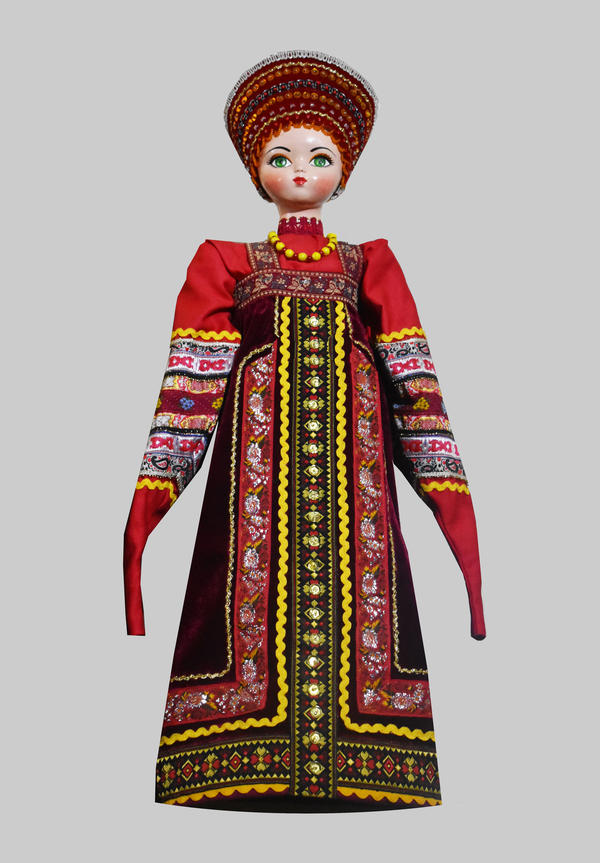
Doll of Smolensk Governorate
#8
#9
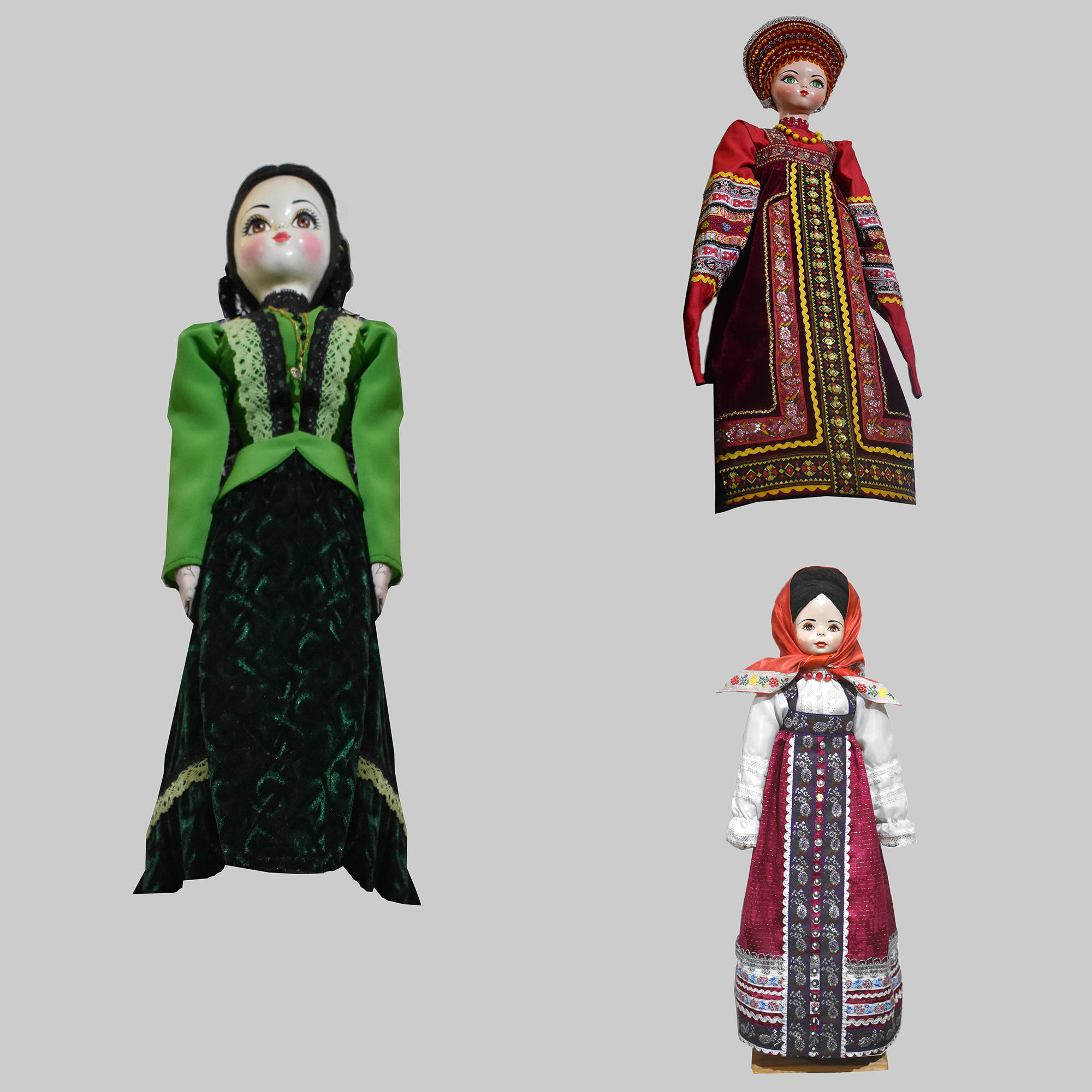
Since the dawn of time, a doll has been a favorite toy in Russia made of clay, fabrics, straw, wood, and even threads. Doll costumes reflected not only fashion trends of a certain epoch, but also traditions of different ethnic groups or regions. If you look at the doll made by artist Valentina Gorbacheva, you will see what girls and women in Smolensk Governorate wore in the 18th – 19th century.
The Smolensk region is located at the intersection of two territories having very different historical background and culture. These are Great Russians who occupied the northern and eastern territories and Belarusians located in the south-west. That is why the inhabitants of Smolensk Governorate assimilated traditions of the two peoples which also reflected in their clothing. Up to the first half of the 20th century, a classical festive women’s costume was made up of a red shirt with long sleeves that narrowed down. This style of the shirt was common for Great Russians, however, its color and fabrics were borrowed from their Belarusian neighbors. Another common garment was a red velvet sarafan with beads and lacing that also combined the traditions of the two peoples. Velvet, being a very expensive fabric for festive clothing, had long been used in northern regions. In southern territories, such sarafans were made of bleached linen while fancy lacing and beads are traditional Belarus ornaments.
A kokoshnik complementing women’s costume of Smolensk Governorate is a common headwear for Great Russians while lapti were universal shoes for the Slavs although they were different in weaving style and materials. As for a beaded necklace, this accessory was popular both in the north and in the south.
A traditional costume of Smolensk Governorate has its own specific features, for example, the fit of the shirt that was often made of three or four pieces of fabric. Better fabrics was used for the sleeves and the top while rougher pieces could be used for the bottom. Moreover, this model also featured poliks, or special shoulder pads. The neck line was decorated with fine laces and fixed on a band so that it fit the neck tightly. The shirt had button fastening at the front or the back. The sleeves always featured ukrasy – lacing or beaded embroidery. Usually the sarafan was ornamented with the same ukrasy pattern.
Another way of shirt sleeve decoration was embroidery that often served as a protective talisman. The fancy ornament featured trees and female figures as a symbol of fertility as well as straight and curvy lines symbolizing forces of nature. It was often decorated with geometric figures featuring flowers, sketches of people and animals.
Interestingly, a Smolensk sarafan was in a trapezoidal shape, that is, it had side gussets. The bottom of the skirt and the front part were always decorated. The bigger and the brighter the ornaments were, the more festive the sarafan.
#10
Full name:
Doll of Smolensk Governorate
Author:
Valentina Yakovlevna Gorbacheva
Date: the 20th century
Dimensions: 58 cm
Collection: Boguchar District Museum of Local History
Copyright: Boguchar District Museum of Local History
Goskatalog Number: 16046123
Doll of Smolensk Governorate
Author:
Valentina Yakovlevna Gorbacheva
Date: the 20th century
Dimensions: 58 cm
Collection: Boguchar District Museum of Local History
Copyright: Boguchar District Museum of Local History
Goskatalog Number: 16046123
#4
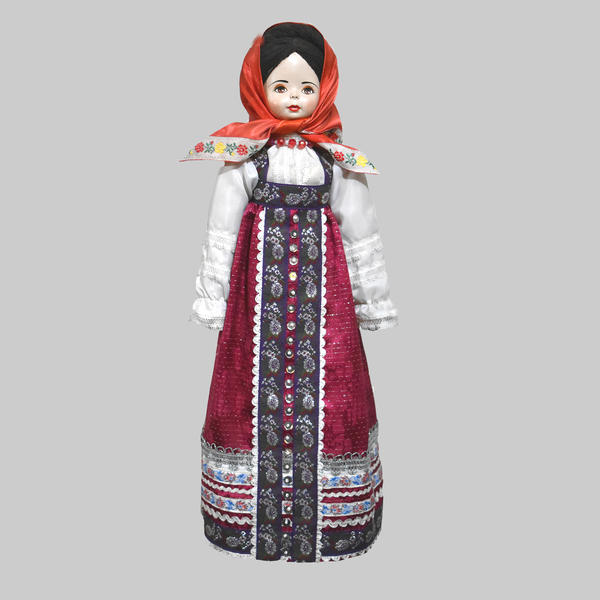
Doll, a Girl with a Braid
#11
#12
The everyday outfit of Tambov peasant women consisted of a shirt made of homespun cloth with trapezoid (polikami) inserts on the shoulders and a checkered poneva. The latter differed from a simple skirt in stitching - a dark piece of plain fabric. Ponevas were worn so that the seam was at the front or slightly on the side as it wasn’t noticeable behind the apron.
Sashes were worn by both men and women. These multi-colored belts were wrapped several times around the waist and tied in a knot. Its ends drooped freely. These sashes not only supported loose trousers, ponevas or shirts, but also played a role of one of the main pieces of decoration of the outfit.
Children of both sexes wore shirts from homespun cloth girdled with narrow sashes. Girls dressed like that until the age of 15-16. Then the outfit was complemented by bright skirts or sundresses. This is what was worn at girls’ gatherings and dances during celebrations. It was believed that if a girl put on a skirt over a shirt, you could send marriage proposals to her family.
The fabric for sewing shirts was woven by the people themselves. The manufacturing process of linen, hemp and wool was long and laborious. Throughout autumn, winter and early spring, all women in the house participated in it. Textile production continued until the start of sowing.
Seven-year-old girls performed simple work - unwinding threads, and after five years of that became experienced spinners. From the age of 15 they were sent to whitewash canvas. Weaving was considered the most important and difficult work. This was done by older women, 20-40 years old. The process began after harvesting, spun on long winter evenings.
Finished yarn was dyed black, red, blue or orange. In homes, people mostly could make only black threads. To make dye, hot kvass was poured on iron scrap. Most of the time, yarn was given to professional dyers.
Weaving began in early spring, during Lent. At that time, a weaving mill was brought into the house and put close to the window. Simple weaving techniques were usually used, although from time to time people resorted to more complex techniques. In addition to hemp and linen, woolen and semi-woolen materials could also be made at home. Ponevas and outerwear were then sewn from them.
Women also engaged in sewing using hemp thread. The styles of their outfits depended on the size of available fabrics. Casual clothes, such as sundresses and skirts, did not have wide hems.
#13
Full name: Doll in traditional Tambov province dress
Author: Valentina Yakovlevna Gorbacheva
Date: 20th century
Dimensions: 50 cm
Collection: Old Fashions
Copyright: Boguchar District Museum of Local History
Goskatalog Number: 15968103
Author: Valentina Yakovlevna Gorbacheva
Date: 20th century
Dimensions: 50 cm
Collection: Old Fashions
Copyright: Boguchar District Museum of Local History
Goskatalog Number: 15968103
read morehide
00:00
00:00
1x
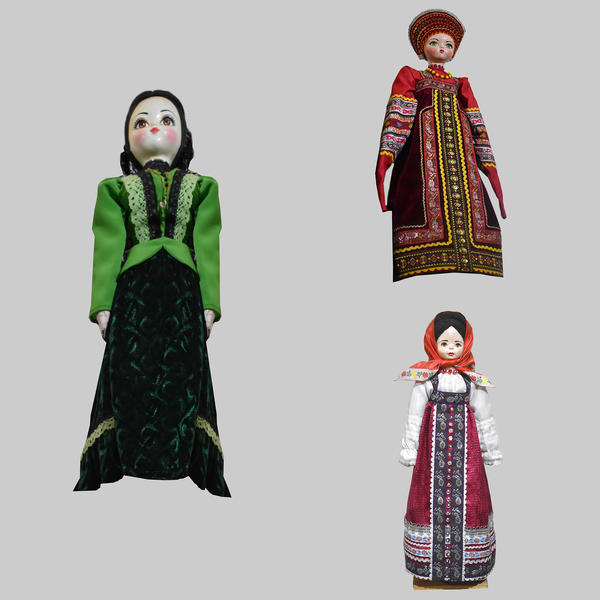
Smolensk dolls, Cossack, Girl with a scythe
Exhibition
0
 Point your smartphone camera to open in the app
Open in app
Share