

#1
Dolls of Nizhnedevitsk, Boguchar, Kursk, Gypsy
#2
#3
#4
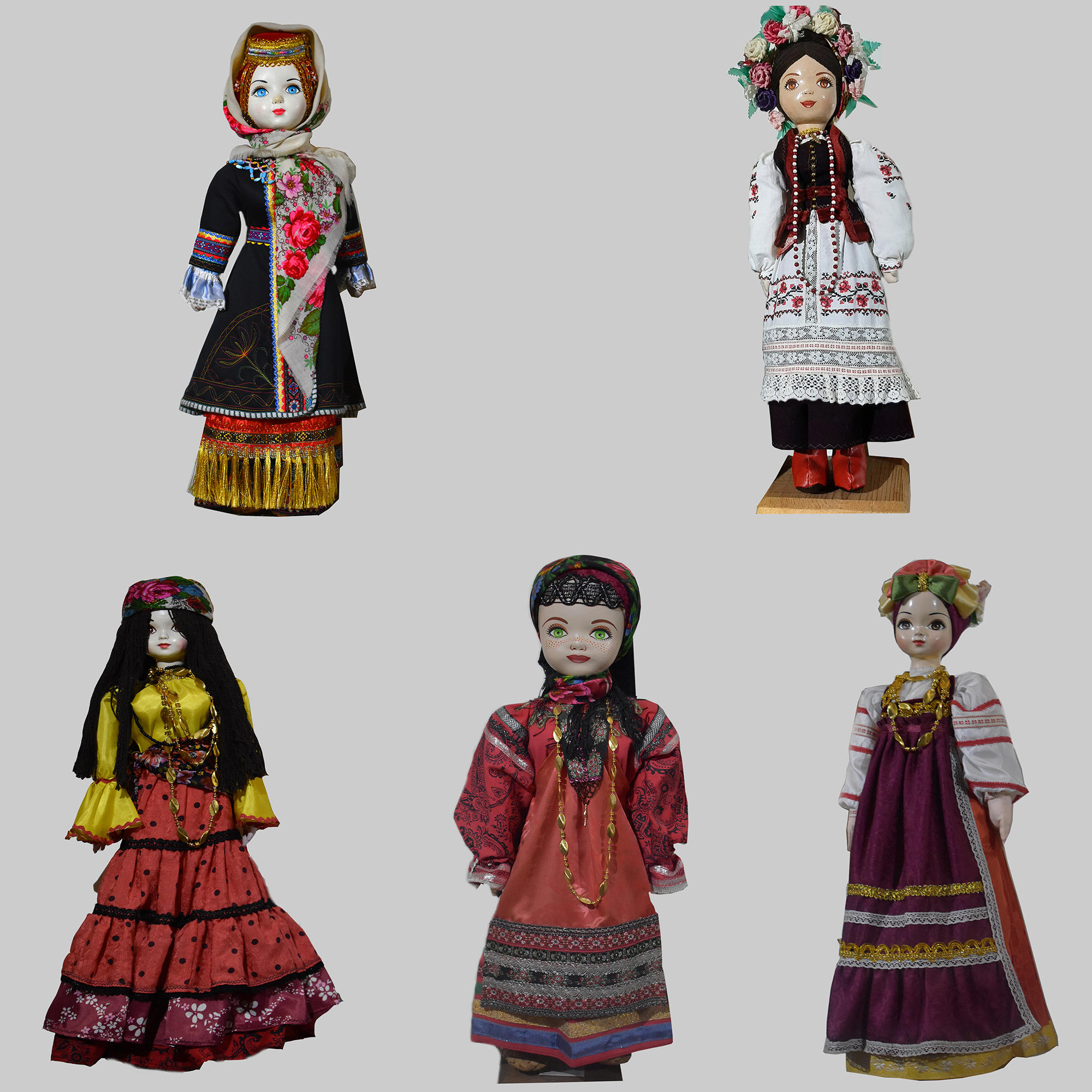
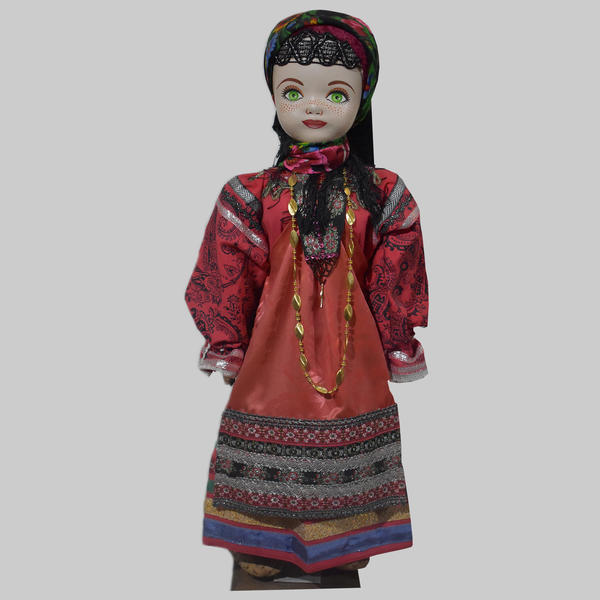
This green-eyed doll with freckles generously scattered on her round face is wearing an original colourful female costume characteristic of the Nizhnedevitsky district. Women wore such clothes here during the late 19th and early 20th centuries. The peculiar and catchy detail of a traditional costume was a wide belt with ''makhras'', or ''terry, ’ - threads or tassels hanging around the edges of the clothing and resembling a fringe. “Makhras” were manually made of rainbow colour threads, purchased bright ribbons and hem (fringe or lacing with gold and silver thread) were sometimes added to them. Fabrics for shirts were also bought from visiting merchants.
The outfit is complemented by a red ''curtain'', or ''veil'' (apron), decorated with ribbons and braids, a ''poddushnik '' (an element covering the collar of the shirt), and a ''podpruzhka'' (an element made of a narrow fabric strip and supporting the veil). The finishing touch of this image is a scarf made of silk Chinese fabric with a gold pattern. Nizhnedevitsky peasant women used to put on a soft chintz hat called ''shlychok'' under a headscarf. It was decorated with lace or skillfully embroidered with silk and beads ''ochelye'' (''around the head''), which covered almost the entire forehead. A short ribbon with a mascot icon and several threads of multi-coloured beads was worn over a shirt and a poddushnik.
Nizhnedevitsky unmarried girls wore costumes consisting of a sundress, poddyovka - a petticoat, worn under a sundress, - and a white shirt. A “girdle” belt emphasized a thin waist, a coronet covered a head in the middle of a forehead, ribbons decorated a chest. A zapana with sleeves complemented the outfit.
Girls wore a close sundress made of slanting wedges which belonged to the oldest type of women’s dress. Such a dress was made of material called ''volosen'' (literally ''hair'') - a dense black fabric (usually black wool). Girls used a bandage made of brocade or braid with gilding as a headdress. It had a cardboard or hard coarse canvas backing. They called this bandage a ''coronet'', and decorated it with beads or multi-coloured terry.
This type of costume is called ''Southern Great Russian'', with a ponyova for married women and a sundress for unmarried girls. However, in some villages even mothers of a family would have a sundress in their wardrobes. Ponyova, or paneva, is the oldest Slavic skirt sewn from three longitudinal woolen homespun cloths 35 centimeters wide; this was exactly the loom’s width. Ponyova could be close or swinging / open. The swinging ones had a second name - “raznopolka” - three pieces of fabric sewn together in a rectangular cloth.
The name of the women’s clothing item ''paneva'' first appeared on the pages of Russian chronicles. And on the 12th century casement silver bracelet found by archaeologists in Old Ryazan, a woman in a paneva over a shirt is depicted. They wore panevas with a placket either in the front or on the side. The skirt was fastened at the waist with a ''gashnik'' - a twisted woolen cord.
The outfit is complemented by a red ''curtain'', or ''veil'' (apron), decorated with ribbons and braids, a ''poddushnik '' (an element covering the collar of the shirt), and a ''podpruzhka'' (an element made of a narrow fabric strip and supporting the veil). The finishing touch of this image is a scarf made of silk Chinese fabric with a gold pattern. Nizhnedevitsky peasant women used to put on a soft chintz hat called ''shlychok'' under a headscarf. It was decorated with lace or skillfully embroidered with silk and beads ''ochelye'' (''around the head''), which covered almost the entire forehead. A short ribbon with a mascot icon and several threads of multi-coloured beads was worn over a shirt and a poddushnik.
Nizhnedevitsky unmarried girls wore costumes consisting of a sundress, poddyovka - a petticoat, worn under a sundress, - and a white shirt. A “girdle” belt emphasized a thin waist, a coronet covered a head in the middle of a forehead, ribbons decorated a chest. A zapana with sleeves complemented the outfit.
Girls wore a close sundress made of slanting wedges which belonged to the oldest type of women’s dress. Such a dress was made of material called ''volosen'' (literally ''hair'') - a dense black fabric (usually black wool). Girls used a bandage made of brocade or braid with gilding as a headdress. It had a cardboard or hard coarse canvas backing. They called this bandage a ''coronet'', and decorated it with beads or multi-coloured terry.
This type of costume is called ''Southern Great Russian'', with a ponyova for married women and a sundress for unmarried girls. However, in some villages even mothers of a family would have a sundress in their wardrobes. Ponyova, or paneva, is the oldest Slavic skirt sewn from three longitudinal woolen homespun cloths 35 centimeters wide; this was exactly the loom’s width. Ponyova could be close or swinging / open. The swinging ones had a second name - “raznopolka” - three pieces of fabric sewn together in a rectangular cloth.
The name of the women’s clothing item ''paneva'' first appeared on the pages of Russian chronicles. And on the 12th century casement silver bracelet found by archaeologists in Old Ryazan, a woman in a paneva over a shirt is depicted. They wore panevas with a placket either in the front or on the side. The skirt was fastened at the waist with a ''gashnik'' - a twisted woolen cord.
#5
Full name: A doll in an old costume from Nizhnedevitsky district
Author: Valentina Yakovlevna Gorbacheva
Date: the 20th century
Dimensions: 70 cm
Collection: Boguchar District Museum of Local History
Copyright: Boguchar District Museum of Local History
Goskatalog Number: 16046113
Author: Valentina Yakovlevna Gorbacheva
Date: the 20th century
Dimensions: 70 cm
Collection: Boguchar District Museum of Local History
Copyright: Boguchar District Museum of Local History
Goskatalog Number: 16046113
#6
Doll in a Boguchar Costume
#7
#8
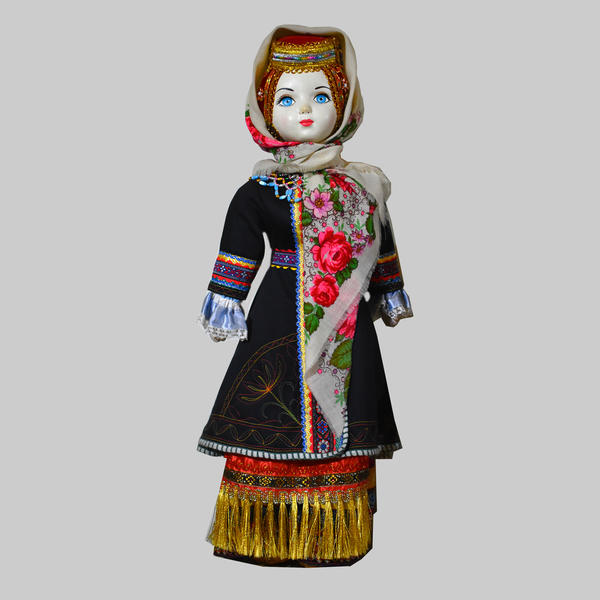
The blue-eyed doll in a folk costume attracts attention with unusual eye-colored beads, a luxurious kerchief over the garment richly embroidered with sequins and golden braid. These details are traditional for Boguchar District. Back in the 19th century, each village of the District had its own traditions, rites, songs, men’s and women’s costumes intended for various occasions. One costume was only to be worn to the church, another on festive occasions, and still another one at harvest time. This also applied to winter clothing, which the doll is wearing.
The basis of the winter version of the women’s outfit with the symbolic name ‘Boguchar Ukrainian woman’ was the so-called ‘pair’ - a waistcoat (a close-fitting sleeveless garment) and a warm woolen skirt, which was made from purchased fabric and generously decorated with golden braid. The set included a traditional embroidered white gown, an apron that served as a veil, a handbag with women’s trifles, and a large kerchief painted with roses. Beads of various shapes and colors complemented the image.
The traditional wedding ritual - covering the bride’s head with a kerchief - had a sacred meaning: from the moment the girl became a married wife her hair was always covered with a kerchief. According to an ancient belief, a woman’s hair hides witchcraft power, so a woman could appear with an uncovered head only in front of her husband; even close relatives who she shared a house with - a father-in-law and a mother-in-law - were not supposed to see her without a kerchief.
Every woman had several favorite kerchiefs, they were bought and given as presents, and such gifts were always welcome. Boguchar settlers from Ukraine, unlike Russian beauties, did not wear red scarves, but only white or milky colored ones, with fringes and a variety of floral patterns, but the most popular pattern were roses. In very cold weather women complemented their outfits with a white shawl.
A poneva – a woolen skirt, was an essential element of the women’s costume. It was sewn both from a rough home spun cloth made from long sheep’s wool, and a finer fabric which was purchased. The usual coloring of the poneva was ‘black eyes’ – the background of the black soil color with red stripes forming squares. The stripes symbolized the division of the earth by roads, clearings and rivers.
The traditional dowry of each Boguchar Ukrainian girl included at least twelve sets of ponevas and embroidered gowns. Festive clothings usually did not wear out, so they were often passed on by inheritance. In the 20th century, some families inherited richly embroidered ponevas; they ripped the seams of the garments and used the pieces as wall carpets or bedspreads.
The embroidered hemp gown was considered to be both a festive and an underwear garment. At the end of the 19th century the gown consisted of two parts connected by a transverse seam. The upper part was called a ‘torso’ and the lower part - a ‘hem’ or ‘support’. Usually a home spun canvas was used for a gown: the coarser type was for everyday wear, and the finer - for festive clothes.
The basis of the winter version of the women’s outfit with the symbolic name ‘Boguchar Ukrainian woman’ was the so-called ‘pair’ - a waistcoat (a close-fitting sleeveless garment) and a warm woolen skirt, which was made from purchased fabric and generously decorated with golden braid. The set included a traditional embroidered white gown, an apron that served as a veil, a handbag with women’s trifles, and a large kerchief painted with roses. Beads of various shapes and colors complemented the image.
The traditional wedding ritual - covering the bride’s head with a kerchief - had a sacred meaning: from the moment the girl became a married wife her hair was always covered with a kerchief. According to an ancient belief, a woman’s hair hides witchcraft power, so a woman could appear with an uncovered head only in front of her husband; even close relatives who she shared a house with - a father-in-law and a mother-in-law - were not supposed to see her without a kerchief.
Every woman had several favorite kerchiefs, they were bought and given as presents, and such gifts were always welcome. Boguchar settlers from Ukraine, unlike Russian beauties, did not wear red scarves, but only white or milky colored ones, with fringes and a variety of floral patterns, but the most popular pattern were roses. In very cold weather women complemented their outfits with a white shawl.
A poneva – a woolen skirt, was an essential element of the women’s costume. It was sewn both from a rough home spun cloth made from long sheep’s wool, and a finer fabric which was purchased. The usual coloring of the poneva was ‘black eyes’ – the background of the black soil color with red stripes forming squares. The stripes symbolized the division of the earth by roads, clearings and rivers.
The traditional dowry of each Boguchar Ukrainian girl included at least twelve sets of ponevas and embroidered gowns. Festive clothings usually did not wear out, so they were often passed on by inheritance. In the 20th century, some families inherited richly embroidered ponevas; they ripped the seams of the garments and used the pieces as wall carpets or bedspreads.
The embroidered hemp gown was considered to be both a festive and an underwear garment. At the end of the 19th century the gown consisted of two parts connected by a transverse seam. The upper part was called a ‘torso’ and the lower part - a ‘hem’ or ‘support’. Usually a home spun canvas was used for a gown: the coarser type was for everyday wear, and the finer - for festive clothes.
#9
Full name: Doll in a Traditional Boguchar Costume (Ukrainian Woman)
Author: Galina Yakovlevna Sysoeva
Date: 20th century
Dimensions: 66 cm
Collection: Old Fashions
Copyright: Boguchar District Museum of Local History
Goskatalog Number: 15967498
Author: Galina Yakovlevna Sysoeva
Date: 20th century
Dimensions: 66 cm
Collection: Old Fashions
Copyright: Boguchar District Museum of Local History
Goskatalog Number: 15967498
#10
Doll in Boguchar Traditional Costume
#11

#12
The Boguchar District was one of the Voronezh Province Southern territories. Same as many South Russian regions, the Boguchar land gave shelter to emigrants from Ukraine. In the Boguchar traditional costume, one can trace Ukrainian garment motives – wreaths, bands, floral embroidery. Intermingling of the Russian and Ukrainian traditions is especially evident in one version of the traditional costume – Boguchar Khokhlushka (Ukrainian Woman). A brown swing skirt from woolen factory-made fabric gathered at the waist was combined with a tight fit waistcoat decorated with crinkled basque which formed a pair set. At the hem, the skirt was bordered with braid with metal decorations. The waistcoat (sleeveless blouse) was worn on top of the shirt and was buttoned or hooked at the front with closely set buttons or hooks.
On the shirt sleeves and hem, traditional geometric patterns of Russian costumes were intertwined with floral patterns coming from Ukrainian garments. Normally, in South Russian costumes, the shirt sleeves were decorated with embroidery without clear outlines – the patterns were scattered all over the sleeve cloth. While Boguchar garments could be distinguished and differentiated from all others by the clear border formed by male and female figures embroidered on the sleeve with black and red threads.
On top of the skirt, an apron richly decorated with multilayer floral embroidery was worn. Embroidered stripes on the fabric were interspersed with lace inserts, with lace ruche sewn onto the apron rim. The apron was one of the most important elements of the Voronezh woman’s costume. In the olden days, it was called zapan, zaveska, zanaveska (“curtain”). There were a few versions of apron in women’s costumes – wait-high, chest-type, and tunic-shaped.
In the Boguchar traditional costume, instead of bast shoes (lapty), red leather boots predominated which were also borrowed from Ukrainian national garments. Women covered their heads with a soft woolen shawl of light shades, usually Cashmere, with a floral pattern. Over the shawl, a wreath from artificial flowers with white and pink buds was worn. In the absence of a wreath, in accordance with the Ukrainian tradition, the ends of the shawl could be twisted and wrapped over the head. Boguchar maidens’ neck was decorated with a long necklace of large beads.
Men’s garments were not so diverse, but also consisted of a few mandatory pieces: a long girded Kosovorotka (skewed-collared) shirt, pants, bast shoes (lapty), peak cap. On holidays, bridegrooms and suitors decorated the peak cap with a romantic red rosebud, put on chest decorations – garus or gribatka (monisto necklace). In cold time, the costume was completed with a fur coat or a half-length fur coat, malakhai (fur cap), bashlyk (pointed cloth hood). On the feet, they wore valenki (felt snow boots) or boots. By silhouette, men’s shirts could be divided into three types: tunic-shaped loose fit shirt; shirt with straight poliks (shoulder inserts); shirt decorated with a yoke.
A shirt played an important role in the men’s traditional costume. It was not only a piece of clothes, but was also considered a strong talisman. They put it on a newly born baby, a festal shirt was worn at weddings and rituals, the same item was put on a deceased man when he was laid into the coffin. In a secret place of the shirt collar of soldiers defending the Russian land, a magic protective symbol was embroidered.
On the shirt sleeves and hem, traditional geometric patterns of Russian costumes were intertwined with floral patterns coming from Ukrainian garments. Normally, in South Russian costumes, the shirt sleeves were decorated with embroidery without clear outlines – the patterns were scattered all over the sleeve cloth. While Boguchar garments could be distinguished and differentiated from all others by the clear border formed by male and female figures embroidered on the sleeve with black and red threads.
On top of the skirt, an apron richly decorated with multilayer floral embroidery was worn. Embroidered stripes on the fabric were interspersed with lace inserts, with lace ruche sewn onto the apron rim. The apron was one of the most important elements of the Voronezh woman’s costume. In the olden days, it was called zapan, zaveska, zanaveska (“curtain”). There were a few versions of apron in women’s costumes – wait-high, chest-type, and tunic-shaped.
In the Boguchar traditional costume, instead of bast shoes (lapty), red leather boots predominated which were also borrowed from Ukrainian national garments. Women covered their heads with a soft woolen shawl of light shades, usually Cashmere, with a floral pattern. Over the shawl, a wreath from artificial flowers with white and pink buds was worn. In the absence of a wreath, in accordance with the Ukrainian tradition, the ends of the shawl could be twisted and wrapped over the head. Boguchar maidens’ neck was decorated with a long necklace of large beads.
Men’s garments were not so diverse, but also consisted of a few mandatory pieces: a long girded Kosovorotka (skewed-collared) shirt, pants, bast shoes (lapty), peak cap. On holidays, bridegrooms and suitors decorated the peak cap with a romantic red rosebud, put on chest decorations – garus or gribatka (monisto necklace). In cold time, the costume was completed with a fur coat or a half-length fur coat, malakhai (fur cap), bashlyk (pointed cloth hood). On the feet, they wore valenki (felt snow boots) or boots. By silhouette, men’s shirts could be divided into three types: tunic-shaped loose fit shirt; shirt with straight poliks (shoulder inserts); shirt decorated with a yoke.
A shirt played an important role in the men’s traditional costume. It was not only a piece of clothes, but was also considered a strong talisman. They put it on a newly born baby, a festal shirt was worn at weddings and rituals, the same item was put on a deceased man when he was laid into the coffin. In a secret place of the shirt collar of soldiers defending the Russian land, a magic protective symbol was embroidered.
#13
Full name: Doll in Boguchar Traditional Costume with Black Poddyovka and Colorful Shawl
Author: Valentina Yakovlevna Gorbacheva
Date: 20th century
Dimensions: 64 cm
Collection: Boguchar District Museum of Local History
Copyright: Boguchar District Museum of Local History
Goskatalog Number: 16046102
Author: Valentina Yakovlevna Gorbacheva
Date: 20th century
Dimensions: 64 cm
Collection: Boguchar District Museum of Local History
Copyright: Boguchar District Museum of Local History
Goskatalog Number: 16046102
#15
Kursk Region Doll
#14
#16
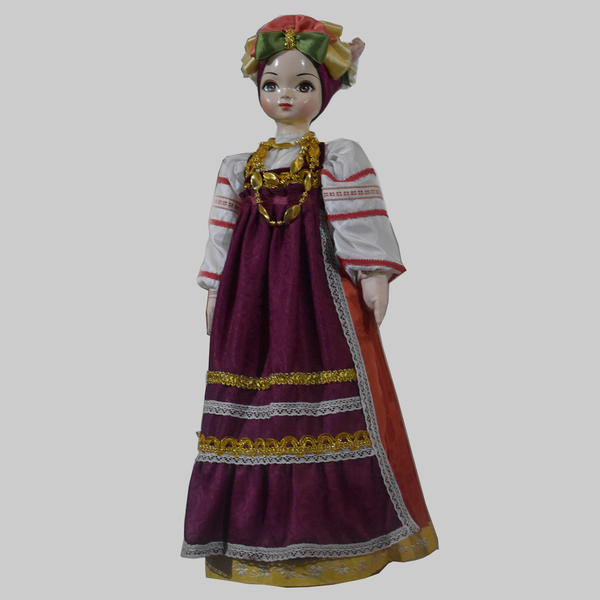
The outfits of female residents of the Kursk Region combined, in an unusual way, the features of the Volga region, Ukrainian and Belarusian folk costumes. They included workers', everyday, festive and ceremonial (wedding, funeral) clothes. Festive and wedding dresses were carefully stored and passed from generation to generation.
Girls who reached marriageable age (namely, 15-16 years of age) wore sarafans (sundresses). They were worn over a long gown, the upper part of which was made of the best linen cloth. Wide sleeves, assembled from below on a cuff, and the neckline were decorated with embroidery. The lower part of the gown was made of unbleached hemp canvas. The edge of the hem was covered with colored ribbon or lace.
The sarafan was tucked at the back with the folds resembling modern pleating. To prevent the folds from deforming, a sarafan’s bottom was tied up before the garment was placed in the chest. The sarafan was girded with a beautiful wool or silk belt. An apron covered the sarafan front like a veil. For this reason, girls from poor families often made the sarafan front from coarse fabric and did not decorate it at all, as it was not visible under the apron.
The apron was decorated with embroidery, appliqués and lace. According to tradition, the mother-in-law gave her daughter-in-law a veil (an apron) before the wedding. The richer was the apron embroidery, the better welcome was in store for the bride in her husband’s house. A simple canvas apron without embroidery meant that the young woman would be treated as a servant. In response, the daughter-in-law embroidered the sleeves on her mother-in-law’s gown and the bride’s work was demonstrated at the wedding to all guests.
In Kursk Region, the girls’ thinness was perceived as a sign of illness and a potential obstacle to marriage. To make their figures more sumptuous, young slim girls wore several sarafans for the holiday. After getting married, the girl replaced the sarafan by a poneva (wrap skirt) which consisted of two or three woolen pieces. It was worn, like the sarafan, above the gown. Beads were an essential element of the outfit.
Kursk women paid keen attention to hats. On weekdays, women and girls wore kerchiefs: women tied them at the back of their heads and girls did it in the front. On festive occasions, the girls wore wreaths made of artificial flowers, richly decorated with ribbons. Instead of a wreath, they would occasionally create a complex structure of a head band and satin ribbons. Those around them could admire the top of the girl’s head and a plait in a special cover - the nakosnik (braided decoration for unmarried women).
The festive head wear of a married Kursk woman differed from that of a girl, for not a single hair should be visible from under her head dress. It was a terrible shame for a woman to show her hair to strangers (make an unfortunate slip). Newly wed women wore tall, richly colored kokoshniks (a traditional Russian head dress).
After the birth of the first baby, the kokoshnik was hidden in the chest and saved for the woman’s daughter. The woman wore a slightly less spectacular hat, but it still contained 18 elements. In winter, women wore warm shawls, fur hats and sheepskin coats. Lapty (straw shoes) were the daily footwear. Festive footwear was made of leather, cloth and felt.
Girls who reached marriageable age (namely, 15-16 years of age) wore sarafans (sundresses). They were worn over a long gown, the upper part of which was made of the best linen cloth. Wide sleeves, assembled from below on a cuff, and the neckline were decorated with embroidery. The lower part of the gown was made of unbleached hemp canvas. The edge of the hem was covered with colored ribbon or lace.
The sarafan was tucked at the back with the folds resembling modern pleating. To prevent the folds from deforming, a sarafan’s bottom was tied up before the garment was placed in the chest. The sarafan was girded with a beautiful wool or silk belt. An apron covered the sarafan front like a veil. For this reason, girls from poor families often made the sarafan front from coarse fabric and did not decorate it at all, as it was not visible under the apron.
The apron was decorated with embroidery, appliqués and lace. According to tradition, the mother-in-law gave her daughter-in-law a veil (an apron) before the wedding. The richer was the apron embroidery, the better welcome was in store for the bride in her husband’s house. A simple canvas apron without embroidery meant that the young woman would be treated as a servant. In response, the daughter-in-law embroidered the sleeves on her mother-in-law’s gown and the bride’s work was demonstrated at the wedding to all guests.
In Kursk Region, the girls’ thinness was perceived as a sign of illness and a potential obstacle to marriage. To make their figures more sumptuous, young slim girls wore several sarafans for the holiday. After getting married, the girl replaced the sarafan by a poneva (wrap skirt) which consisted of two or three woolen pieces. It was worn, like the sarafan, above the gown. Beads were an essential element of the outfit.
Kursk women paid keen attention to hats. On weekdays, women and girls wore kerchiefs: women tied them at the back of their heads and girls did it in the front. On festive occasions, the girls wore wreaths made of artificial flowers, richly decorated with ribbons. Instead of a wreath, they would occasionally create a complex structure of a head band and satin ribbons. Those around them could admire the top of the girl’s head and a plait in a special cover - the nakosnik (braided decoration for unmarried women).
The festive head wear of a married Kursk woman differed from that of a girl, for not a single hair should be visible from under her head dress. It was a terrible shame for a woman to show her hair to strangers (make an unfortunate slip). Newly wed women wore tall, richly colored kokoshniks (a traditional Russian head dress).
After the birth of the first baby, the kokoshnik was hidden in the chest and saved for the woman’s daughter. The woman wore a slightly less spectacular hat, but it still contained 18 elements. In winter, women wore warm shawls, fur hats and sheepskin coats. Lapty (straw shoes) were the daily footwear. Festive footwear was made of leather, cloth and felt.
#17
Full name: Doll in the Folk Costume of the Kursk Region
Author: Valentina Yakovlevna Gorbacheva
Date: 20th century
Dimensions: 55 cm
Collection: Boguchar District Museum of Local History
Copyright: Boguchar District Museum of Local History
Goskatalog Number: 16046125
Author: Valentina Yakovlevna Gorbacheva
Date: 20th century
Dimensions: 55 cm
Collection: Boguchar District Museum of Local History
Copyright: Boguchar District Museum of Local History
Goskatalog Number: 16046125
#18
Gypsy Folk Costume
#19
#20
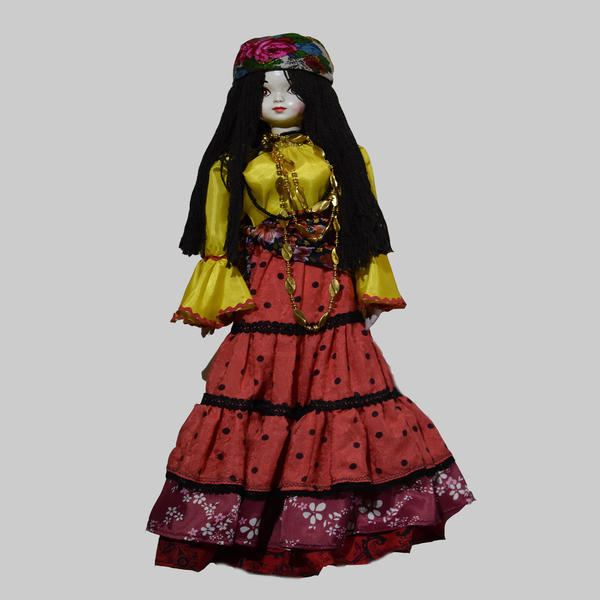
The Gypsies have inhabited the Boguchar district for a long time, some of them still live in the village of Zaliman. The Romani women’s folk costume in this area looked approximately similar to what the doll is wearing: a wide three-tier red skirt with black polka dots and a black ribbon trim, a yellow satin shirt with belt-shaped sleeves decorated with red ribbon, and a white colorful headscarf. And gypsy women have, of course, always loved flashy large jewelry- beads, earrings and bracelets.
The legend has it that gypsies are the descendants of lower caste Indians, so they have always liked - in spite of their poverty - to dress in an expensive and flamboyant style. The cut of their clothes was influenced by different cultures, but the elements of ancient Indian style can be seen in gypsy outfits to this day, according to researchers. This is especially true of women’s dresses that have retained their distinctive cultural character.
The main element of the gypsy costume is a floor length skirt. The woman’s legs must be completely covered – the Roma consider the lower half of the woman’s body ‘bad’ and ‘unclean’, so it is necessary to hide it. And you can wear everything you want at the top: any shirts and blouses. Low necklines and open shoulders are not frowned upon, they are not considered vulgar. It is the other way round - this way of demonstrating the female nature is considered beautiful and aesthetic.
Married women cover their heads with a triangular scarf, which is called diklo. It is first twisted at the ends and then tied on the back of the head. Their festive kerchiefs are decorated with fringe, embroidered with beads and bedazzlers.
Massive gold jewelry is an integral part of a gypsy woman image. The Europeans usually invest their wealth in the house and everyday life, while the Gypsy nomads have always worn all the gold on themselves.
A shawl made of wool or silk complements the outfit. The variety of the color schemes in their outfits is amazing. Gypsies prefer bright, vibrant colors featuring rich ornaments. Bachelorettes are not allowed to wear yellow clothes, however, and you will never see black monochrome wardrobe items on gypsies.
Typical costume elements for men are bright silk or satin shirts, vests and Turkish-style trousers.
Little Roma children are wrapped in soft fabrics; women often carry them in a sling on the chest or the back. Older children wear loose dresses and Turkish-style trousers. Nowadays, you can often come across Roma children wearing clothes we are used to. On holidays, girls dress up in long skirts, and boys put on beautiful shirts.
The legend has it that gypsies are the descendants of lower caste Indians, so they have always liked - in spite of their poverty - to dress in an expensive and flamboyant style. The cut of their clothes was influenced by different cultures, but the elements of ancient Indian style can be seen in gypsy outfits to this day, according to researchers. This is especially true of women’s dresses that have retained their distinctive cultural character.
The main element of the gypsy costume is a floor length skirt. The woman’s legs must be completely covered – the Roma consider the lower half of the woman’s body ‘bad’ and ‘unclean’, so it is necessary to hide it. And you can wear everything you want at the top: any shirts and blouses. Low necklines and open shoulders are not frowned upon, they are not considered vulgar. It is the other way round - this way of demonstrating the female nature is considered beautiful and aesthetic.
Married women cover their heads with a triangular scarf, which is called diklo. It is first twisted at the ends and then tied on the back of the head. Their festive kerchiefs are decorated with fringe, embroidered with beads and bedazzlers.
Massive gold jewelry is an integral part of a gypsy woman image. The Europeans usually invest their wealth in the house and everyday life, while the Gypsy nomads have always worn all the gold on themselves.
A shawl made of wool or silk complements the outfit. The variety of the color schemes in their outfits is amazing. Gypsies prefer bright, vibrant colors featuring rich ornaments. Bachelorettes are not allowed to wear yellow clothes, however, and you will never see black monochrome wardrobe items on gypsies.
Typical costume elements for men are bright silk or satin shirts, vests and Turkish-style trousers.
Little Roma children are wrapped in soft fabrics; women often carry them in a sling on the chest or the back. Older children wear loose dresses and Turkish-style trousers. Nowadays, you can often come across Roma children wearing clothes we are used to. On holidays, girls dress up in long skirts, and boys put on beautiful shirts.
#21
Full name: Gypsy Folk Costume, Boguchar Province
Author: M.N. Fokina, Yakovlevna Tkacheva
Date: 2nd half of the 19th century.
Dimensions: 58 cm
Collection: Old fashions
Copyright: Boguchar District Museum of Local History
Restorers: Valentina Yakovlevna Gorbacheva
Goskatalog Number: 16046104
Author: M.N. Fokina, Yakovlevna Tkacheva
Date: 2nd half of the 19th century.
Dimensions: 58 cm
Collection: Old fashions
Copyright: Boguchar District Museum of Local History
Restorers: Valentina Yakovlevna Gorbacheva
Goskatalog Number: 16046104
read morehide
00:00
00:00
1x
Dolls of Nizhnedevitsk, Boguchar, Kursk, Gypsy
Exhibition
0
 Point your smartphone camera to open in the app
Open in app
Share