#1
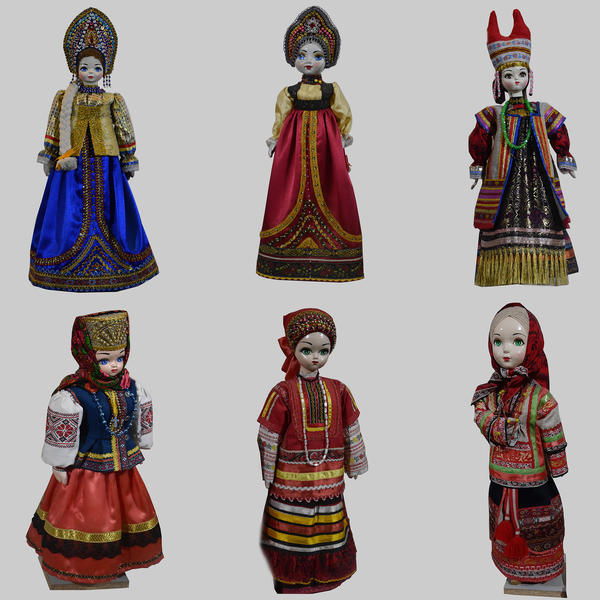
Куклы Москвы, Рязани, Тамбова, Верхнего Мамона
#2
#8
#9
Our ancestors’ clothes were very harmonious and sophisticated. Each element of clothing revealed specific features of everyday life in different counties. They had not only fancy and casual costumes, but also different garments depending on the season, way of life, welfare, and marital status.
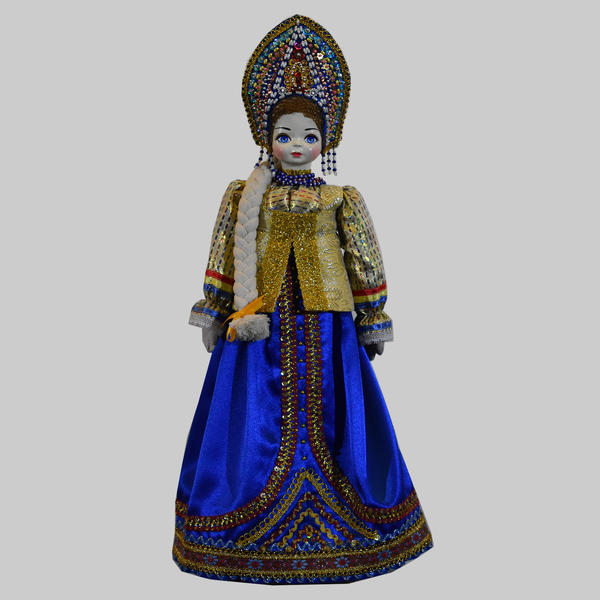
Women in Moscow Governorate wore a shirt that usually fully covered their arms. It was draped around the neck and fixed with fine embroidery. You could see people in streets wearing clothes of different fit. Garments with straight poliks, or shoulder pads, that were attached to the weft were usually worn with a trapezoidal sarafan. If poliks were attached to the warp, the garment was worn with a buttoned down sarafan.
When a woman’s marital status changed, she also changed her clothing. When girls matured or got married, they started wearing a poneva wool skirt. This ancient female garment was fixed at waist height with a decorative rope. Later on, a poneva was replaced with more modern items – skirts and sarafans. Ladies living in towns started sewing sarafans earlier than countrywomen – already back in the 16th century. This garment was named after a man’s kaftan tunic.
Women in Moscow Governorate loved sarafans. Kumashnik was the name of a popular trapezoidal sarafan. It could be with buttons or closed at the front. Later on, women started wearing straight strap sarafans, in Moscow Governorate such model was called a round sarafan, while in other regions it was dubbed a Moscow sarafan.
Headwear also reflected the marital status of a lady. Before marriage, girls wore different kinds of headbands, crowns, and towels. However, the top of the head always remained uncovered. The ritual of initiation into the married life always took place after the church wedding. Girls unbraided the bride’s hair and then made two braids placing them on the head in the form of a crown. This crown was then topped with a low one-horned kichka headdress.
After giving birth to her first baby, the lady changed her headwear again. Instead of a one-horned kichka which she had the right to wear after marriage, she could now put on a head garment with a high horn or a decorated crown on a wired basis. This accessory showed that its owner proved her ability to give birth to a child. Women in Moscow Governorate had several types of headwear depending on where the lady lived. The simplest garments were in the Zvenigorod county where women wore kokoshnik and soroka headdresses.
Women and men wore the same kind of shoes. The most common footwear until the first half of the 20th century was lapti bast shoes – casual and sometimes festive footwear. While citizens of the Moscow county had already started wearing leather boots and koty fur shoes instead of lapti, peasants in the Serpukhov and Ruza counties continued wearing lapti with wool socks.
Women in Moscow Governorate wore a shirt that usually fully covered their arms. It was draped around the neck and fixed with fine embroidery. You could see people in streets wearing clothes of different fit. Garments with straight poliks, or shoulder pads, that were attached to the weft were usually worn with a trapezoidal sarafan. If poliks were attached to the warp, the garment was worn with a buttoned down sarafan.
When a woman’s marital status changed, she also changed her clothing. When girls matured or got married, they started wearing a poneva wool skirt. This ancient female garment was fixed at waist height with a decorative rope. Later on, a poneva was replaced with more modern items – skirts and sarafans. Ladies living in towns started sewing sarafans earlier than countrywomen – already back in the 16th century. This garment was named after a man’s kaftan tunic.
Women in Moscow Governorate loved sarafans. Kumashnik was the name of a popular trapezoidal sarafan. It could be with buttons or closed at the front. Later on, women started wearing straight strap sarafans, in Moscow Governorate such model was called a round sarafan, while in other regions it was dubbed a Moscow sarafan.
Headwear also reflected the marital status of a lady. Before marriage, girls wore different kinds of headbands, crowns, and towels. However, the top of the head always remained uncovered. The ritual of initiation into the married life always took place after the church wedding. Girls unbraided the bride’s hair and then made two braids placing them on the head in the form of a crown. This crown was then topped with a low one-horned kichka headdress.
After giving birth to her first baby, the lady changed her headwear again. Instead of a one-horned kichka which she had the right to wear after marriage, she could now put on a head garment with a high horn or a decorated crown on a wired basis. This accessory showed that its owner proved her ability to give birth to a child. Women in Moscow Governorate had several types of headwear depending on where the lady lived. The simplest garments were in the Zvenigorod county where women wore kokoshnik and soroka headdresses.
Women and men wore the same kind of shoes. The most common footwear until the first half of the 20th century was lapti bast shoes – casual and sometimes festive footwear. While citizens of the Moscow county had already started wearing leather boots and koty fur shoes instead of lapti, peasants in the Serpukhov and Ruza counties continued wearing lapti with wool socks.
#10
Full name: Muscovite Young Lady Doll
Author: Valentina Yakovlevna Gorbacheva
Date: the 20th century
Dimensions: 50 cm
Collection: Boguchar District Museum of Local History
Copyright: Boguchar District Museum of Local History
Restorers: Valentina Gorbacheva
Goskatalog Number: 15968104
Author: Valentina Yakovlevna Gorbacheva
Date: the 20th century
Dimensions: 50 cm
Collection: Boguchar District Museum of Local History
Copyright: Boguchar District Museum of Local History
Restorers: Valentina Gorbacheva
Goskatalog Number: 15968104
#3
Mamon Doll in Kokoshnik
#11
#12
A unique folk costume complex emerged in Verkhny (Upper) Mamon district, in the south of the Voronezh Region. It was a fusion of the Ukrainian, Cossack and Russian cultures resulting from intermingling the ethnic groups that lived on that territory.
The village of Mamon was the area’s center, founded as a guard post in the first quarter of the 18th century on the left tributary of the Don - the Mamonka River. One more settlement bearing the same name appeared later. To distinguish them, the villages were called Upper and Lower Mamon.
The traditional costume retained its original features in these lands until the middle of the 20th century. In the early period, women’s outfits included a gown, a poneva (a wrap shirt), an apron, outdoor clothes and a head wear. But eventually, women stopped wearing wrap skirts which were replaced by long skirts made of three pieces of fabric. Sateen, cashmere and heavy silk were used as a material for sewing festive clothes, and block printed cotton was used for everyday wear.
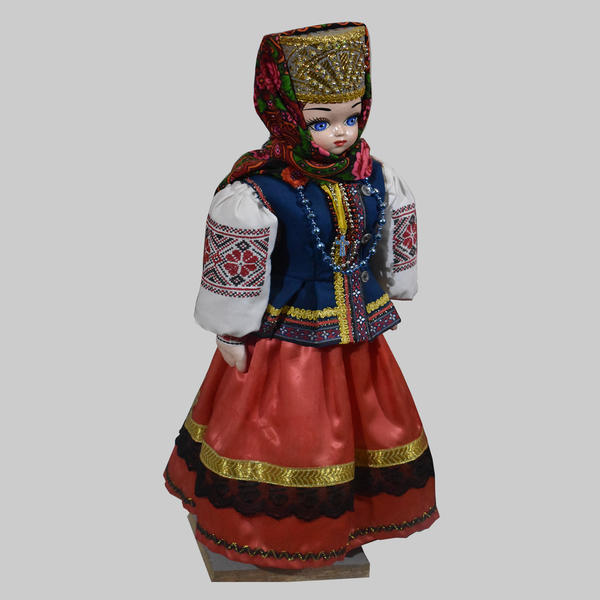
Mamon gowns were sewn with straight ‘polikas’ (shoulder inserts between the collar and the sleeves). The wide sleeves were richly decorated with embroidery. A favorite motif was the geometric ornament with a rhombus in the base. In ancient times, its image symbolized fecundity of the earth, women and plants. When put on its corner, the rhombus was called a ‘circle’ and straight lines ending in hooks and curls often diverged from its corners. People called it ‘burdock’.
Vegetable patterns in the embroidery of the Voronezh Region were more typical for the costumes of the Ukrainian population. They became widespread among the Russians in the second half of the 19th century under the influence of its Ukrainian neighbors, as well as because relatively cheap printed albums and sheets of embroidery patterns became available.
A lined elongated vest with folds on the back complemented the women’s outfit. It was made from black or blue sateen and decorated with ribbons and braid.
A married woman’s festive costume included a kokoshnik (a headwear). The village of Upper Mamon was famous for craftswomen who made them. In the Mamon district, kokoshniks were made in the shape of a high hat finished with gold braiding. A shawl or a kerchief was put on top of the headdress.
Kokoshniks were expensive, so not every family could afford one. They were carefully stored and handed over by inheritance. Kokoshniks were borrowed for especially solemn occasions (a wedding, for example). On Sundays and less festive days, women wore a shlyk – a soft velvet cap, embroidered with gold or silver threads.
The village of Mamon was the area’s center, founded as a guard post in the first quarter of the 18th century on the left tributary of the Don - the Mamonka River. One more settlement bearing the same name appeared later. To distinguish them, the villages were called Upper and Lower Mamon.
The traditional costume retained its original features in these lands until the middle of the 20th century. In the early period, women’s outfits included a gown, a poneva (a wrap shirt), an apron, outdoor clothes and a head wear. But eventually, women stopped wearing wrap skirts which were replaced by long skirts made of three pieces of fabric. Sateen, cashmere and heavy silk were used as a material for sewing festive clothes, and block printed cotton was used for everyday wear.
Mamon gowns were sewn with straight ‘polikas’ (shoulder inserts between the collar and the sleeves). The wide sleeves were richly decorated with embroidery. A favorite motif was the geometric ornament with a rhombus in the base. In ancient times, its image symbolized fecundity of the earth, women and plants. When put on its corner, the rhombus was called a ‘circle’ and straight lines ending in hooks and curls often diverged from its corners. People called it ‘burdock’.
Vegetable patterns in the embroidery of the Voronezh Region were more typical for the costumes of the Ukrainian population. They became widespread among the Russians in the second half of the 19th century under the influence of its Ukrainian neighbors, as well as because relatively cheap printed albums and sheets of embroidery patterns became available.
A lined elongated vest with folds on the back complemented the women’s outfit. It was made from black or blue sateen and decorated with ribbons and braid.
A married woman’s festive costume included a kokoshnik (a headwear). The village of Upper Mamon was famous for craftswomen who made them. In the Mamon district, kokoshniks were made in the shape of a high hat finished with gold braiding. A shawl or a kerchief was put on top of the headdress.
Kokoshniks were expensive, so not every family could afford one. They were carefully stored and handed over by inheritance. Kokoshniks were borrowed for especially solemn occasions (a wedding, for example). On Sundays and less festive days, women wore a shlyk – a soft velvet cap, embroidered with gold or silver threads.
#13
Full name: Mamon Doll in Kokoshnik
Author: Valentina Yakovlevna Gorbacheva
Date: 20th century
Technique: handicraft
Dimensions: 56 cm
Collection: Boguchar District Museum of Local History
Copyright: Boguchar District Museum of Local History
Goskatalog Number: 16046120
Author: Valentina Yakovlevna Gorbacheva
Date: 20th century
Technique: handicraft
Dimensions: 56 cm
Collection: Boguchar District Museum of Local History
Copyright: Boguchar District Museum of Local History
Goskatalog Number: 16046120
#4
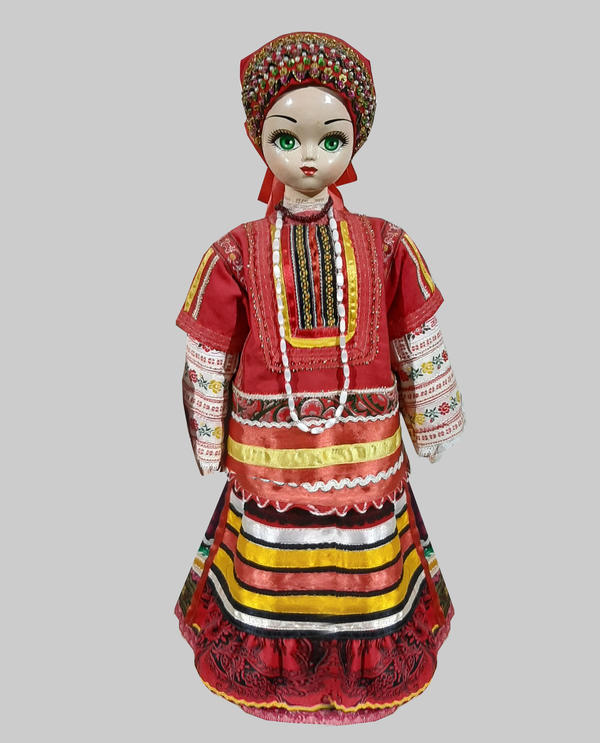
Doll in Ryazan Province Traditional Costume
#14
#15
The Ryazan Province nature specifics are almost impenetrable forests. The consequent separation from the rest of the country’s territories gave an impetus to the formation of an original traditional costume, quite different from clothes worn in other regions.
The variety of Ryazan peasants’ garments is striking. Even today, there are places here, for example, some villages of the Skopin District, where people keep with care and, on holidays, wear traditional costumes. Traditional Ryazan garments combine shades of red and black. White color is much rarer, and small accents of green, blue and yellow vivify rather strict women’s garments.
This province traditional costume has some characteristic features. Usually, they are multilayered, many elements are put one on top of the other, creating a noticeable volume. The sets are very beautiful and even solemn, thanks to various patterns and specifics of the color palette.
The cut of Ryazan shirts is quite varied: with straight or beveled poliks (shoulder inserts), triangle or square gores. The collar is often gathered, though, in earlier models, a usual straight version can be found. There were so many shirt varieties in this region that just naming them presents a problem. The variations can be considered as landmarks in the history speaking of the migration of tribes that lived here in the ancient times, casting light upon events unknown to our contemporaries.
The apron is made with the “front” and the “sides” from three squares of cloth. The rims were decorated with a patterned stripe, colored ribbons, braid, gay white colored lace and red calico. A short sarafan (pinafore dress) made from four pieces of cloth, with a stripe of red calico inserted between them, was called navershnik. Red calico, in combinations with back and green braid, also decorates the article lower part and the neckline.
It was considered necessary to protect the legs where they were touched by the shirt hem. Women decorated the collar, the sleeves and the hem of the garment with embroidery which served as an amulet.
In ancient times, embroidered or woven ornament was imbued with a magic meaning. But, in the course of time, people forgot old beliefs, stopped attributing charming powers to the patterns, and only preserved their beauty. It was protected by women who carefully passed them over to the descendants, and it was only the names of the patterns that reminded of the ancient magic – “mouse paths”, “poleaxes”, “fur trees”, etc.
The variety of Ryazan peasants’ garments is striking. Even today, there are places here, for example, some villages of the Skopin District, where people keep with care and, on holidays, wear traditional costumes. Traditional Ryazan garments combine shades of red and black. White color is much rarer, and small accents of green, blue and yellow vivify rather strict women’s garments.
This province traditional costume has some characteristic features. Usually, they are multilayered, many elements are put one on top of the other, creating a noticeable volume. The sets are very beautiful and even solemn, thanks to various patterns and specifics of the color palette.
The cut of Ryazan shirts is quite varied: with straight or beveled poliks (shoulder inserts), triangle or square gores. The collar is often gathered, though, in earlier models, a usual straight version can be found. There were so many shirt varieties in this region that just naming them presents a problem. The variations can be considered as landmarks in the history speaking of the migration of tribes that lived here in the ancient times, casting light upon events unknown to our contemporaries.
The apron is made with the “front” and the “sides” from three squares of cloth. The rims were decorated with a patterned stripe, colored ribbons, braid, gay white colored lace and red calico. A short sarafan (pinafore dress) made from four pieces of cloth, with a stripe of red calico inserted between them, was called navershnik. Red calico, in combinations with back and green braid, also decorates the article lower part and the neckline.
It was considered necessary to protect the legs where they were touched by the shirt hem. Women decorated the collar, the sleeves and the hem of the garment with embroidery which served as an amulet.
In ancient times, embroidered or woven ornament was imbued with a magic meaning. But, in the course of time, people forgot old beliefs, stopped attributing charming powers to the patterns, and only preserved their beauty. It was protected by women who carefully passed them over to the descendants, and it was only the names of the patterns that reminded of the ancient magic – “mouse paths”, “poleaxes”, “fur trees”, etc.
#16
Full name: Doll in Ryazan Province Traditional Costume “In Obvyazka” (Wrapper)
Author: Valentina Yakovlevna Gorbacheva
Date: 20th century
Dimensions: 55 cm
Collection: Old Fashions
Copyright: Boguchar District Museum of Local History
Goskatalog Number: 16046122
Author: Valentina Yakovlevna Gorbacheva
Date: 20th century
Dimensions: 55 cm
Collection: Old Fashions
Copyright: Boguchar District Museum of Local History
Goskatalog Number: 16046122
#5
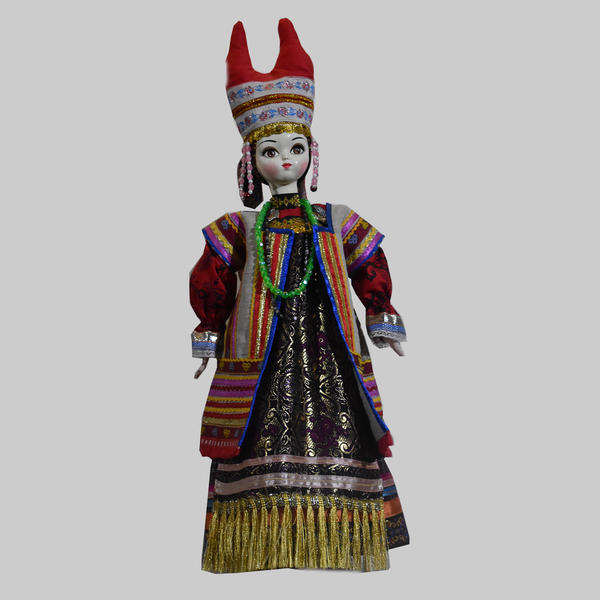
Ryazan Region Doll
#17
#18
The traditional costume was formed over the centuries and reflected the people’s worldview, religion and life. The history of the ethnos’ development, the ways of its resettlement and foreign influence – all these factors impacted the way the folk costumes looked. Researchers distinguish the costumes of northern and southern regions of Russia. The Ryazan land belongs to the latter. It was a sparsely populated territory with forest and steppe areas, with the hardly accessible Meshchera Region among them. All those natural factors contributed to shaping a kind of outfit that differed from that of other regions.
Women’s costume of the Ryazan Region consisted of a gown, a poneva (wrap skirt), an apron, a navershnik (a long, wide, short- sleeved dress, which looked like a tunic) and a headdress. Bead decorations - necklaces and others - complemented the outfit. The Ryazan peasant women’s clothing is distinguished for a broad variety of cuts. Gowns came in many variations - they were made with straight and slanting ‘polikas’ (shoulder inserts between the collar and the sleeves) or without them, with square or triangular underarm gores. The fabric was usually pulled together at the neck, but there were gowns of the early periods with a regular straight collar.
The costume had a sacral character, and the collar, the chest, the hem and sleeves were the most important details of clothes from this point of view. They were decorated with embroidery which featured geometric motifs and served as a protective shield. People borrowed patterns from nature, which was reflected in their names – ‘axes’, ‘mouse paths’, ‘fir trees’ and ‘burdocks’. Patchwork weaving was less widespread. The ancient beliefs have gradually disappeared from everyday life, while the tradition of rich decorative finishing has been preserved.
The girl in the photo is dressed in a black checkered poneva (wrap shirt) and a navershnik (top): that was the name of the upper tunica-like clothing without clasps, similar to a kaftan, made from homespun semi-wool fabric. It was made of four cloths with wedges on the sides and long sleeves on a canvas lining. The tops were embroidered with colorful ribbons and worsted yarn. One of their varieties was a semi –caftan called shushpun (shushun, shugai).
A horned kika (headdress) completed the female image. It symbolized fecundity and was worn only by young married women. Elderly peasant women exchanged horned kikas for hornless ones. The sophisticated headdress completely covered the woman’s hair.
It is, in fact, a multi-element headdress with various details typical of the region’s culture of the time.
Women’s costume of the Ryazan Region consisted of a gown, a poneva (wrap skirt), an apron, a navershnik (a long, wide, short- sleeved dress, which looked like a tunic) and a headdress. Bead decorations - necklaces and others - complemented the outfit. The Ryazan peasant women’s clothing is distinguished for a broad variety of cuts. Gowns came in many variations - they were made with straight and slanting ‘polikas’ (shoulder inserts between the collar and the sleeves) or without them, with square or triangular underarm gores. The fabric was usually pulled together at the neck, but there were gowns of the early periods with a regular straight collar.
The costume had a sacral character, and the collar, the chest, the hem and sleeves were the most important details of clothes from this point of view. They were decorated with embroidery which featured geometric motifs and served as a protective shield. People borrowed patterns from nature, which was reflected in their names – ‘axes’, ‘mouse paths’, ‘fir trees’ and ‘burdocks’. Patchwork weaving was less widespread. The ancient beliefs have gradually disappeared from everyday life, while the tradition of rich decorative finishing has been preserved.
The girl in the photo is dressed in a black checkered poneva (wrap shirt) and a navershnik (top): that was the name of the upper tunica-like clothing without clasps, similar to a kaftan, made from homespun semi-wool fabric. It was made of four cloths with wedges on the sides and long sleeves on a canvas lining. The tops were embroidered with colorful ribbons and worsted yarn. One of their varieties was a semi –caftan called shushpun (shushun, shugai).
A horned kika (headdress) completed the female image. It symbolized fecundity and was worn only by young married women. Elderly peasant women exchanged horned kikas for hornless ones. The sophisticated headdress completely covered the woman’s hair.
It is, in fact, a multi-element headdress with various details typical of the region’s culture of the time.
#19
Full name: Ryazan Region Doll
Author: Valentina Yakovlevna Gorbacheva
Date: 20th century
Dimensions: 65 cm
Collection: Boguchar District Museum of Local History
Copyright: Boguchar District Museum of Local History
Goskatalog Number: 16046121
Author: Valentina Yakovlevna Gorbacheva
Date: 20th century
Dimensions: 65 cm
Collection: Boguchar District Museum of Local History
Copyright: Boguchar District Museum of Local History
Goskatalog Number: 16046121
#6
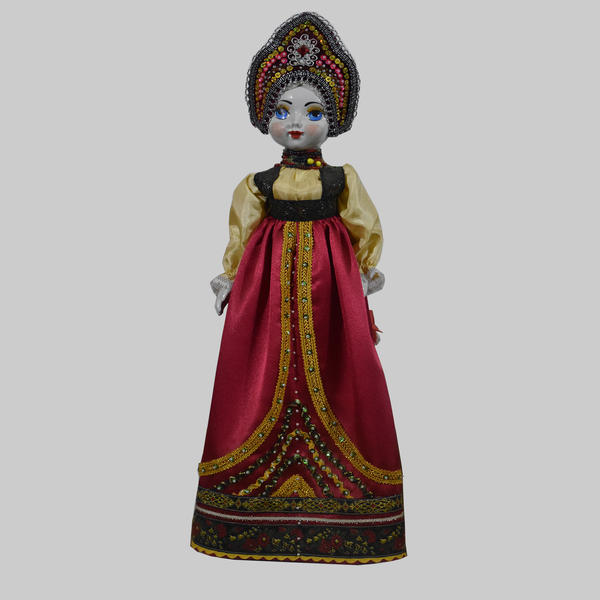
Tambov Region Doll
#20
#21
Women’s costume of Tambov Region belongs to the South Russia’s version of folk clothing, to the poneva (wrap skirt) type. Its key element was a gown - the oldest item of clothing - worn by women of all ages, from girls to old women. Gowns were decorated with embroidery and braid. A common technique of double-sided embroidery was the cross, which became a distinctive feature of the Tambov costume decoration. People paid keen attention to the collar, shoulder, sleeves and the hem. They believed that patterns with sacral motifs would help protect them from the bad influence of supernatural powers.
Girls often wore just a belted white gown, lapty (straw shoes) and headgear. They wore soft bands, kerchiefs and ochelyes (part of the headgear that covered the forehead). Unlike the women’s head dresses, they did not cover a girl’s hair. Married women wore another wardrobe element, which was not part of a girl’s outfit a poneva (a wrap skirt). A bride put one on before the wedding during a special ceremony of “jumping into the wrap skirt”. Peasant women often called it an “eternal yoke” or “woman”s bondage”.
Each village preserved its own tradition of sewing wrap skirts. Most often, chequered home-spun wool or linen was used. The favorite colours of the fabric in Tambov Region were black and indigo. The “enclosed” skirt was made of four pieces of fabric, and gathered on top by a cord. The older type consisted of three cloths of fabric: the back and two side ones. Such a skirt was called a “triple-piece skirt”.
Panevas were abundantly decorated at the back, because the front was covered with an apron which came in several designs. A tunic-like apron with sleeves or arm-holes, which a woman put on from her head down, was called a “curtain” or “veil”. The festive aprons were made of brocade or silk and were richly decorated with ribbons, fringe and lace. There were also waist-level aprons.
The top clothes of Tambov peasant women were garments resembling short gowns with long sleeves. The front part was decorated with multicolored fabric and lace. Shoulders and necklines were accentuated by stripes of cloth or embroidery.
The women looked majestic in the traditional costume. Massive footwear matched the outfit: peasant women put on several pairs of woolen stockings, so they needed large lapty. The people’s belief that thick legs were a sign of health and female beauty gave rise to the tradition.
Girls often wore just a belted white gown, lapty (straw shoes) and headgear. They wore soft bands, kerchiefs and ochelyes (part of the headgear that covered the forehead). Unlike the women’s head dresses, they did not cover a girl’s hair. Married women wore another wardrobe element, which was not part of a girl’s outfit a poneva (a wrap skirt). A bride put one on before the wedding during a special ceremony of “jumping into the wrap skirt”. Peasant women often called it an “eternal yoke” or “woman”s bondage”.
Each village preserved its own tradition of sewing wrap skirts. Most often, chequered home-spun wool or linen was used. The favorite colours of the fabric in Tambov Region were black and indigo. The “enclosed” skirt was made of four pieces of fabric, and gathered on top by a cord. The older type consisted of three cloths of fabric: the back and two side ones. Such a skirt was called a “triple-piece skirt”.
Panevas were abundantly decorated at the back, because the front was covered with an apron which came in several designs. A tunic-like apron with sleeves or arm-holes, which a woman put on from her head down, was called a “curtain” or “veil”. The festive aprons were made of brocade or silk and were richly decorated with ribbons, fringe and lace. There were also waist-level aprons.
The top clothes of Tambov peasant women were garments resembling short gowns with long sleeves. The front part was decorated with multicolored fabric and lace. Shoulders and necklines were accentuated by stripes of cloth or embroidery.
The women looked majestic in the traditional costume. Massive footwear matched the outfit: peasant women put on several pairs of woolen stockings, so they needed large lapty. The people’s belief that thick legs were a sign of health and female beauty gave rise to the tradition.
#22
Full name: Tambov Region Doll
Author: Valentina Yakovlevna Gorbacheva
Date: 20th century
Dimensions: 50 cm
Collection: Old Fashions
Copyright: Boguchar District Museum of Local History
Goskatalog Number: 16046126
Author: Valentina Yakovlevna Gorbacheva
Date: 20th century
Dimensions: 50 cm
Collection: Old Fashions
Copyright: Boguchar District Museum of Local History
Goskatalog Number: 16046126
#7
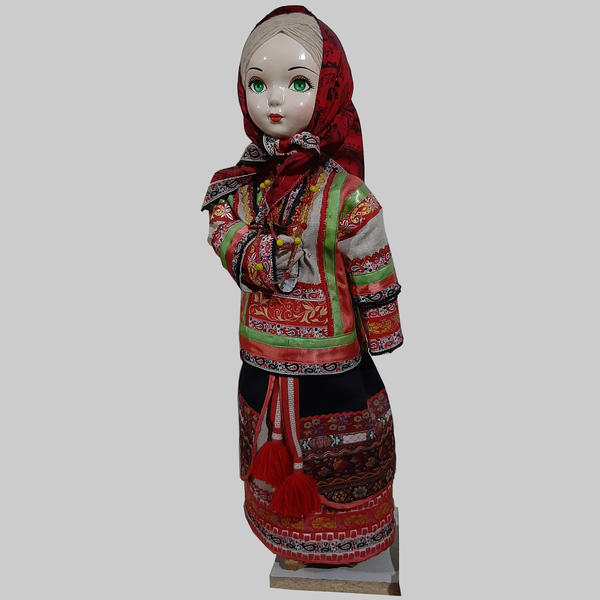
Doll in old folk costume from Tambov province
#23
#24
The Tambov province inhabitants used homespun linen and natural wool to fabricate men’s and women’s clothes. A little later they started to apply chintz. Women manually made cloths for tailoring. Flax, hemp, and wool were the hardest to handle. Girls and women were engaged in tissue manufacturing all autumn, winter and the first days of spring. Girls were put in charge of unwinding threads, at the age of twelve they started spinning and at the age of fifteen they passed to whitewashing the linen. The most serious and honourable work – weaving – was perfomed by 18-45 years old women.
Work began at the end of the harvest season. Yarn was dyed in different colours. Black, blue, red and yellow colours dominated in local costumes. In the Tambov province, peasants dyed yarn either on their own or gave it to professional dyers. During Lent, a large loom would appear in almost every hut, and throughout the early spring, women made cloth for future outfits.
Different techniques were used, but the usual weave was the simplest. The canvas was made of linen and hemp fabric. Woolen and half-woolen fabrics were extremely popular. They were used for sewing a skirt-ponyova and warm clothes. Women sewed clothes manually, stitching elements together with hemp threads. Their styles depended on the available material width.
Women’s clothing was divided by purpose: festive, everyday, wedding and mourning. The Tambov costume consisted of a shirt made of a homespun cloth with ''kosye poliki'' (a trapezia-shape element connecting sleeves and a collar), generously decorated with embroidery, a ''zatkanka'' (strips of fabric sewn onto the sleeves), elegant braid and sequins elements. To decorate outfits, women often used cross-stitches, combining white and red shades. Also traditional clothes included a cheсkered ponyova decorated with coloured ribbons, a shirt and an apron, and there were a kichka or a soroka to cover the head.
The ponyova was made of several pieces of checkered dark colour linen. Women wore it together with a shushpan – a short breastplate, or ''curtains'', or ''veil'' – an apron worn as a pullover. Beautiful inserts, lacing, applications were sewn onto its central part. The neckline, collar, shoulders, sleeves, hem were decorated with embroidery. The obligatory part of a clothing was a belt woven from coloured wool.
Every clothing item had a special meaning. It was possible to determine by a female headdress the marital and property status of its owner. Young girls used silk ribbons imitating loose hair. Peasant men’s and women’s shoes almost did not differ: usually these were bast shoes. In a season, a person wore out at least twenty pairs.
Work began at the end of the harvest season. Yarn was dyed in different colours. Black, blue, red and yellow colours dominated in local costumes. In the Tambov province, peasants dyed yarn either on their own or gave it to professional dyers. During Lent, a large loom would appear in almost every hut, and throughout the early spring, women made cloth for future outfits.
Different techniques were used, but the usual weave was the simplest. The canvas was made of linen and hemp fabric. Woolen and half-woolen fabrics were extremely popular. They were used for sewing a skirt-ponyova and warm clothes. Women sewed clothes manually, stitching elements together with hemp threads. Their styles depended on the available material width.
Women’s clothing was divided by purpose: festive, everyday, wedding and mourning. The Tambov costume consisted of a shirt made of a homespun cloth with ''kosye poliki'' (a trapezia-shape element connecting sleeves and a collar), generously decorated with embroidery, a ''zatkanka'' (strips of fabric sewn onto the sleeves), elegant braid and sequins elements. To decorate outfits, women often used cross-stitches, combining white and red shades. Also traditional clothes included a cheсkered ponyova decorated with coloured ribbons, a shirt and an apron, and there were a kichka or a soroka to cover the head.
The ponyova was made of several pieces of checkered dark colour linen. Women wore it together with a shushpan – a short breastplate, or ''curtains'', or ''veil'' – an apron worn as a pullover. Beautiful inserts, lacing, applications were sewn onto its central part. The neckline, collar, shoulders, sleeves, hem were decorated with embroidery. The obligatory part of a clothing was a belt woven from coloured wool.
Every clothing item had a special meaning. It was possible to determine by a female headdress the marital and property status of its owner. Young girls used silk ribbons imitating loose hair. Peasant men’s and women’s shoes almost did not differ: usually these were bast shoes. In a season, a person wore out at least twenty pairs.
#25
Full name: Doll in old folk costume from Tambov province
Author: Valentina Yakovlevna Gorbacheva
Date: the 20th century
Dimensions: 61 cm
Collection: Boguchar District Museum of Local History
Copyright: Boguchar District Museum of Local History
Goskatalog Number: 16046107
Author: Valentina Yakovlevna Gorbacheva
Date: the 20th century
Dimensions: 61 cm
Collection: Boguchar District Museum of Local History
Copyright: Boguchar District Museum of Local History
Goskatalog Number: 16046107
read morehide
00:00
00:00
1x
Dolls of Moscow, Ryazan, Tambov, Upper Mamon
Exhibition
0
 Point your smartphone camera to open in the app
Open in app
Share