Font
Color
Graphics
Изображение точки

To see AR mode in action:

1. Install ARTEFACT app for iOS or Android;

2. Find the exhibition «Apartment-Museum of the Ulyanov Family»

3. Push the «Augmented reality» button and point your phone's camera at the exhibit;

Скрыть точки интересаПоказать точки интереса
Показать в высоком качестве

Homemade peasant doll

Creation period
1970
Place of сreation
Ulyanovsk, the USSR
Dimensions
41x21x5 cm
Technique
fabric; hand and machine sewing
Collection
0
Open in app
#6

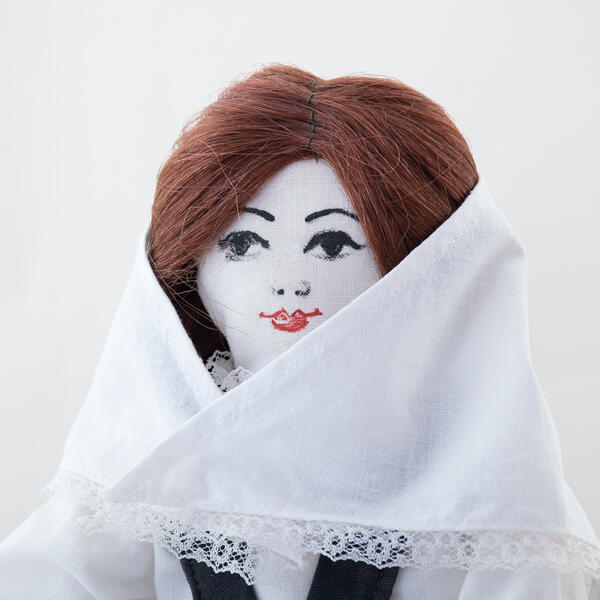
The doll, which is presented in the collection, is homemade. It is sewn from white cotton fabric and stuffed with cotton wool. The face is painted. Hair is made of threads sewn to the head, braided and tied with a white kerchief. The peasant doll is dressed in a black satin sarafan, a white cotton blouse with long sleeves and a white oval apron. The edges of the kerchief, sleeves and apron are trimmed with narrow white lace. On her feet there are stockings, which are sewn from pink-colored knitwear, and ankle boots made of black dermatin.

The Russian rag doll comes from a family of folk toys, its history goes back to ancient times. Dolls accompanied people from their first steps. Wood, clay, straw, cloth and other available materials were used to create toys. The doll’s purpose was not only in play, but also in protection of the child. It was believed that it guarded children’s sleep and protected them from evil forces.

Dolls were made for different purposes, so several types of them can be distinguished: play dolls, ritual dolls, amulet dolls. As the name implies, ritual dolls were used for various types of rituals: agricultural, wedding or festive. Amulets were made from ashes, pieces of cloth and birch branches. The main rule in their manufacture was not to use any tools. The dolls were created for a certain person or family.

Traditional dolls had their own characteristics. Most often they had no facial features, in rare cases those were painted with embers. A folk rag doll was made from wool or cotton pieces of fabric, linen, using multicolored ribbons. All the details were tied with threads or fixed with knots. Scissors were not used for this purpose, since a sharp blade could damage the handiwork.

Over time, the doll, in addition to being the sacred symbol and toy, began to acquire the status of an expensive gift and an attribute of the interior. In the 19th century, game dolls acquired painted faces: most often they had feminine features.
“In traditional folk culture, a doll was a sacred object, a necessary attribute of most rituals of the calendar and life cycle, one of the means of building a child’s social and work skills. The doll was always unique because it was made in a single copy at home, in the family,” says the article “A doll as an integral part of aesthetic culture, human traditions and human experience” by Lyudmila Pavlovna Shipovskaya and Maria Igorevna Shelaeva.

#8
Homemade peasant doll
#7
read morehide
00:00
00:00
1x

Homemade peasant doll

Creation period
1970
Place of сreation
Ulyanovsk, the USSR
Dimensions
41x21x5 cm
Technique
fabric; hand and machine sewing
Collection
0
Point your smartphone camera to open in the app
Share
VkontakteOdnoklassnikiTelegram
Share on my website
Copy linkCopied
Copy
Open in app
To see AR mode in action:
  1. Install ARTEFACT app for 
  2. iOS or Android;
  3. Find and download the «Paintings in Details» exhibition
  4. Push the «Augmented reality» button and point your phone's camera at the painting;
  5. Watch what happens on your phone screen whilst you flip through the pictures.
 
We use Cookies
Cookies on the Artefact Website. We use cookies to ensure that we give you the best experience on our website. If you continue without changing your settings, we'll assume that you are happy to receive all cookies on the Artefact website. However, if you would like to, you can change your cookie settings at any time.
Learn more about useHide
Content is available only in Russian

X

Нашли опечатку?...

%title%%type%
