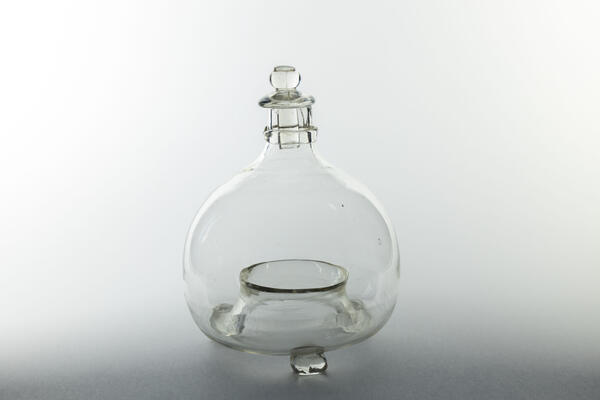
A flytrap is a glass vessel for killing flies. The first flycatchers were made at Russian glass-blowing factories in the 17th century, and they were available only to notable people. Later, glass flytraps appeared in many houses, as well as in taverns and restaurants, where they remained in use until the middle of the 20th century.


#1
Flytrap
#3
#4
We all live together, cramped together and we all rub against each other. Have you seen, in some houses they put glass flytraps with beer inside? Swarms of flies would get it and they would all stew in their own juice and sour until the day they die. So, did we, brother Sasha, turn sour in our flycatcher and get angry.
In the short story “In Retirement”, published in 1902, Aleksandr Kuprin writes
#5
There were two types of glass flytraps: two-piece and solid ones. The former had a detachable cap to cover the main vessel, and the solid one was a spherical vessel on three legs and with two holes. The top hole was a low opening with a glass stopper, and the lower one was a wide funnel in the center of the bottom.
The book for housewives by Elena Molokhovets, published in 1895, describes the principle of the trap, “Glass flycatchers are devices, under which a piece of rye bread sprinkled with sugar, or just fine sugar, is placed, and into which soap or tea water is poured. Flies are enticed by the sugar, they fly up and fall into the poured liquid, from which they can no longer get out.”
The book for housewives by Elena Molokhovets, published in 1895, describes the principle of the trap, “Glass flycatchers are devices, under which a piece of rye bread sprinkled with sugar, or just fine sugar, is placed, and into which soap or tea water is poured. Flies are enticed by the sugar, they fly up and fall into the poured liquid, from which they can no longer get out.”
#6
Some liquid that attracts flies — whey or kvass — is poured from above. The opening of the flycatcher is closed from above with a cork. The fly climbs into the flycatcher from below and, not knowing how to get out again, dies after a while in the liquid. If you remove all the crumbs from the table and if you cover the food well, the flies would gather en mass in a short time in the flycatcher.
In the Soviet brochure of the 1920s, “Destroy the Flies!”
#7
It is especially noteworthy how the brochure “Destroy the Flies!” ends, “The key to the fight against flies is the activity, self-initiated activity of the population itself, its common people. Mothers, citizens! A fly brings death and illness to your children. The question of their destruction, the complete extermination of flies depends on your activities. Get to work, comrades! Death to the flies!”
#2
Name: Flytrap
Date of creation: the late 19th — early 20th century
Place of creation: The Russian Empire
Technique: glass, blowing
Dimensions: 18×12×12 cm
Place of creation: The Russian Empire
Technique: glass, blowing
Dimensions: 18×12×12 cm
#9
Kerosene lamp
#10
A kerosene lamp is a lighting device that uses kerosene as a fuel. From 1860 to 1920, it was the main source of lighting in European homes. Before the kerosene lamp, an oil lamp was used, which was filled with solid or liquid oil. The lamp has been known since the Paleolithic period, but it was unsafe and produced dim light and a lot of smoke. Today oil lamps are used for church services and rituals.
The kerosene lamp appeared in the era of technological progress and active oil refining. The brightness of the kerosene lamp depended on the length of the wick, which was measured by an old Russian and English unit — the line. The first kerosene lamps burnt like ten wax candles, and the more advanced ones — like 300-watt electric bulbs. The wick was covered with a transparent glass topper with a hole for letting air flow in and out. The flame was regulated using a special wheel on the side of the lamp, which released or shortened the wick.
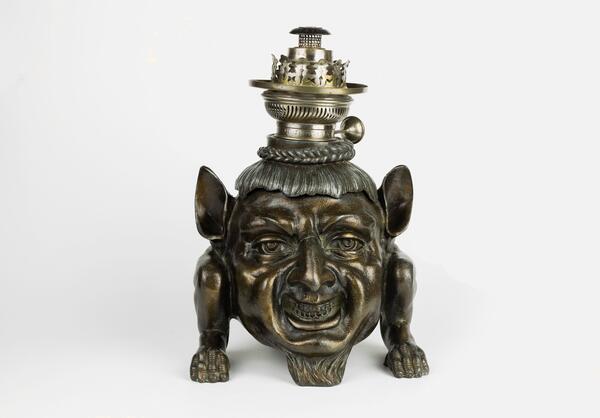
Kerosene lamps often had a utilitarian design, but some were true works of decorative and applied art. The glass was painted with a bright pattern or covered with a ceramic lampshade in the form of a flower, a house or an animal. The lamp from the collection of the Glazov Museum of Local Lore is made in the form of the head of a Kobold. It was a character of English, German and Scandinavian mythology. A Kobold is a brownie, an underground spirit, a relative of an elf and a goblin. Its name translates as “the lord of the room”; it is good-natured, but likes to make fun of people. Most often, a Kobold is depicted as a dwarf with pointed ears, however, it can take on different guises, one of which is the flame.
The kerosene lamp in the shape of a Kobold’s head is a product of the famous German company Hugo Schneider. The products of Hugo Schneider’s workshops were patented in Russia at the beginning of the 20th century as “B.Sch.D.” — “Joint Stock Company Bruner, Schneider, Ditmar”. These factories specialized in kerosene lamps, primuses and burners. Their era ended with the spread of electricity and gas, but kerosene appliances are still used by tourists and residents of regions where power outages are common.
The kerosene lamp appeared in the era of technological progress and active oil refining. The brightness of the kerosene lamp depended on the length of the wick, which was measured by an old Russian and English unit — the line. The first kerosene lamps burnt like ten wax candles, and the more advanced ones — like 300-watt electric bulbs. The wick was covered with a transparent glass topper with a hole for letting air flow in and out. The flame was regulated using a special wheel on the side of the lamp, which released or shortened the wick.
Kerosene lamps often had a utilitarian design, but some were true works of decorative and applied art. The glass was painted with a bright pattern or covered with a ceramic lampshade in the form of a flower, a house or an animal. The lamp from the collection of the Glazov Museum of Local Lore is made in the form of the head of a Kobold. It was a character of English, German and Scandinavian mythology. A Kobold is a brownie, an underground spirit, a relative of an elf and a goblin. Its name translates as “the lord of the room”; it is good-natured, but likes to make fun of people. Most often, a Kobold is depicted as a dwarf with pointed ears, however, it can take on different guises, one of which is the flame.
The kerosene lamp in the shape of a Kobold’s head is a product of the famous German company Hugo Schneider. The products of Hugo Schneider’s workshops were patented in Russia at the beginning of the 20th century as “B.Sch.D.” — “Joint Stock Company Bruner, Schneider, Ditmar”. These factories specialized in kerosene lamps, primuses and burners. Their era ended with the spread of electricity and gas, but kerosene appliances are still used by tourists and residents of regions where power outages are common.
#8
Name: Kerosene lamp
Date of creation: the late 19th century
Place of creation: Leipzig, Germany
Technique: metal, factory work
Dimensions: 27×15×15 cm
Place of creation: Leipzig, Germany
Technique: metal, factory work
Dimensions: 27×15×15 cm
#12
Figured Toby jug
#13
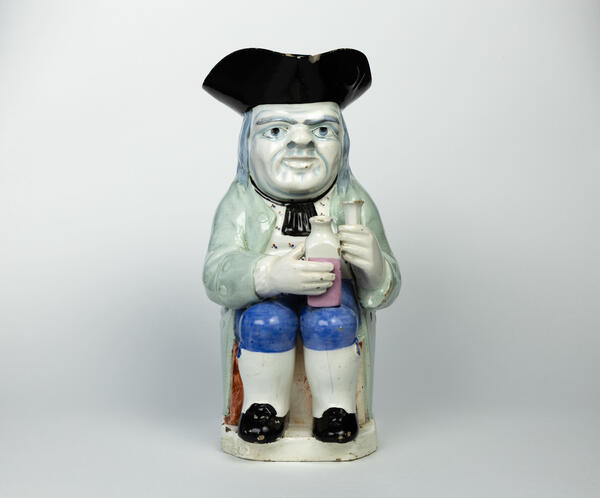
The Toby jug is an English ceramic beer mug in the form of a cheerful little man. These vessels glorified the traditional English breakfast, which for ordinary Britons consisted of a piece of cold meat, bread and a mug of ale. The Glazov Museum of Local Lore presents a clay beer mug in the form of a chubby man in an 18th century attire.
There is no factory stamp on this Toby mug, so it is not easy to determine the country of origin. The Russian Toby jugs can always be distinguished from the English ones by technique and décor, as well as by their faces. The Russian jugs have unique facial features, and each character was designed by ceramists of Russian factories. The Glazov Toby looks a lot like an Englishman, but non-standard colors and décor suggest that this jug was made in another country, for example, in Holland or Portugal. The bottle and glass in Toby’s hands, which are traditional for the south of Europe, speak in favor of the Portuguese origin of this mug.
The Glazov Toby jug was made in the late 19th century and donated to the museum in 1978. The English Toby jugs in the form of human figures were invented by potters of Staffordshire, a major English center for the production of ceramics in the 1760s–1780s. Most often, the beer mugs were faience. They were made in the majolica technique.
The name of Toby beer jugs is associated with various legends: according to one, it was connected with Sir Toby Belch from William Shakespeare’s “Twelfth Night”; according to another version, it was the drunkard Toby Philpot from a folk English drinking song who gave name to this mug. Early Toby jugs depicted ordinary Britons — colorful sailors and esquires, pipe smokers, guards, merchants or pastors. The Toby mugs quickly became popular with frequent pub-goers, they were often displayed in the window of a tavern or hotel to entice passers-by to drink some ale.
In the middle of the 19th century, the Toby mugs became souvenirs. People gave them to each other and decorated their houses with them if silver and crystal dishes were unavailable. The Toby became known outside of England and appeared in France, Germany, Holland, Australia, America and Russia.
There is no factory stamp on this Toby mug, so it is not easy to determine the country of origin. The Russian Toby jugs can always be distinguished from the English ones by technique and décor, as well as by their faces. The Russian jugs have unique facial features, and each character was designed by ceramists of Russian factories. The Glazov Toby looks a lot like an Englishman, but non-standard colors and décor suggest that this jug was made in another country, for example, in Holland or Portugal. The bottle and glass in Toby’s hands, which are traditional for the south of Europe, speak in favor of the Portuguese origin of this mug.
The Glazov Toby jug was made in the late 19th century and donated to the museum in 1978. The English Toby jugs in the form of human figures were invented by potters of Staffordshire, a major English center for the production of ceramics in the 1760s–1780s. Most often, the beer mugs were faience. They were made in the majolica technique.
The name of Toby beer jugs is associated with various legends: according to one, it was connected with Sir Toby Belch from William Shakespeare’s “Twelfth Night”; according to another version, it was the drunkard Toby Philpot from a folk English drinking song who gave name to this mug. Early Toby jugs depicted ordinary Britons — colorful sailors and esquires, pipe smokers, guards, merchants or pastors. The Toby mugs quickly became popular with frequent pub-goers, they were often displayed in the window of a tavern or hotel to entice passers-by to drink some ale.
In the middle of the 19th century, the Toby mugs became souvenirs. People gave them to each other and decorated their houses with them if silver and crystal dishes were unavailable. The Toby became known outside of England and appeared in France, Germany, Holland, Australia, America and Russia.
#11
Name: Figured Toby jug
Date of creation: the late 19th century
Place of creation: Europe
Technique: majolica
Dimensions: 28×15×17 cm
Place of creation: Europe
Technique: majolica
Dimensions: 28×15×17 cm
#14
Ministry of Culture of the Russian Federation
read morehide
00:00
00:00
1x
Flytrap, Kerosene lamp, Figured Toby jug
Exhibition
0
 Point your smartphone camera to open in the app
Open in app
Share