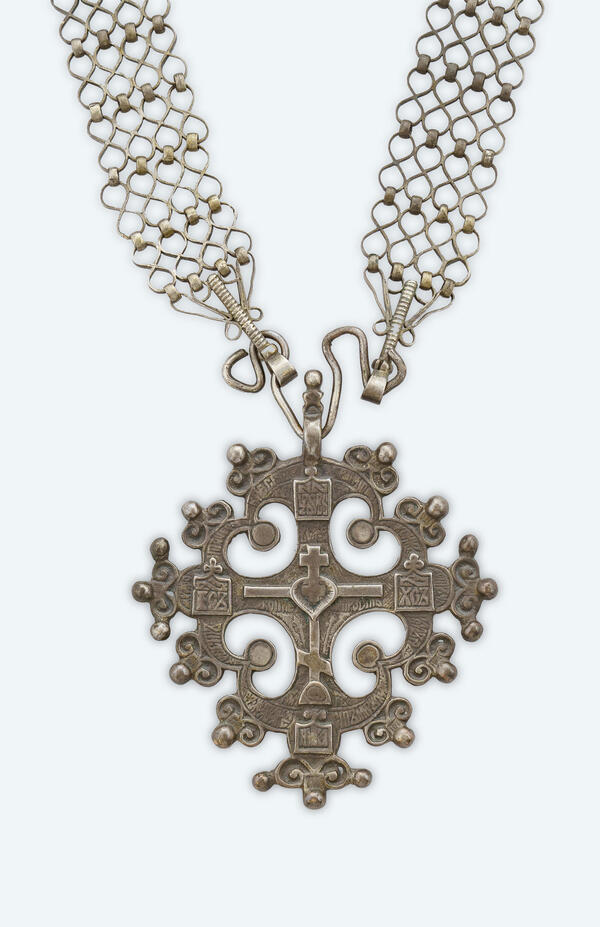
The four-pointed cross with an expanding crossing point and serrated branch ends from the collection of the Andrei Rublev Museum is a cross worn next to the skin (“telnik”). It was donated to the museum by the family of the artist Vasily Yakovlevich Sitnikov.
The outer edges of the branches are interconnected and marked with curls with three relief “beads”, the inner ones — with four circles. The crossing point features an embossed image of the eight-pointed cross of Golgotha with a wreath, a spear, and a cane. At the base of the cross is the head of Adam. On the sides, there are four rectangular relief overlays with inscriptions in old Cyrillic capitals: “ЦРЬ СЛВЫ” (“King of Glory”), “IСЪ” (“Jesus”), “ХСЪ” (“Christ”), and “НИКА” (“Victory”).
On the margins of the cross, there is an embossed text of the prayer to the Cross, and the entire surface is covered with vegetal and geometric patterns. Therefore, the decorations of the cross have references to the Holy Trinity, the actual Cross of the Crucifixion, and the number of apostles.
Researchers believe that as early as in the 5th century it was customary to address prayers to the cross regardless of the location of its placement, technique, or material of manufacture. Since the era of Emperor Justinian, the veneration of the cross became a leading theme of church decoration in different variants, from a simple four-pointed cross in the zenith of the dome of Hagia Sophia in Constantinople to a standalone composition “Adoration of the Cross”.
The custom of placing the cross on the altar table is mentioned in Syriac texts of the 5th–6th centuries. In the 6th–7th centuries, silver — treated with niello or gilded — was mostly used as the material for altar and processional crosses, yet it was soon replaced by bronze. Most crosses had extended ends, although there are examples with straight ends. Those often bore engraved or nielloed inscriptions (generally, with the text of the Trisagion or those of dedicatory nature), monograms (for example, the names of donors), and sometimes — the image of the Crucifixion (there are no known specimens of cast relief crosses with the image of the Crucifixion dated earlier than the 10th century).
Crosses were also often decorated with figures of
the Apostles or Evangelists, the Virgin Mary, and St. John the Baptist, which
make part of the composition of the Deisis. Images of the Virgin Mary and
saints are often placed on the reverse side of the cross.