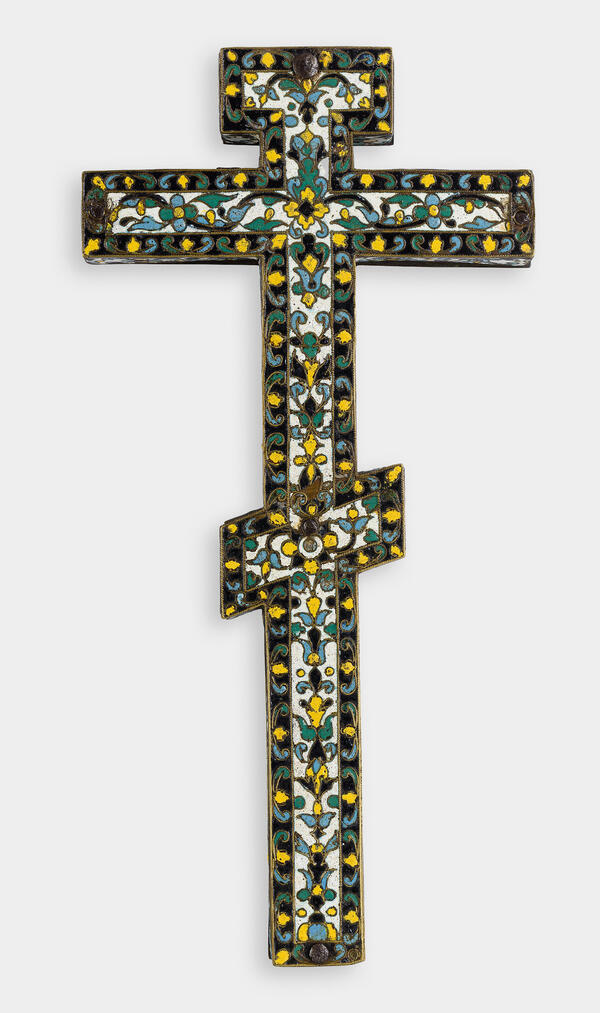
The altar cross is a mandatory attribute of Christian liturgy, one of the most significant liturgical utensils and elements of décor of any Orthodox church. It differs from other types of crosses used during services in terms of size, shape, and its abundant and elaborate décor.
The design of the altar cross is not strictly defined, but it usually depicts the scene of the Crucifixion of Jesus. The altar cross may be made of various materials, including wood, bone, and metal. Particularly beautiful are the altar crosses painted with enamel.
According to Orthodox traditions, at the end of the Divine Liturgy, the priest brings out the altar cross for the congregation to kiss. Altar crosses are also used during other solemn ceremonies, such as weddings, baptisms, and anointings.
The altar cross that is used during services represents the Cross of Christ. For Christians, the cross is a symbol of salvation, through which Jesus achieved victory over the Devil and granted people the opportunity to be with God both in their earthly and eternal lives.
The altar cross, or the “Crucifixion”, from the exhibition of the Andrei Rublev Museum, is made from a gilded copper alloy. It differs from Moscow crosses in terms of its abundant decorative patterns, original style, manufacturing technique, and relatively inexpensive materials. Researchers have noted similar patterns, the same colors of enamel painting on copper, and characteristic techniques of enamel painting on filigree on similar late-17th-century artifacts found in Veliky Ustyug.
The small elements of the floral pattern were created using the filigree technique and decorated with opaque enamel of dark blue, light blue, yellow, and white colors. The same pattern can be seen on the reverse and side surfaces of the cross. The obverse side of the cross features a cast image of the crucified Jesus with a cruciform halo. This is a round halo with a cross within and sometimes also Greek letters. The figure of the Savior is inspired by the 17th-century folk art of the Russian North. Images of Christ with a similar face or figure can be seen on numerous prominent carved wood statues, as well as in cast and stamped images on liturgical crosses from the late Middle Ages.
In the lower part of the vertical bar, under the lower crossbar, there is a
filigree image of Adam’s head, indicating the place of the Crucifixion — Mount
Golgotha. According to late apocryphal texts, Adam, the first man created by
God, was buried in the same place on Mount Golgotha, near Jerusalem, where
Jesus Christ died a sacrificial death.